A week after the former Minneapolis police officer Derek Chauvin was convicted of murder in George Floyd’s death, the unabated epidemic of police killings of Black men and women in the US has now attracted scorching international attention.
In a devastating report running to 188 pages, human rights experts from 11 countries hold the US accountable for what they say is a long history of violations of international law that rise in some cases to the level of crimes against humanity.
Before Chauvin: decades of Minneapolis police violence that failed to spark reform
They point to what they call “police murders” as well as “severe deprivation of physical liberty, torture, persecution and other inhuman acts” as systematic attacks on the Black community that meet the definition of such crimes.
They also call on the prosecutor of the international criminal court (ICC) in The Hague to open an immediate investigation with a view to prosecutions.
“This finding of crimes against humanity was not given lightly, we included it with a very clear mind,” Hina Jilani, one of the 12 commissioners who led the inquiry, told the Guardian. “We examined all the facts and concluded that that there are situations in the US that beg the urgent scrutiny of the ICC.”
Among its other findings, the commission accuses the US of:
violating its international human rights obligations, both in terms of laws governing policing and in the practices of law enforcement officers, including traffic stops targeting Black people and race-based stop and frisk;
tolerating an “alarming national pattern of disproportionate use of deadly force not only by firearms but also by Tasers” against Black people;
operating a “culture of impunity” in which police officers are rarely held accountable while their homicidal actions are dismissed as those of just “a few bad apples”.
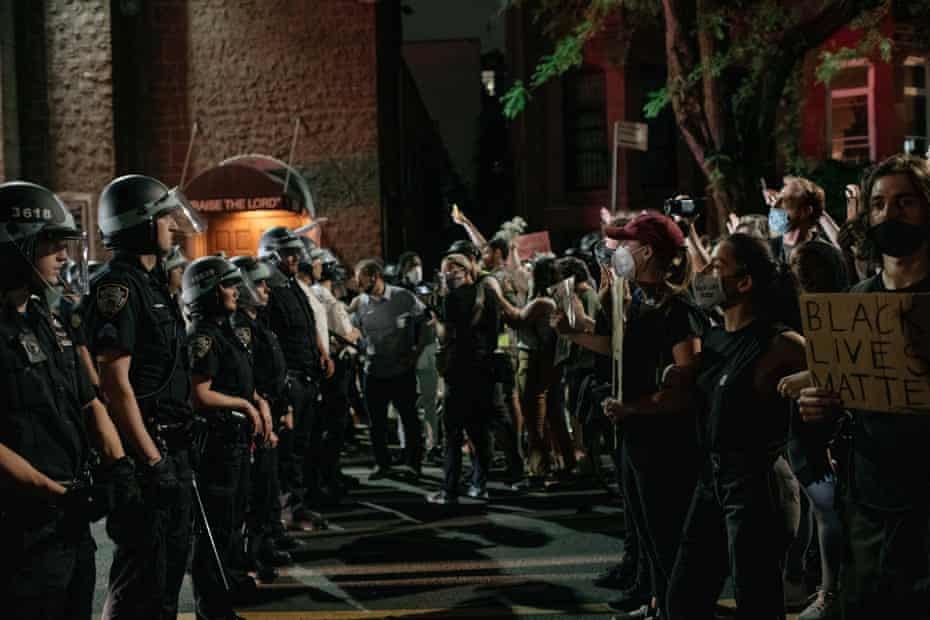
Demonstrators denouncing systemic racism in law enforcement face off with a line of NYPD officers, 4 June 2020. Photograph: Scott Heins/Getty Images
The commissioners also charge that African Americans are frequently subjected to torture at the hands of police. They assert that the use of chokeholds and other violent restraints during arrests are tantamount to torture – also a crime against humanity under international law.
Jilani, who is president of the World Organisation Against Torture, said that last week’s guilty verdict in the Floyd killing substantiated the commission’s views. “It clarified for us that the use of force during the arrest of an individual is not just dehumanizing, it clearly amounts to torture and potential loss of life.”
The report arose directly out of the foment that swept the country in the wake of Floyd’s murder last May. As protests erupted across the nation and around the world, the families of Floyd and other Black people killed by police in recent years petitioned the UN to set up an official inquiry into the shootings.
Under intense pressure from the Trump administration, however, the UN shrank from being drawn into the debate. A coalition of three leading lawyers’ organizations – the US-based National Conference of Black Lawyers and the National Lawyers Guild, and the worldwide International Association of Democratic Lawyers – stepped into the breach, joining forces to stage their own independent inquiry into US police brutality.
A panel of commissioners from Africa, Asia, Europe, Latin America and the Caribbean was assembled to look into police violence, and the structural racism that underpins it. Virtual public hearings were held earlier this year, with testimony from the families of the victims of some of the most notorious police killings in recent times.
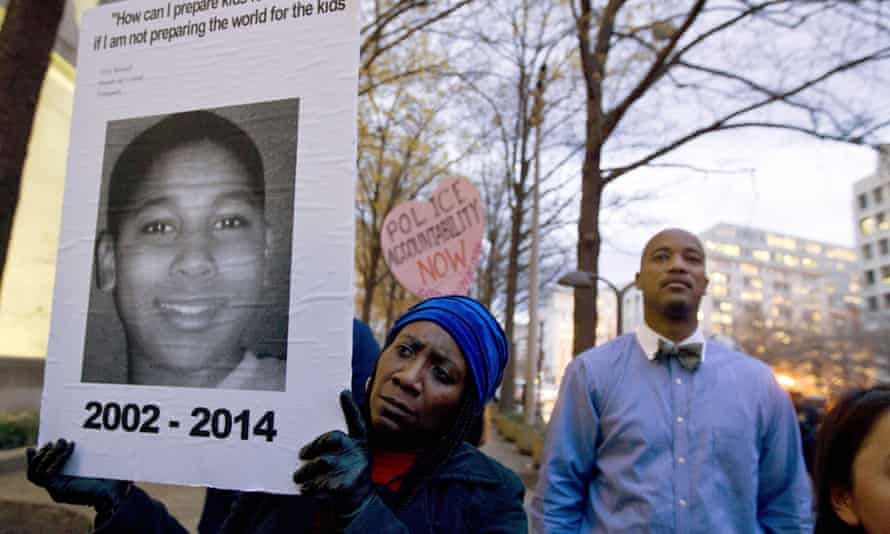
Among the 44 black people who died or were maimed by police and whose cases were put under the commission’s spotlight were: Floyd; Sean Bell, killed on his wedding day in 2006 after police fired 50 bullets; Eric Garner, who died in a chokehold in 2014 crying “I can’t breathe”; Tamir Rice, the 12-year-old playing with a toy gun shot in 2014 seconds after police arrived; Michael Brown, the unarmed 18-year-old whose killing ignited the Black Lives Matter movement; Freddie Gray who died in 2015 after enduring a “rough ride” in a police van; and Breonna Taylor, killed as she was sleeping in a police raid on her home in March 2020 in Louisville, Kentucky.
Tomiko Shine holds up a poster of Tamir Rice during a protest in Washington, 1 December 2014. Photograph: Jose Luis Magana/AP
On Monday, the US Department of Justice announced that it was holding a civil rights inquiry into police practices in Louisville.
Jilani told the Guardian that as a native of Pakistan who has participated in many UN investigations probing human rights abuses, she is familiar with accounts of extreme brutality by law enforcement. “But even I found the testimonies we heard in the US extremely distressing. I was taken aback that this country, which claims to be a global champion of human rights, itself fails to comply with international law.”
She added that as she listened to relatives of police shooting victims relate their stories, “it became clear that this was no longer an account of individual trauma, it was an account of trauma inflicted on a whole section of the US population.”
The commission’s report puts the human impact of systemic discrimination against African Americans in stark terms. It says that the US is operating two systems of law.
“One is for white people, and another for people of African descent,” it said.
In the course of the public hearings held in January and February, relatives gave a more personal impression of what such trauma entails. Nicole Paultre Bell, the wife of Sean Bell, testified: “Imagine living in a world where you must explain to your children that their father, an unarmed bridegroom on the morning of his wedding, can be justifiably killed in a hail of 50 police bullets.”
One of the most visceral accounts was given by Dominic Archibald, the mother of Nathaniel Pickett who was gunned down by a police officer in 2018 for doing nothing other than walking unarmed across the street. In her testimony, Archibald began by explaining that “Nate” was her only child.
“He was my legacy, my faith in the present moment, and my hope for the future. Can I ever put this impact into words? Would anyone ever understand?” she said.
Answering her own question, she went on: “That answer is no. Nate was my perfect gift from God. When he was killed, every hope and dream in my head was destroyed, taken and relegated to a statistic.”
The report gives its own searing figures. Unarmed Black people are almost four times as likely as their white equivalents to be killed by police.
Since 2005, about 15,000 people have been killed by law enforcement – a rate of about 1,000 every year. During that same period only 104 police officers have been charged with murder or manslaughter in relation to the incidents, and of those only 35 were convicted of any crime.
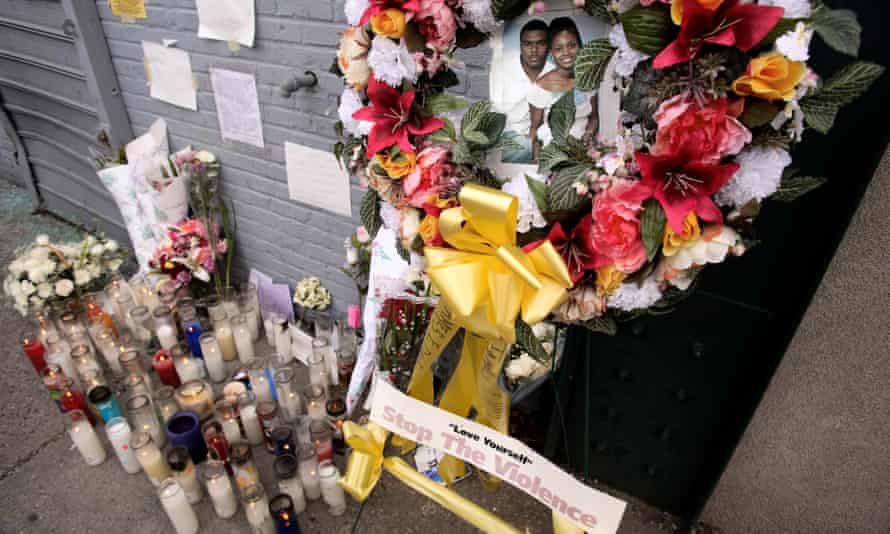
A photo of Sean Bell with Nicole Paultre Bell and one of his children at a candlelight memorial at the scene of his shooting in the Queens borough of New York, 29 November 2006. Photograph: Adam Rountree/AP
The commissioners make a number of demands on the US government and Congress. They want to see demilitarization of local police forces, and prohibition of no-knock warrants that allow officers to raid the homes of Black people like Breonna Taylor’s without warning and often without cause.
They also want an end to qualified immunity through which police officers avoid civil lawsuits. The commissioners say the loophole “amounts to condoning brutal police violence”.
But the most contentious demand is likely to be the call on the ICC prosecutor to launch an investigation against the US for crimes against humanity. It is questionable how effective that tactic would be even were such an inquiry started, given that the US has refused to recognize the international criminal court.
Jilani said she hoped that the US government would see that such an action would support much needed change. “We felt that the US would benefit were individual police officers further deterred from resorting to unjustified force, knowing that some kind of international criminal responsibility might be held against them.”
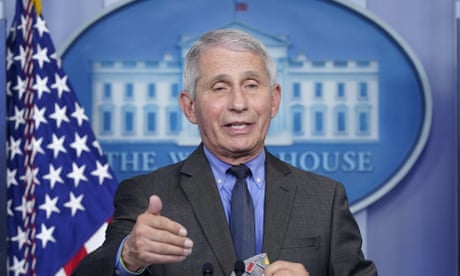
Guardian (UK) Dr Anthony Fauci, the White House’s chief medical adviser, has said countries have failed to unite to provide an adequate global response to prevent the “tragic” coronavirus outbreak from overwhelming India, and singled out wealthier nations for failing to provide equitable access to healthcare around the world.
Speaking to Guardian Australia from the US, Fauci said the situation in India had highlighted global inequality.
“The only way that you’re going to adequately respond to a global pandemic is by having a global response, and a global response means equity throughout the world,” Fauci said.
Australia should make Covid vaccine rollout ‘top priority’, Anthony Fauci says
“And that’s something that, unfortunately, has not been accomplished. Often when you have diseases in which there is a limited amount of intervention, be it therapeutic or prevention, this is something that all the countries that are relatively rich countries or countries that have a higher income have to pay more attention to.”
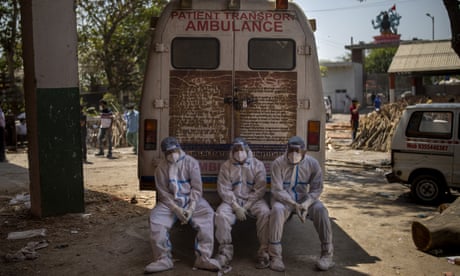
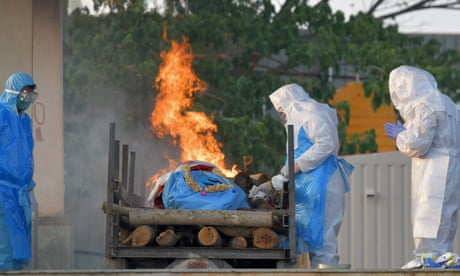
India recorded 360,960 new cases in the 24 hours to Wednesday morning according to health ministry data, another new daily global record. The ministry also said that India’s total number of fatalities had passed 200,000 to stand at 201,187.
The latest epidemiological update from the World Health Organization (WHO) issued on Tuesday said Covid-19 cases increased globally for the ninth consecutive week, with nearly 5.7m new cases reported. India accounts for the majority of cases, with 2,172,063 new cases reported in the past week – a 52% increase.
WHO chief says the Covid surge in India ‘beyond heartbreaking’ – video
Fauci said while WHO was trying to accelerate support to India through the Covax initiative – a global program aimed at ensuring countries most in need get access to vaccines and other treatments – “we have to do even more than that”.
“The United States has really revved up their activity in helping out India … we’re sending oxygen, remdesivir, personal protective equipment, a variety of other medications and soon we’ll be sending vaccine to help out,” he said.
Australia ‘morally obliged’ to help repatriate citizens caught in India’s Covid crisis
“So I think that that’s a responsibility that the rich countries need to assume. Right now it’s a terrible tragic situation where people are dying because there’s not enough oxygen, where there’s not enough hospital beds. We have to try, looking forward, to get as much equity when it comes to public health issues as we possibly can.
“Because we’re all in this together. It’s an interconnected world. And there are responsibilities that countries have to each other, particularly if you’re a wealthy country and you’re dealing with countries that don’t have the resources or capabilities that you have.”
Looking ahead, health systems globally would need to be upgraded so that issues emerging could be detected sooner, Fauci said. Transparency and communication between countries would be key, he said, adding that this was not just an issue for countries like India but for the US as well.
“You want to have the capability of better surveillance internationally, so that when something comes up and emerges in a given country there’s not a big delay in getting recognition of what’s going on,” he said.
“I know in the United States, for example, our local public health system has not been kept up to the level that we would have liked … we are still using fax machines, which is really unacceptable. You have to be prepared to have interconnectivity.”
As the tragedy unfolds in India, he said Australians should feel grateful that they had two safe and effective vaccines in AstraZeneca and Pfizer, even if the rollout of those vaccines had been slower than anticipated.
‘I don’t stop crying’: families of Australians caught in India Covid surge plead for repatriation
“Just because you have only two vaccines that are available, that doesn’t necessarily mean you’re at a disadvantage, so long as you have enough efficacious and safe vaccine,” he said. “I don’t think the numbers of [different types of] vaccines in the sense of different vaccines is as important as getting enough for your citizens.”
Though there had been delays to the rollout in Australia, the federal government has secured enough vaccine supply to vaccinate the entire Australian population of 25m, even before other candidates such as the Novavax vaccine have been approved and available. If regulators approve the Novavax vaccine once more clinical trial data is available, the government anticipates 51m doses of that vaccine will be made available in Australia during 2021.
Asked whether the situation in India and elsewhere, such as in Papua New Guinea, meant the world would struggle to ever contain Covid, Fauci responded: “I believe we will get there.
“But it makes it more difficult when you have the spread of infection in a country that’s not handling it very well. If you get infections in a country in which there are a lot of immunosuppressed individuals, including people who are infected with HIV and the virus infects them, they don’t clear it as rapidly as you would hope and that gives the virus a chance to mutate, which leads to the development of additional variants.”
Why Australia is under pressure to upgrade advice on Covid’s aerosol transmission
Fauci said the evolving situation meant he “can’t even begin to think” of a life and career beyond responding to the pandemic. While the rapid pace of the vaccination program in the US has seen a reduction of new infections, there were nonetheless 406,000 new cases reported in the US in the past week – a 15% decrease from the week prior.
“This is such an important and challenging situation we’re dealing with right now,” Fauci said. “I’m devoting all of my attention, all of my energy, 24/7, on trying to get control of this terrible outbreak that we’re experiencing, not only here in the United States, but throughout the world.”
New guidance from the Centers for Disease Control and Prevention (CDC) says it is safe for people who have been fully vaccinated against COVID-19 to be outside without a mask, but only in small groups.
The guidance, which CDC Director Rochelle Walensky outlined during a White House press conference Tuesday, builds on previous updates from the agency about the activities people can feel comfortable with once fully vaccinated.
“Today is another day we can take a step back to the normalcy of before. Over the past year, we have spent a lot of time telling Americans what they cannot do, what they should not do,” Walensky said. “Today, I’m going to tell you some of the things you can do if you are fully vaccinated.”
The guidance includes a color-coded chart that describes activities for both vaccinated and unvaccinated people indoors and outdoors, both with and without masks.
According to the CDC, fully vaccinated people do not need to wear masks during small, outdoor gatherings even if there’s a mixture of vaccinated and unvaccinated people.
Dining at an outdoor restaurant with friends from multiple households is also considered a safe activity for vaccinated people to do without a mask, the agency said.
“The release of these new guidelines is a first step at helping fully vaccinated Americans resume what they had stopped doing because of the pandemic, at low risk to themselves, while being mindful of the potential risk of transmitting the virus to others,” the CDC said.
Last month, the CDC said it was safe for fully vaccinated people to safely gather indoors with other fully vaccinated people without wearing masks, and could visit indoors with unvaccinated people from a single household.
People are considered fully vaccinated by the CDC two weeks after the second dose of the Pfizer-BioNTech or Moderna vaccines or two weeks after the single-dose Johnson & Johnson vaccine.
More than 42 percent of the U.S. population has received at least one vaccine dose, including nearly 30 percent who have been fully vaccinated, according to the CDC.
CDC emphasized that it’s ultimately up to individuals to consider their own personal situation and the risk to themselves, their family and community before venturing out without a mask.
Even vaccinated people should wear a mask when outdoors in a crowded public space, indoors in public spaces like a mall, houses of worship, or even a small indoor gathering with a mixture of vaccinated and unvaccinated people.
Studies have consistently found the risk of transmitting COVID-19 is significantly reduced when outdoors, particularly when individuals are socially distanced. Experts have increasingly questioned the need for mask use outdoors given the rising percentage of Americans who are vaccinated against the virus.
As vaccination levels have increased and infections dropped, there’s been a growing chorus of public experts calling for CDC to update its guidance on outdoor activities. But there are likely some who think this does not go far enough.
For example, the guidelines for unvaccinated people have not changed. The agency still recommends wearing a mask when outside in public spaces.
“Masks may not be necessary when you are outside by yourself away from others, or with people who live in your household,” the current guidance states.
“However, some areas may have mask mandates while out in public, so please check the rules in your local area (such as in your city, county, or state),” it adds.
Many states instituted strict universal mask mandates for indoors and outdoors, even if you’re alone. Some are beginning to lift them, and Walensky encouraged governors to distinguish between vaccinated and unvaccinated people, as well as between small outdoor gatherings and large ones, like concerts or sporting events, where many unvaccinated people may also be present.
But there’s widespread consensus that brief encounters with an unmasked person running, hiking or biking are very low risk.
“I think we have to say, no need for blanket outdoor mask mandates,” Leana Wen, a public health professor at George Washington University, said in an e-mail.
She noted that the World Health Organization says masks are not necessary outside unless physical distancing of three feet can’t be maintained.
“If you are vaccinated, it’s fine to take off your mask any time outdoors, even if you are around others,” Wen said. “If you are unvaccinated, you should keep three feet away from others who are also unvaccinated, or are of unknown vaccination status when outdoors; if you cannot maintain 3 feet distance, you should wear a mask.”
The U.S. Census Bureau has rolled out the first data from its decennial count of American residents, figures that will be used to apportion seats in the House of Representatives for the next decade.
The results both confirmed long-running trends and offered surprises for demographers and political observers who were expecting more significant shifts. Here are five takeaways from the first wave of data, and what it means for the balance of power in Washington.
Sun Belt Beats Rust Belt
For a century Sun Belt and Western states have been accruing power at the expense of Northeastern and Rust Belt states. This decade’s Census continued that trend.
Six of the seven states that will lose a seat in Congress — Illinois, Michigan, New York, Ohio, Pennsylvania and West Virginia — are in the Rust Belt. Five of those states, leaving West Virginia aside, have been losing seats for a long time.
This Census marks the tenth straight reapportionment process that Pennsylvania has lost a seat. For New York, the losing streak stands at eight, and for Illinois it’s at nine.
On the flip side, four of the six states that will gain seats — Texas, Colorado, North Carolina and Florida — are in the Sun Belt. Texas has gained at least one seat in each of the last eight reapportionment cycles, dating back to the 1950 Census. Florida has gained a seat in each of the last 12 reapportionments.
To put it another way: After the 1940 Census, New York held 45 seats in the House of Representatives, the same size as the combined delegations of California, Texas and Florida. In the next Congress, New York’s delegation will have 11 fewer members than Texas’s alone.
Every Person Matters
Reapportionment data is to political nerds what the NCAA tournament’s Selection Sunday is to basketball fans: There’s always someone on the bubble — in this case, of winning or losing a seat in Congress.
And this year, the race for the 435th seat in Congress was the closest it has ever been. That seat went to Minnesota, which surprised observers who expected it to lose one of its eight seats. But Minnesota will keep its entire delegation by a margin of just 26 residents. New York, in line to receive what would have been the 436th seat in the House, missed out by just 89 residents.
Think about how close that is. If one 737 half-full of hot dish-sporting migrants had left Minneapolis for La Guardia last April, New York would not have lost its seat.
Now the grim way to look at things: New York had lost nearly 2,000 people to the coronavirus by Census Day last year, far more than would have been enough to hold onto its last seat.
Ohio lost its seat by a margin of just 11,462 residents, according to calculations from the demographer Kimball Brace. Arizona, another state many expected to pick up a seat, missed out by just under 80,000 residents. Better luck next decade.
California’s Winning Streak Is Over
California gained at least one seat in every decade since it joined the Union in 1850, at least until the 2010 Census paused their delegation at 53. But the combination of low immigration rates and high domestic out-migration now means the Golden State is losing a seat for the first time in its history.
The state’s population grew by 6.1 percent over the last decade, a result that put it behind the national average — and a rate less than half the growth of neighboring Nevada and arch-rivals Texas and Florida.
California experts expect the state’s independent redistricting commission to consolidate some of the districts in Los Angeles County, where population growth hasn’t kept up with the rest of the state. It’s not clear yet which districts are in jeopardy, but expect two incumbents to be pitted against each other next year.
The Mountain West Is Booming
While Californians may be moving elsewhere, they aren’t going far. Five of the eight states in the Mountain West — Idaho, Nevada, Utah, Arizona and Colorado — grew by more than 10 percent over the last decade. Montana almost did too; the population there grew 9.6 percent.
The rest of the West Coast is doing just fine, too. Washington, which earned a new House seat last decade, and Oregon, which will get a new seat this time around, both reached double-digit growth rates.
Property costs are already sky-high in California. They’re getting there in Seattle and Portland. Maybe Las Vegas, Phoenix, Boise and Salt Lake City are next in line for the housing boom.
Crises Take Decades To Play Out
The population of the United States grew by just 7.4 percent in the last decade, its second-slowest rate in any decade since the first Census was taken back in 1790. The only other decade with slower growth? The 1930s.
Those two decades — the 1930s and the one that just ended — have the same thing in common: An economic catastrophe at the beginning that took years to play out.
Ninety years ago, World War II ushered in an era of explosive economic growth and the birth of the Baby Boom generation. This time, the economic growth has returned, but the population growth hasn’t. Women are having children at older ages, either by choice or for economic reasons, and having fewer of them. The population is aging rapidly. Migration has fallen, especially during former President Donald Trump’s term.
The slow population growth of the last decade is a reverberating echo of the Great Recession. We won’t know its full impacts for many decades to come, as fewer and fewer workers support a rising number of retired Americans.
Royal Caribbean Group has announced it will gift the Access Accelerator Small Business Development Centre $250,000 to support a financing program for micro, small and medium-sized enterprises (MSMEs) in the tourism sector.
The Access Accelerator’s Executive Director Davinia Bain said yesterday during a webinar to apprise businesses of opportunities available through Royal Caribbean’s home porting initiative, that the $250,000 will be dispersed as loans, so that, that tranche of money continues to grow and support more businesses.
Bain said the interest rate on those loans will be extremely low.
According to an Access Accelerator statement on the disbursement, the funds will be provided to businesses in Grand Bahama, the Berry Islands and New Providence.
“This partnership has the potential to be the largest linkage between Bahamian MSMEs and the global market,” said Bain.
“It gives local entrepreneurs direct access to expand their offerings to cater to millions of visitors who vacation in The Bahamas, including those sailing with one of the largest cruise companies in the world.”
Royal Caribbean will begin to home port at Nassau’s cruise port in June, providing myriad opportunities for businesses as cruise visitors become stopover guests to Nassau.
Vice President of Government Relations for Royal Caribbean Group Russell Benford said this new type of tourist for Nassau will likely increase demand for tour excursions, arts, crafts and authentic cultural experiences.
Bain added: “Access to prospective procurement contracts can be a result of this deepened relationship. The opportunities are endless. The Access Accelerator is ready to assist with guaranteed funding to make this a reality. We want to be able to expand the experience by fostering innovation to diversify the tourism product while keeping it authentic. Let’s build on the home port effort.”
The $250,000 will be facilitated and administered by the Access Accelerator.
Police in St. Kitts and Nevis have launched an investigation following confirmation by the Forensic Department that remains found in the Needsmust area are that of a human.
That Department is now undertaking the process of trying to ascertain the identity of the remains.
Acting on information received, at about 11 a.m. on April 23, 2021, a Soldier from the St. Kitts and Nevis Defence Force conducted a patrol in the Needsmust area and found bones that appeared to be that of a human. The Police were subsequently contacted and Officers responded to the scene. Personnel from the Forensic Department visited the scene and collected the remains and pieces of clothing that were also found in the area.
Persons with information regarding this matter are urged to contact the Violent Crime Unit by dialling 467-1887, 467-1888, 662-3468, their nearest Police Station or the Crime Hotline at 707 where information can be given anonymously.
The 2021 Caribbean Premier League tournament (CPL) will be played entirely in St. Kitts and Nevis at the Warner Park Cricket Stadium Minister Of Sports Jonel Powell has announced.
Powell speaking at a CPL media conference on Tuesday made the announcement noting that the Cabinet on Monday approved the hosting of the games.
Powell also announced that as of May 15 half capacity will be allowed at sporting stadiums for fully vaccinated individuals.
The tournament is set to bowl off on August 28th and will run for a four week period all 33 games will be played at Warner Park.
Washington: The US Department of Justice in Puerto Rico has announced a record-breaking cocaine bust after officials seized a submarine in Caribbean waters.
Officials captured a 15.8-metre-long, 2.4-metre-wide semi-submersible carrying 2,500 kilograms of cocaine worth about $US75 million, US Attorney for the District of Puerto Rico Stephen Muldrow said.
US Coast Guard members board a self-propelled semi-submersible in international waters in 2019. A new “narco sub” has been intercepted on its way to Puerto Rico.Credit:US Coast Guard/AP
The vessel had allegedly left Colombia’s northern coast with the goal of unloading its cargo in Puerto Rico. The submersible and three Colombian crewmen were detained by the US Coast Guard about 24 kilometres north of South America on April 8 and the men were indicted April 14. But the Department of Justice announced the bust Monday (Tuesday AEST).
Semi-submersible and fully-submersible drug-trafficking vessels are captured off the Pacific Coast of Central America frequently, but it’s unusual for such a craft to be intercepted in the Caribbean, Muldrow said.
It’s too soon to tell if the submarine represents a new smuggling tactic in the region.
“Only time will tell,” he said. “These things are very hard to find, very hard to detect and very costly to construct.”
Because Puerto Rico is a US jurisdiction it’s seen as “an ideal objective” for drug trafficking groups that want to ship their profits home in US dollars, Muldrow said.
Since October, the US Caribbean Corridor Strike Force, as the law enforcement group is known, has seized 17,000 kilograms of cocaine worth more than $US510 million off the coasts of the US territory, a figure the Department of Justice said “significantly outpaced” the previous two fiscal years.
The Pan American Health Organisation (PAHO) on Monday urged countries to close the immunisation gap that resulted in hundreds of thousands of children missing vaccinations last year, due in part to the interruptions in health services because of the COVID-19 pandemic.
The call for stepped-up immunisation coincides with the April 24-30 Vaccination Week in the Americas and World Immunisation Week, regional and global events when countries launch immunisation campaigns. The 2021 theme, “Vaccines bring us closer”, highlights the need to focus on closing the immunisation breach.
“The Americas has been tremendously successful in immunisation against many serious diseases,” said PAHO Director Dr Carissa Etienne.
“We were the first region in the world to eliminate smallpox, polio, and rubella. But we are now seeing declines in immunisation, and we must reverse that trend not only for the health of our children but also for the well-being of our entire society.”
In 2020 in the WHO Region of the Americas, 18.2 per cent fewer children (474,395 in total) received all three shots of DPT3 vaccines against diphtheria, tetanus, and pertussis, compared to 2019. Also in 2020, 13.9 per cent fewer children (379,208 in total) received their dose of MMR1 vaccine against measles, mumps, and rubella, compared to the year before.
COVID-19 restrictions on movement contributed to fewer vaccinations. In addition, many people were reluctant to go to health facilities to request vaccinations for fear of COVID-19 transmission.
“The Americas has been at the forefront of reducing deadly and life-altering disease through vaccination,” said Dr Cuauhtemoc Ruiz Matus, Chief of PAHO’s Immunisation Unit.
“In recent years, we have seen a dangerous decline. This year’s Vaccination Week in the Americas is a chance not only to celebrate the availability of immunization but also to get vaccination back on track.”
Urging countries to increase immunisation, Etienne called for government policies to strengthen public confidence in vaccination. She urged the promotion of immunisation during the COVID-19 pandemic and support for the introduction of COVID-19 vaccines.
She also called for maintaining public health measures – physical distancing, mask-wearing and proper hand hygiene – throughout the COVID-19 vaccination process and until the pandemic is defeated.
Amid the decline in immunisation last year, there was good news. During the 2020 vaccination week, 16 countries immunised populations against influenza, prioritising health care workers, older adults and people with chronic illness.
More than 100 million people were vaccinated, reducing the potential that health systems already taxed by COVID-19 could be overwhelmed by flu patients.
In 2020, 10 countries vaccinated more than 250,000 children and adults against measles. Nine countries vaccinated against polio, and eight countries immunised against HPV (human papillomavirus) during that week.
For over 40 years, PAHO’s Expanded Programme on Immunisation (EPI) has helped make the Americas a global leader in the elimination and control of vaccine-preventable diseases – rubella, congenital rubella syndrome, measles, and neonatal tetanus.
Since the creation of the EPI in 1977, countries have moved from using six vaccines in their national vaccination schemes to an average of more than 16 vaccines, which represents greater protection for the population.
Prime Minister Dr. Hubert Minnis says that persons who are fully vaccinated will be able to travel to The Bahamas as of May 1 and be exempted from testing requirements.
Minnis, who made the announcement last Wednesday, added said that fully vaccinated travellers within the country also will be exempt from test requirements when travelling to and from the islands New Providence, Grand Bahama, Abaco, Exuma and Eleuthera.
According to Minnis, proof of full vaccination will be required in both instances.
He added that fully vaccinated people in The Bahamas will be immediately exempted from the travel requirements while travellers to the country will be exempted no sooner than two weeks after they receive their final vaccine dose“Once individuals within our shores… once they have received the second dose of the vaccine or they have met the vaccination requirement, they do not need any further testing to move about through our Bahama-land,” Minnis said while speaking in Parliament
“Therefore, I encourage individuals, receive the vaccines as soon as possible. I’m aware of CDC regulations. CDC states that there must be a two-week delay post the second vaccination shot. However, within The Bahamas, we recognize the antibody level and immunity (level), therefore that two-week requirement is not necessary. Once you receive the second dose, you could move. However, you must still adhere to mitigation protocols in terms of social distancing, mask-wearing, sanitization, etc.
“Effective the 1st of May––this is important for tourism so as to give them adequate time to put out necessary warning and alerts––those travelling to The Bahamas from outside the country will be exempted from a COVID-19 test if they are fully vaccinated and have passed the two-week immunity period. A full vaccination will be required. If an individual is not fully vaccinated, that individual will still be required to provide a negative COVID-19 test. This will greatly assist our economy and will also assist in reducing the number of infections.”
Minnis, who is also a medical doctor, said fully vaccinated people will get other benefits.
‘Once individuals are fully vaccinated,” he said, “individuals can participate in a closed environment, once all within that closed environment are fully vaccinated. The mask would not be necessary and they can participate within that environment. That means indoor dining can resume for those individuals who are completely vaccinated.”
The Prime Minister acknowledged that enforcement will be key as vaccination status determines what people can and cannot do.
“Most important as we move forward, enforcement must be adhered to,” he said. “I recognize (the) excellent work the police and COVID ambassadors are doing and I recognize many of them are probably burnt out, but I ask them to just provide us with that extra burst of energy for the next two weeks so that we can enforce our laws, our order, especially with all the events that are occurring around our islands.”
He added that the country is expected to receive 33,000 doses of the AstraZeneca vaccine before the end of May through the World Health Organisation’s/Pan American Health Organisation’s COVAX facility.
Minnis’ comments came as health officials have warned of a third wave of COVID-19 cases amid a steady rise in infections.
The case increases have been linked to travel and relaxed adherence to guidelines and officials warn that variants of concern may be in the country.