Tag Archives: caribbean

US Religious Right Fueling Steep Decline in Church Membership

Donald Trump with religious leaders for a national day of prayer in September 2017. Photograph: Evan Vucci/AP 

Percentage of churchgoing Americans is steadily falling, and the swirl of rightwing politics and Christianity is playing a key role

Guardian (UK)- Fewer than half of Americans belong to a house of worship, a new study shows, but religion – and Christianity in particular – continues to have an outsize influence in US politics, especially because it is declining faster among Democrats than Republicans.

Just 47% of the US population are members of a church, mosque or synagogue, according to a survey by Gallup, down from 70% two decades ago – in part a result of millennials turning away from religion but also, experts say, a reaction to the swirling mix of rightwing politics and Christianity pursued by the Republican party.

The evidence comes as Republicans in some states have pursued extreme “Christian nationalist” policies, attempting to force their version of Christianity on an increasingly uninterested public.

This week the governor of Arkansas signed a law allowing doctors to refuse to treat LGBTQ people on religious grounds, and other states are exploring similar legislation.

Gallup began asking Americans about their church membership in 1937 – and for decades the number was always above 70%. That began to change in 2000, and the number has steadily dropped ever since.

Some of the decline is attributable to changing generations, with about 66% of people born before 1946 are still members of a church, compared to just 36% of millennials.

Among other groups Gallup reported, the decline in church membership stands out among self-identified Democrats and independents. The number of Democratic church members dropped by 25% over the 20 year period, with independents decreasing by 18%. Republican church members declined too, but only by 12%.

David Campbell, professor and chair of the University of Notre Dame’s political science department and co-author of American Grace: How Religion Divides and Unites Us, said a reason for the decline among those groups is political – an “allergic reaction to the religious right”.

“Many Americans – especially young people – see religion as bound up with political conservatism, and the Republican party specifically,” Campbell said.

“Since that is not their party, or their politics, they do not want to identify as being religious. Young people are especially allergic to the perception that many – but by no means all – American religions are hostile to LGBTQ rights.”

Research by Campbell shows that a growing number of Americans have turned away from religion as politicians – particularly Republicans – have mixed religion with their politics. Campbell says there has always been an ebb and flow in American adherence to religion, but he thinks the current decline is likely to continue.

“I see no sign that the religious right, and Christian nationalism, is fading. Which in turn suggests that the allergic reaction will continue to be seen – and thus more and more Americans will turn away from religion,” he said.

The number of people who identify as non-religious has grown steadily in recent decades, according to Michele Margolis, associate professor of political science at the University of Pennsylvania and author of From Politics to the Pews. More than 20% of all Americans are classed as “nones”, Margolis said, and more than a third of Americans under 30.

“That means non-identification is going to continue becoming a larger share of population over time as cohort replacement continues to occur,” Margolis said. But she agreed another factor is the rightwing’s infusion of politics with theism.

“As religion has been closed linked with conservative politics, we’ve had Democrats opting out of organized religion, or being less involved, and Republicans opting in,” she said.

Christian nationalists – who believe America was established as, and should remain, a Christian country – have pushed a range of measures to thrust their version of religion into American life.

In states including Louisiana, Arkansas and Florida, Republicans have introduced legislation which would variously hack away at LGTBQ rights, reproductive rights, challenge the ability of couples to adopt children, and see religion forced into classrooms.

The governor of Arkansas recently signed into law a bill that allows medical workers to refuse to treat LGBTQ people on religious grounds. Montana is set to pass a law which would allow people or businesses to discriminate, based on religion, against the LGBTQ community.

“Do not make me NOT do what my God tells me I have to do,” said Republican Montana congressman John Fuller, a supporter of the law.

Alison Gill, vice-president for legal and policy at American Atheists, who authored a report into the creep of Christian extremism in the US, warned that the drop-off in religious adherence in America could actually accelerate that effort, rather than slow it down.

“Surveys of those who identify with Christian nationalist beliefs consistently show that this group feels that they are subject to more discrimination and marginalization than any other group in society, including Islamic people, Black people, atheists, [and] Jewish people,” Gill said.

“They are experiencing their loss of prominence in American culture as an unacceptable attack on their beliefs — and this is driving much of the efforts we are seeing to cling onto power, undermine democracy, and fight for ‘religious freedom’ protections that apply only to them.”

The influence of religion over politics is stark, Gill said.

“America perceives itself to be a predominantly religious society, even if the facts no longer agree. Politicians often feel beholden to pronounce their religious faith – and are attacked for a perceived lack of it,” she said.

While the danger of a right-wing backlash is real, Annie Laurie Gaylor, co-founder of the Freedom From Religion Foundation, said that the Gallup data suggests the US is moving in a positive direction.

“We have this constitutional separation of church and state in America, and our constitution is godless, and it says you can’t have a religious test for public office, and yet you virtually have to wear religion on your sleeve in order to be elected,” Gaylor said.

“There is movement [away from religion], and we’re just delighted to see this. We think it’s great that Americans are finally waking up.”

The post US Religious Right Fueling Steep Decline in Church Membership appeared first on The St Kitts Nevis Observer.

Study of Caribbean Energy Consumption

Energy is one of the most scarce resources in the Caribbean. A new study by the Inter-American Development Bank (IDB) provides an analysis of the evolution of energy consumption and expenditures in Latin America and the Caribbean (LAC), composition by energy source.

The study by the Washington-based financial institution says that energy services represent the second most important expense in household budgets in LAC, surpassed only by food.

Based on information at the country and household levels, the study says that households have a different share of energy within their total spending that varies depending on their income level.

“Households within the two highest income deciles represent more than 40 percent of the total energy expenditures, while those in the two lowest income deciles account for approximately 8 percent of total energy expenditures,” the study says.

It also reveals that households with the lowest income levels spend 27.6 times less on transportation than those households with highest income levels, and 2.5 times less on fuel for cooking.

An analysis of the composition of energy spending shows that as family incomes increase, households replace traditional fuels, such as wood, with electricity and natural gas.

“The demand for energy is very unequal among households and is linked to income level,” said Ariel Yépez, chief of the IDB’s Energy division and co-author of the publication. “Absolute spending is greater as household income increases; however, the composition of the energy basket changes notably.

“The households with highest incomes concentrate the greater part of their spending on fuels for private transportation,” he added. “As a consequence, universal generalized subsidy schemes tend to benefit these groups to a greater extent, which leads to regressive effects that are contrary to the initial objective for which these subsidies were designed.”

The study says electricity is an “essential service”, stating that “increases in energy prices will tend to increase household spending on these services, which mainly affects groups with lower income.”

Nevertheless, in many cases, the study says current electricity tariff structures allow cross-subsidies to trickle down to higher-income households, “which affects the financial viability of the electricity systems.”

The study says the electricity subsidies represent 0.5 to 1 percent of the Gross Domestic Product (GDP).

Raúl Jiménez, an economist in the Development Effectiveness Division of IDB Invest and co-author of the book, noted that the report shows “empirical regularities and common challenges in our region, as well as evidence of policies that have worked.”

He said that the current crisis has “magnified the seriousness of persistent problems in the region with respect to energy, and mainly in the area of energy poverty.”

However, Jiménez said “there are experiences that demonstrate the compatibility of meeting sustainability and equity criteria with the growing energy needs” of regional households.

“For this reason, we cannot lose sight of long-term objectives,” he said.

The book underscores the relevance of applying price policy measures that promote efficiency in energy supply and avoid waste.

“The establishment of efficient prices will prevent indiscriminate application of subsidies, and will promote the adoption of measures of direct support to the most vulnerable consumers,” the study says.

On the other hand, the authors propose to apply prices that reflect economic costs of energy, while also promoting energy efficiency.

The post Study of Caribbean Energy Consumption appeared first on The St Kitts Nevis Observer.

St. Vincent: Countdown to Major Volcanic Eruption

CNW- Director of the National Emergency Management Organisation (NEMO), Michelle Forbes is again urging St Vincent residents to prepare for the possibility of an explosive eruption of La Soufriere.

The volcano has been erupting effusively since December and returned to its “normal” dome-building activity last Friday, after three days of elevated seismic activity.

Forbes said on VC3’s Round Table Talk on Wednesday that the cessation of the elevated seismic activity is no reason to become complacent.

“….We cannot sit and think it is all over because we know we are in it for the long haul,” she said.

“As I keep saying, I believe we are on borrowed time. The volcano has given us enough time to get things in order and we continue to basically prepare, think about the worst-case scenarios, think about the different scenarios, whether it can happen in the night, during the day, and the different types of resources we will need for each event.”

The NEMO director said that her agency continues with preparation activities, including a pre-planned tabletop simulation exercise during the heightened activity last week.

“This is not the time for us to become complacent because we hear that things have quieted down last week, because we can expect to have similar events,” she said.

“This can go on for quite a while and it can go in any direction from this point on because we have already seen the signs that it can go either way. So, we cannot rest on our laurels, if you want to put it that way, but we continue to prepare, we continue to engage the communities.”

Forbes said that over the last week, in particular, NEMO has “really worked on finalizing any kinks in our transportation and evacuation planning, how we are going to move people, the resources that we need to move people; we need to have that well-oiled down in the event that we actually go into an explosive eruption”.

Meanwhile, speaking on the same program, geologist Professor Richard Robertson said that the cessation of the heightened seismic activity puts the nation “back into that sort of uncertain period” where it is not clear what the volcano will do next.

“We know it can change rapidly and it could possibly still go explosive or to could speed up in growth or it could stop,” he said.

CMC

The post St. Vincent: Countdown to Major Volcanic Eruption appeared first on The St Kitts Nevis Observer.

SKN Offers Condolences To Taiwan After Deadly Train Accident

St Kitts and Nevis Governor-General Sir S W Tapley Seaton has reached out to the Government and people of Taiwan following the fatal train accident that occurred on April 2.

A statement said Seaton relayed to resident Ambassador of Taiwan, Tom Lee, his “profound sympathy on behalf of the people of Saint Kitts and Nevis and on his own behalf,” while recalling his visit to Taiwan when he travelled on their very efficient train service

At least 50 of the train’s 490 passengers have died. It was the deadliest train crash in 50 years.

Authorities believe the accident was caused when a truck, from a nearby construction site, slid down a bank next to the track and collided with the train. They are working on the theory that the truck’s emergency brakes were not engaged.

The post SKN Offers Condolences To Taiwan After Deadly Train Accident appeared first on The St Kitts Nevis Observer.

Once Secret Guantanamo Detention Center Closes

Washington: A once-secret unit within the Guantanamo Bay detention centre that had fallen into disrepair has been closed and the prisoners moved to another facility on the American base in Cuba.

The prisoners at Camp 7 were transferred to another unit as part of what US Southern Command said in a statement on Sunday (Monday AEDT) was an effort to “increase operational efficiency and effectiveness”.

Camp 7 opened in December 2006 for prisoners previously held in a network of clandestine CIA detention facilities, often referred to as “black sites,” where they were subjected to brutal interrogation techniques. The military ran it under an agreement with CIA and Southern Command said intelligence agencies were involved with the transfer.

New detainees escorted through Guantanamo in 2002, when it held hundreds of prisoners. There are only 40 held there now.
New detainees escorted through Guantanamo in 2002, when it held hundreds of prisoners. There are only 40 held there now. Credit:MARC SEROTA

The military long refused to even acknowledge the location of Camp 7 on the base and has never allowed journalists to see the inside of the facility. Officials had said that unit, which was never designed to be permanent, had structural issues and needed to be replaced, but the Pentagon dropped plans to seek money for the construction.

Among those held at Camp 7 were the five prisoners charged with war crimes for their alleged roles planning and providing logistical support for the September 11, 2001, terrorist attacks.

Miami-based Southern Command, which oversees the detention centre at the southeastern edge of Cuba, did not say how many prisoners were moved. Officials have previously said about 14 men were held in Camp 7. There are 40 prisoners at Guantanamo.

Southern Command said the Camp 7 prisoners were moved to Camp 5 “safely and without incident,” but did not say when the transfer occurred. Camp 5, which was largely empty, is next to Camp 6, where the other detainees are held.

President Joe Biden has said he intends to close Guantanamo, but that would require approval from Congress to move some prisoners to the US for trial or imprisonment.

Advertisement

The post Once Secret Guantanamo Detention Center Closes appeared first on The St Kitts Nevis Observer.

Associated Press World View-A Year of Pandemic, Floyd Murder, Stanford Wins, More

March 19, 2021

Alternate text

Today we bring you a selection of top stories from The Associated Press at this hour to begin the U.S. day. Our Europe team will be back tomorrow to hand-select the best of AP’s news report.

The Associated Press

Advancing the Power of Facts

The Rundown

I'm an image

NEW YORK (AP) — It was the eve of the deadliest day of the coronavirus spike that brought New York City to a trembling standstill. They were a handful of people doing what they could in the city’s……Read More

I'm an image

MINNEAPOLIS (AP) — The trial of a former Minneapolis police officer in George Floyd’s death is expected to turn toward the officer’s training on Monday after a first week that was dominated by… …Read More

I'm an image

VATICAN CITY (AP) — Christianity’s most joyous feast day was celebrated worldwide with faithful sitting far apart in pews and singing choruses of “Hallelujah” through face coverings on a second… …Read More

I'm an image

PALMETTO, Fla. (AP) — Florida Gov. Ron DeSantis said Sunday that crews are working to prevent the collapse of a large wastewater pond in the Tampa Bay area while evacuating the area to avoid a “catas…Read More

I'm an image

SAN ANTONIO (AP) — Haley Jones scored 17 points and Stanford beat Arizona 54-53, giving the Cardinal and coach Tara VanDerveer their first national championship in 29 years on Sunday… …Read More

OTHER TOP STORIES

JAKARTA, Indonesia (AP) — Before each rainy season Lu Lu Aung and other farmers living in a camp for internally displaced people in Myanmar’s far northern Kachin state wou…Read More

WASHINGTON (AP) — Pete Buttigieg was a few weeks into his job as transportation secretary, buried in meetings and preparing for the launch of President Joe Biden’s $2.3 tr…Read More

The starry cast of Aaron Sorkin’s 1960s courtroom drama “The Trial of the Chicago 7” took the top prize Sunday at a virtual Screen Actors Guild Awards where actors of colo…Read More

JERUSALEM (AP) — Israeli Prime Minister Benjamin Netanyahu’s corruption trial is to resume Monday as the country’s political parties weigh in on whether he should form the…Read More

The post Associated Press World View-A Year of Pandemic, Floyd Murder, Stanford Wins, More appeared first on The St Kitts Nevis Observer.

CARICOM to Study How Product Packaging Should Appear

Gleaner- To guide Caricom countries on the shaping of policy surrounding ‘front of package’ labelling, or FOPL, standards for manufactured goods, the trade bloc will be conducting an eight-month study on what is currently a hot-button issue.

The impact study to be done by Caricom Private Sector Organisation will assess various FOPL models, said CPSO economic and trade consultant Dr Patrick Antoine while addressing a webinar CPSO on the issue on Thursday. The webinar was organised by CPSO and the Jamaica Manufacturers and Exporters Association.

The study, titled ‘The Caricom Impact Assessment Determination of an Appropriate FOPL Scheme and the Identification of a Harmonised Approach for Implementation’, will take place between May and December of this year.

“The related preliminary processes for this work has already commenced and we anticipate the unswerving support of the entire community in this ‘whole of society’ approach in facilitating the space required to undertake this work,” Antoine said.

The JMEA has said it is broadly on board with the FOPL initiative, which is meant to assist consumers make healthier food choices so as to reduce the incidences of non-communicable diseases, but they have concerns on its potential commercial impact, having noted in past statements that the warning labels could create the impression that a product was unhealthy.

“The JMEA believes that it is critical that introduction of such measures should be rooted in a model which provides best fit for the realities faced by Jamaica and other Caricom countries,” said Deputy President of the JMEA Jerome Miles during the webinar.

Both the JMEA and the CPSO are at loggerheads with the Pan American Health Organization, the regional body charged with overseeing health policy at a multilateral level. Miles noted that JMEA has registered concerns about the implementation of new FOPL standards using ‘PAHO Thresholds’.

The regional private sector has already adopted the FOPL models and labelling of major trading partners, Antoine noted. The steps now being taken by Caricom, he said, are meant to harmonise policies across the 15-member trading bloc, using the FOPL model that best suits the circumstances of Caricom businesses.

“We should use the best experiences in Jamaica and other Caricom countries, where we have done it well, in ensuring that we do not make these unforced errors in instituting models without the benefit of the scientific help or without looking to find the best FOPL model that is good for Caricom,” Antoine said.

The post CARICOM to Study How Product Packaging Should Appear appeared first on The St Kitts Nevis Observer.

Argentina: Pres. Tests Positive After Having Russian Vaccine

BUENOS AIRES, Argentina (AP) — Argentine President Alberto Fernández says he had an initial positive test for COVID-19, despite having been vaccinated in January.

Fernández sent a tweet early Saturday saying he took a quick antigen test for the virus after feeling a headache and experiencing a fever of 37.3 Celsius (99.1 Fahrenheit). He said he otherwise has light symptoms, is isolating and is “physically well.”

He said he is awaiting a confirmation of the result using a more rigorous PCR test.

The president, who turned 62 on Friday, received a dose of the Sputnik V vaccine on Jan. 21 and a second dose a few days later.

ADVERTISEMENT

None of the vaccines used against the new coronavirus completely eliminate infections, though they have been shown to sharply reduce the rate of infection and its severity.

The Russian Gamaleya Institute that produced the vaccine tweeted that it wished the president a quick recovery, and said the vaccine has a 91.6% rate of effectiveness against infection and 100% against critical cases.

“If the infection is confirmed and occurred, the vaccination assures a rapid recovery without severe symptoms,” it said.

More than 650,000 people in Argentina have received both scheduled shots of the vaccine and only about 1,000 of those have been found to be infected more than 14 days after the final dose, according to national health statistics.

“It is totally plausible, probable, logical and expectable that people are infected with the virus” even after two shots, said virologist Humberto Debat of the National Institute of Agroindustrial Technology in Cordoba, Argentina. He noted that the main purpose of the vaccine is to prevent serious illness and deaths.

Argentina recently tightened border restrictions due to an upsurge in cases. The nation of some 45 million people has recorded nearly 2.4 million infections, with 56,000 deaths. It has administed more than 4 million doses of vaccine against the disease.

Officials said several people were also in isolation after recent close contact with the president, including his spokesman, the secretary-general of the presidency and the head of his party in the lower house of congress, Máximo Kirchner, the son of Vice President — and former President — Cristina Fernández.

The post Argentina: Pres. Tests Positive After Having Russian Vaccine appeared first on The St Kitts Nevis Observer.

Caribbean Get Ready: Vaccinated Americans are Free to Travel, World Stats

Alex Butler

Senior woman and adult son wearing face mask at airport in fear of coronavirus and travel ban and international trips cancellations for disease control and prevention of COVID-19 outbreak pandemic.Fully vaccinated people can travel within the US, according to the CDC © Getty Images/iStockphoto
People who are fully vaccinated against COVID-19 can travel domestically in the US, according to new guidelines released by the US Centers for Disease Control (CDC).

The new public health recommendations note that fully vaccinated people are less likely to contract and spread the virus, and can therefore travel domestically without the need to get tested before or after a trip, or self-quarantine afterwards. Vaccinated travelers also don’t need to be tested for COVID-19 before leaving the US—unless it is required by their destination.

While domestic travel is back on the table, the CDC advises anyone interested in international travel to pay attention to the public health situation in their destination of choice before traveling “due to the spread of new variants and because the burden of COVID-19 varies globally”. Some countries are starting to open their borders to vaccinated travelers, however the rules around travel are still rapidly changing in many destinations.

While this opens more doors for vaccinated travelers who are eager to hit the road, things won’t be completely back to normal.

Even those who have received the vaccination are still required to wear a mask on all forms of public transportation and in airports and stations. Fully vaccinated air passengers heading to the US—including US citizens—must still have a negative test result or a documentation showing they have recovered from COVID-19 before boarding a flight to the US. Travelers are encouraged to still get a test three to five days after traveling, regardless of their vaccination status.

=====================================================

Everyone in England to be offered twice-weekly Covid tests, PM to say

Boris Johnson to promise universal rollout of lateral flow testing scheme in bid to ease England out of lockdown

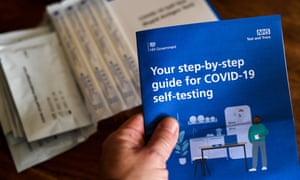
A hand is seen holding a guide for Covid self-testing
The testing scheme will involve kits for use at home or at test centres, workplaces and schools. Photograph: Finnbarr Webster/Getty Images 

Boris Johnson is to unveil a plan for routine, universal Covid-19 tests as a means to ease England out of lockdown, as the government faced a renewed backlash over the idea of app-based “passports” to permit people entry into crowded places and events.

Six months after Johnson unveiled plans for “Operation Moonshot”, a £100bn mass testing scheme that never delivered on its stated aim of preventing another lockdown, all people in England will be offered two Covid tests a week from Friday.

The prime minister is to announce the rollout of the lateral flow tests at a press conference on Monday afternoon, at which he will also outline a programme of trial events for mass gatherings, as well as proposals for potentially restarting foreign travel.

The testing scheme, involving kits for use at home or at test centres, workplaces and schools, is billed as a means to limit any continued community transmission of the virus, in parallel with the vaccination programme, and as a way to track outbreaks of potentially vaccine-resistant Covid variants.

The test-and-trace phone app will also be updated so that when pubs and other hospitality venues reopen everyone in a group will have to register, not just the lead person, with those who test positive asked to share other places they have visited.

Some scientists have expressed scepticism at the plan, noting both the possibility of false negatives with lateral flow tests, and the need for better support for people to self-isolate if they do test positive.

Civil liberties groups and many MPs will also be wary if the new testing system potentially feeds into a regime of Covid certificates, which would use recent tests, vaccination or the presence of antibodies to the virus to determine entry to pubs or mass events. Sometimes also called “Covid passports”, these would be purely for domestic use, and would be distinct from a vaccination record to allow foreign travel.

Over the weekend, the government unveiled plans for nine pilot events, ranging from football matches and a snooker tournament to comedy and business gatherings, to try out the practicalities of Covid certificates, whether using paper or via an app.

Such documents would allow people entry to events if they had been vaccinated, or could show they had recently tested negative for Covid or had antibodies to the virus.

But the day after the pilot events were announced, five of the nine venues insisted they were not taking part in a Covid certification trial, with one saying it had received a “massive backlash” after the government announcement.

woman takes the lateral flow test on in Portsmouth, England.

The scheme will run in parallel with the vaccination programme, and as a way to track outbreaks of potentially vaccine-resistant Covid variants. Photograph: Finnbarr Webster/Getty Images

Liverpool city council, where four of the events are planned, said these would instead be general tests of how such venues could reopen, including social distancing, ventilation and test-on-entry systems, but were not designed to feed into a certificate trial.

Paul Blair, a co-owner of the Hot Water Comedy Club in the city, which is organising an event on 16 April, said the venue had received abuse on social media and emails accusing it of being part of a “medical apartheid”.

Johnson has suggested businesses would welcome the option to use Covid passport schemes, but he faces a battle to win parliamentary support for the idea. Last week more than 70 MPs, including 40 Conservatives, announced they would oppose the idea.One option for the government would be to use such certificates for mass events such as sports and for places such as theatres, but not for access to pubs and bars.

The government has only recently gone public about the plans for such certificates, having previously discounted the idea. However, documents seen by the Guardian show research commissioned for the NHS’s test-and-trace system reported as early as December on ways for Covid passports to operate.

The documents include mock-ups of possible app-based passports, and research about possible public attitudes towards using these as a condition of entry to not just events such as football matches or to pubs, but also for family gatherings such as weddings.

In a quote released to promote the new testing system, Johnson hailed the progress with vaccination, and said tests were now “even more important to make sure those efforts are not wasted”.

He said: “That’s why we’re now rolling out free rapid tests to everyone across England – helping us to stop outbreaks in their tracks, so we can get back to seeing the people we love and doing the things we enjoy.”

Test protocols in the other UK nations are organised by the devolved governments.

A member of staff processes a Covid-19 lateral flow test in the sports hall of Wilberforce college in Hull. Photograph: Paul Ellis/AFP/Getty Images

Free testing is already available to frontline NHS workers, care home staff and residents, and schoolchildren and their families. As part of the rollout to the whole population people will be able to order tests to be delivered to their home and visit participating pharmacies to collect boxes of seven.

Stephen Reicher, professor of psychology at the University of St Andrews and a member of the Spi-B subcommittee of Sage that advises on behavioural science, said testing by itself was “no solution”, noting a rate of false negatives for self-administered lateral flow tests of up to 50%, as well as a lack of contact tracing or support for those self-isolating.

He said: “All in all, the government keeps on seeking quick fixes based on one intervention. What they consistently fail to do is to build a system in which all the parts work together to contain the virus.”

John Drury, professor of social psychology at the University of Sussexand also a member of Spi-B – but speaking in a personal capacity – said: “Is twice-weekly testing going to be accompanied by the required support for self-isolation, which currently is insufficient? If not, increased testing helps with the data but not with the practicalities of dealing with the virus.”

Labour said it backed the mass testing plan, but expressed similar worries. Jonathan Ashworth, the shadow health secretary, said: “To break transmission chains and suppress infections, testing must go hand in hand with community public health-led contact tracing to find cases and must be backed up by decent financial support so sick people can isolate.”

====================================================

WORLD STATS

Coronavirus Cases:

131,955,245

Deaths:

2,867,012

Recovered:

106,272,977
ACTIVE CASES
22,815,256
Currently Infected Patients
22,716,517 (99.6%)
Highlighted in green
= all cases have recovered from the infection
Highlighted in grey
= all cases have had an outcome (there are no active cases)

[back to top ↑]

The post Caribbean Get Ready: Vaccinated Americans are Free to Travel, World Stats appeared first on The St Kitts Nevis Observer.

Bank Accounts Not Needed with Eastern Caribbean Dollar


SAN JUAN, Puerto Rico (AP) — The Eastern Caribbean has created its own form of digital currency meant to help speed transactions and serve people without bank accounts.

The Eastern Caribbean Central Bank said its “DCash” is the first such blockchain-based currency introduced by any of the world’s currency unions, though some individual nations have similar existing systems.

It became available Wednesday in four island nations under a yearlong pilot program: St. Lucia, Grenada, Antigua and Barbuda, and St. Kitts and Nevis.

“(It) is a milestone in the history of monetary instruments,” said Bitt CEO Brian Popelka during a press conference broadcast online.

DCash was created by Barbados-based fintech company Bitt in partnership with the central bank. Unlike cryptocurrencies, it is issued by an official central bank and has a fixed value, tied to the existing Eastern Caribbean dollar used across much of the region.

The system allows users even without bank accounts — but with a smartphone — to use a downloaded app and make payments via a QR code. Those without bank accounts would go to a previously approved agent or nonbanking financial institution who would verify a person’s information and then approve a “DCash” wallet. That person would then go to a supermarket or other store and give the cashier physical cash which would then be deposited as digital currency in their wallet, Bitt spokesman Chris Burnett told The Associated Press.

In addition, there are limits on the amount of money people can send via DCash, there are no plans for now of integrating credit cards and interest does not apply to the digital currency.

While many in the Eastern Caribbean cheered the historic move, some experts worry that digital currency issued by smaller countries could end up being used as a conduit for illicit activities, including terrorism financing and money laundering, said Eswar Prasad, a trade policy professor at Cornell University.

“That skepticism is waning as more central banks get into the act, and as central banks around the world face the inevitability of the declining use of physical cash,” he said.

He noted that the Bahamas last year became the first country to roll out its digital currency nationwide, and that the Marshall Islands is considering its own cryptocurrency. For smaller countries, “there is more at stake” in part because many people remain unbanked, he said.

“That’s why I think small countries are being more aggressive about this, simply because they need to,” Prasad said.

Officials said that by September at the latest, the digital currency will be available in Anguilla, Dominica, Montserrat and St. Vincent and the Grenadines, which form part of the eight island economies under the Eastern Caribbean Central Bank.

The project aims to see a 50% reduction in the use of physical cash by 2025, said Sharmyn Powell, chairperson of the bank’s fintech working group.

“It’s safer, faster and cheaper,” Powell said.

Central Bank Governor Timothy N.J. Antoine said he envisions farmers, fishermen, small business owners, single mothers and people without bank accounts, among others, using the digital currency.

“Payments are still too slow and too expensive,” Antoine said of the current system. “We heard you, and we have delivered.”

Antoine said it is harder to steal digital cash and said it’s a safe way to make payments while avoiding contact during the pandemic.

One Eastern Caribbean dollar is currently equivalent to 37 U.S. cents. All Eastern Caribbean notes feature Queen Elizabeth II of England as head of the Commonwealth.

The project comes more than two months after the European Central Bank, the Bank of Japan, the Bank of Canada, the Bank of England, the Swedish Riksbank and the Swiss National Bank created a group to study whether they should issue digital currencies.

The Swedish central bank already has commissioned a pilot program. Meanwhile, China rolled out a digital currency in four cities in April 2020 as part of a pilot program that has since expanded to more than two dozen cities.

However, Lee Rainers, a fintech law and policy professor at Duke University, said it remains to be seen whether central bank digital currency is the future.

“I approach it with a sense of skepticism because this technology has been around for over 10 years now but has not taken off as a broad medium of exchange,” he said.

The post Bank Accounts Not Needed with Eastern Caribbean Dollar appeared first on The St Kitts Nevis Observer.