Tag Archives: caribbean

Vaccine Passports Become a Hot International Issue

From Europe to the USA, Vaccine passports may be required for travel and public services as a way to prevent spreading coronavirus.  But, this has instantly become a toxic issue for many US politicians.

Republicans are up in arms over the possibility that businesses and local governments may require vaccine passports for people to get access to certain activities, buildings or events.

Florida Gov. Ron DeSantis (R) has urged his state’s GOP-controlled legislature to pass a law forbidding passes showing proof of coronavirus vaccination while vowing to take executive action. Congressional Republicans have similarly slammed the passports, framing them as invasive.

The Biden administration has said it will provide guidance on the matter, but signaled the decisions will largely be left up to local governments and business owners.

“We’re going to provide guidance, just as we have through the [Centers for Disease Control and Prevention],” White House press secretary Jen Psaki said Monday. “There’s currently an interagency process that is looking at many of the questions around vaccine verification.”

Supporters of the idea say it will help boost businesses — especially in hard-hit industries like travel and entertainment — as COVID-19 restrictions are scaled back and more Americans receive vaccines.

“The cruise lines, for instance, want to get people back on cruises. Airlines want to get people back traveling. And quite frankly, I want to get back traveling again as well, because I haven’t been on an airplane since March and I used to travel all the time,” said Tim Paydos, global vice president of IBM’s government industry business.

“I only want to get on that airplane if I feel reasonably safe that everyone in there is healthy, and that the airline is taking care of me. And so that’s what this is really all about,” he added.

Paydos said IBM is in talks with “just about every state” and federal agencies about such passes.

Requiring vaccine passports could allow industries that have been closed off for much of the past year to reopen while minimizing the risks of spreading the virus. And proponents say virtual passes would speed up the verification process.

In New York, which last week became the first state to formally launch a virtual pass, the voluntary information is being touted as helping the state boost businesses that faced some of the toughest restrictions during the pandemic.

For example, New York recently expanded the number of permissible wedding guest attendees from 50 to 150 — as long as all attendees have proof of a negative test result or vaccination. Similar requirements have been made as the state allows sports fans back into stadiums and arenas.

New York’s Excelsior Pass, created in partnership with IBM, allows people to show if they have been vaccinated before attending events where proof is required.

Connecticut Gov. Ned Lamont (D) on Monday signaled his state may launch a similar pass in the coming months.

“I think it’s a little premature, only in that not everyone has the vaccine available to them yet. But I like to think within a month or two when broadly available, I think you will see some type of vaccine passport or validation … probably led by the private sector,” Lamont said at a press briefing.

Some Republican governors, though, are fiercely pushing back on such efforts.

DeSantis vowed on Monday to take executive action this week to ban the passes.

“It’s completely unacceptable for either the government or the private sector to impose upon you the requirement that you show proof of vaccine to just simply participate in normal society,” he said at a press conference.

South Dakota Gov. Kristi Noem (R) slammed the Biden administration for “one of the most un American ideas in our nation’s history,” even though the administration has yet to provide any guidance on the matter.

“The @joebiden #CovidPassport proposal is one of the most un American ideas in our nation’s history. We as Americans should oppose this oppression,” Noem tweeted Monday night.

Congressional Republicans have also joined the chorus of criticism.

Rep. Lauren Boebert (R-Colo.) tweeted that “Vaccine Passports are unconstitutional,” while Rep. Jim Jordan (R-Ohio) used it as a chance to ramp up criticism of President Biden’s immigration policy.

A New York state official pushed back on the GOP criticism that such passports are invasive, telling The Hill that the Excelsior Pass provides less information than residents would otherwise need to show.

The pass lets users verify that they have met either the vaccine or testing standard and then flash a QR code to enter, as opposed to providing specific documents showing a negative test or a vaccine card.

Moreover, the state guidance does not require the Excelsior Pass to show proof. Residents choose to instead show print documents to enter events where proof is required, the official said.

A requirement to show proof of vaccination is not unprecedented, particularly when it comes to international travel. Yellow cards, for example, are required to show proof of yellow fever vaccination before traveling to certain countries.

The International Air Transport Association is testing a COVID-19 passport, called the Travel Pass, that will allow passengers to provide information about testing and vaccination, in addition to checking the COVID-19 requirements for their destination.

Although the group does not support mandatory vaccine requirements for air travel, products such as the virtual Travel Pass could ease the process to help international travel come back if countries decide to put such requirements in place, said spokesperson Perry Flint.

Even with international travel at a fraction of pre-pandemic levels, existing requirements to show a negative coronavirus test are already causing hours-long waits, and the lack of digital passes to provide testing or vaccination proof would cause “enormous jams” in airports, Flint said.

“Forget about 6 feet, there’s going to be lines out the door,” he added.

Former Rep. Justin Amash, a Michigan Libertarian who left the Republican Party after voicing support for former President Trump’s impeachment, dismissed arguments that passes showing proof of COVID-19 vaccinations are similar to requirements already in place for certain forms of travel.

“Let’s get the terms clear: A ‘vaccine passport’ is not ‘what we already do.’ It’s not proof of vaccination for internat’l travel or schooling. It’s proof of vaccination for everyday living—groceries, restaurants, movies. It’s disingenuous to conflate the former with the latter,” Amash tweeted Monday.

“No vaccine passport. It doesn’t get much more dystopian than being required to show your ‘health papers’ wherever you go,” he said in a separate tweet.

Although the Biden administration has not detailed its plans for any passport guidelines, Psaki on Monday said the White House will not create a federal mandate requiring all residents to obtain a single vaccination credential, nor create a centralized, universal federal vaccination database.

She declined to share a timeline on when the guidelines will be released.

As for the creation of such passports, the Biden administration said it is largely leaving that responsibility up to the private sector.

“This is going to hit all — all parts of society.  And so, naturally, the government is involved,” said Andy Slavitt, a White House senior adviser on COVID-19. “But unlike other parts of the world, the government here is not viewing its role as the place to create a passport, nor a place to hold the data of citizens.”

“We view this as something that the private sector is doing and will do,” he added.

=================================================

AND IN THE UK

Covid certificates on the cards for use in England since December
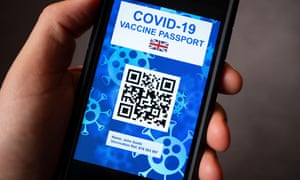
A conceptual design for an electronic Covid-19 certificate using a QR code on a smart phone
A conceptual design for an electronic Covid-19 certificate using a QR code on a smart phone.

A government-commissioned report in December examined how Covid certificates could be used to decide whether people should be allowed into sports events, pubs and other crowded spaces, months before ministers publicly confirmed the plan.

A document prepared for NHS test and trace and seen by the Guardian shows that the research also looked into whether certificates could be made a condition of entry for family events such as weddings or even small casual gatherings.

The report, dated 17 December, was prepared by staff working for Zühlke Engineering, a Swiss-based consultancy that has worked closely on the UK’s Covid contact-tracing app, and has a number of staff embedded within the test-and-trace team.

It details research into possible public attitudes to a Covid certificate, sometimes called a domestic Covid passport. This would use vaccination status, a recent negative Covid test or proof of coronavirus antibodies to allow people into potentially packed places when the country opens up.

The document includes mock-up pictures of how an app-based Covid certificate might work, using scannable QR codes. One shows this on the main NHS app, with a countdown showing when the pass expires.

Another shows the certificate attached to the NHS test and trace app. This option is seen as unlikely, because the test and trace app is anonymous while the certificate involves personal information.

Covid certificates are enormously controversial. At least 40 Conservative backbenchers are among 70-plus MPs who announced last week that they would oppose them.

There has been considerable speculation about the use of such certificates, but as recently as February the vaccines minister, Nadhim Zahawi, said the government was “not looking at a vaccine passport for our domestic economy”.

Boris Johnson is expected to announce the initial findings of a review into the subject on Monday, but not to say categorically whether or not they will be introduced.

The December document uses focus group research to highlight public attitudes towards the idea. It found that people considered them potentially useful for events such as football matches and even weddings, but not for smaller family gatherings.

The post Vaccine Passports Become a Hot International Issue appeared first on The St Kitts Nevis Observer.

Pres. Biden’s Plan to Repair America

The Hill- US President Biden has outlined what he called a “bold” $2 trillion plan to make aggressive investments in repairing U.S. infrastructure and addressing climate change with the goal of spurring job creation.

The investments would be made over eight years, and Biden’s plan relies on a hike to the corporate tax rate to 28 percent that the White House says will pay for the new investments over 15 years.

Here are five takeaways from the announcement.

The proposal is not bold enough for progressives

Biden’s proposal is being met with resistance from some members of the Democratic Party’s progressive wing who argue that it is not large enough, particularly to address climate change.

Rep. Alexandria Ocasio Cortez (D-N.Y.) tweeted Tuesday that the package “needs to be way bigger,” as she noted that the $2.25 trillion plan would be spent over a much longer timetable than Biden’s rescue package.

Meanwhile, a coalition of progressive organizations making up the Green New Deal Network are pressing Biden for bolder action to address climate change, such as the $10 trillion climate agenda backed by Sen. Ed Markey (D-Mass.) and other members of the progressive caucus. The groups have organized grassroots events across the country to highlight the message that Biden must go bolder.

Adam Green, co-founder of the Progressive Change Campaign Committee, described Biden’s plan as a good first step but said that more is needed to address climate change.

“As an infrastructure plan, it’s a home run. As a climate policy, it’s a really significant step, and hopefully there are more steps to come,” Green said.

A lack of Republican support means that Biden will need to keep Democrats in the House and Senate unified behind his plan in order to get it passed using budget reconciliation. That means keeping progressives happy while also addressing concerns from more moderate Democrats, including Sen. Joe Manchin (W.Va.).

Biden found it relatively easy to keep Democrats in line to pass his $1.9 trillion coronavirus relief package earlier this year, especially after the Senate parliamentarian ruled that a hike in the federal minimum wage to $15 could not be part of the package.

This could be a little tougher.

GOP unlikely to offer support 

Getting GOP support for a bill paid for through tax increases was always going to be difficult for the White House, and Republicans were quick to signal their opposition to raising the corporate tax rate.

“Our nation could use a serious, targeted infrastructure plan. There would be bipartisan support for a smart proposal. Unfortunately, the latest liberal wish-list the White House has decided to label ‘infrastructure’ is a major missed opportunity by this Administration,” Senate Minority Leader Mitch McConnell (R-Ky.) said in a statement.

The Biden proposal calls for paying for the legislation over a 15-year period by raising the corporate tax rate from 21 percent to 28 percent. The proposal leaves out other ideas that had been batted around, such as a wealth tax or an increase in the capital gains tax for certain Americans.

The White House has been adamant that Biden’s proposal is a starting point and the administration will seek out members of Congress in both parties to decide how to best move forward, but it’s unclear how the president will be able to satisfy Republicans who are both opposed to tax increases and against adding to the deficit.

But Biden was unable to attract a single GOP vote for his $1.9 trillion COVID-19 relief package.

Biden campaigned on uniting the country and his ability to reach across the aisle to find bipartisan solutions in a deeply polarized Washington, but he’s already finding it hard to make headway on a traditionally bipartisan issue such as infrastructure.

The plan goes well beyond roads and bridges 

Biden is proposing a $620 billion investment to repair America’s aging transportation infrastructure that the White House says will fix 20,000 miles of roads and 10,000 bridges — but the scope is much larger.

The plan puts $174 million toward boosting the electric vehicle market, setting up incentives for state and local governments to build a national network of 500,000 electric vehicle chargers over the next decade.

Biden is also proposing more than $100 billion in funding to ensure safe drinking water by eliminating all lead pipes and service lines. The plan aims to invest $100 billion in expanding broadband access to all Americans, particularly those in rural areas and other underserved communities.

One prong of the package is designed to enhance the “care economy,” with Biden calling for $400 billion to expand access to home and community-based services for elderly people and those with disabilities.

Biden’s plan is also formulated to address racial inequities, including by proposing a $10 billion investment in research and development at historically Black colleges and universities and other minority-serving institutions in the United States and $15 billion for establishing centers of excellence at these institutions to provide graduate fellowships and similar opportunities.

Biden also satisfied gun safety advocates by including in his plan a proposed $5 billion for community violence prevention programs.

Biden bets on big government

Some Democrats and historians have begun likening Biden’s legislative initiatives to those of former President Franklin Roosevelt, whose New Deal aimed to pull the country out of the Great Depression by implementing new government programs to address economic insecurity and drive private sector growth.

With a $1.9 trillion COVID-19 spending package under his belt, Biden is again aiming to reimagine how the government and economy interact with his $2.1 trillion infrastructure bill.

The proposal will touch on many different aspects of American life. In addition to making investments in traditional infrastructure projects such as roads, bridges and broadband, the bill would also direct government money toward electric vehicles, green energy projects, the health care sector, child benefits, elderly care and developing future technologies.

Biden reportedly referenced Roosevelt in a meeting with historians last week. The current president has a lot riding on the success of his programs in transforming the government and society in response to the COVID-19 crisis.

Biden makes the case for the moment 

Biden made the case for passing his sweeping infrastructure plan during an address in western Pennsylvania, arguing that passing it was a test of whether democracies can work for their people.

He spoke with urgency and suggested that America’s future depends on his plan to reshape the economy.

“We have to move now. Because I am convinced that if we act now, in 50 years people are going to look back and say, this was the moment that America won the future,” Biden said in an afternoon address at Carpenters Pittsburgh Training Center.

Biden made a point to focus on his blue-collar roots and talked about his support for union workers and the middle class, pointing to the need to build an economy that “rewards work, not just rewards wealth.”

The rhetoric echoed Biden’s consistent message on the campaign trail to be a president for working Americans.

“Wall Street didn’t build this country. You, the great middle class, built this country, and unions built the middle class. And it’s time we rebuild the middle class. We’re going to bring everybody along,” Biden said.

The post Pres. Biden’s Plan to Repair America appeared first on The St Kitts Nevis Observer.

New Attack on US Capitol- 1 Officer Killed, 1 Injured

One Capitol Police officer was killed and another was injured after a car rammed one of the barriers surrounding the Capitol complex on Friday, forcing the area into a lockdown, with police fatally shooting the suspect.

Police said a vehicle ran into two officers. A suspect exited the vehicle with a knife and started “lunging” toward officers, who then fired on the person, acting Capitol Police Chief Yogananda Pittman said at a briefing Friday afternoon.

“He did not respond to verbal commands. The suspect did start lunging toward U.S. Capitol Police officers, at which time U.S. Capitol Police officers fired upon the suspect,” she said.

“The suspect has been pronounced deceased. Two U.S. Capitol Police officers were transported to two different hospitals, and it is with a very, very heavy heart that I announce one of our officers has succumbed to his injuries,” she said.

Capitol Police identified the officer who was killed as William Evans, a member of the Capitol Police force for 18 years.

House Speaker Nancy Pelosi (D-Calif.), who ordered flags to fly at half-staff to honor the slain officer, called Evans “a martyr for our democracy.”

“Members of Congress, staff and Capitol workers, and indeed all Americans are united in appreciation for the courage of the U.S. Capitol Police. Today, once again, these heroes risked their lives to protect our Capitol and our Country, with the same extraordinary selflessness and spirit of service seen on January 6. On behalf of the entire House, we are profoundly grateful,” she said in a statement.

Police said they will continue to investigate the motive behind the attack.

“It does not appear to be terrorism-related, but obviously we’ll continue to investigate to see if there’s some type of nexus,” acting Metropolitan Police Chief Robert Contee III said of the attack.

“Whoever or whatever, we just don’t know right now, so we have a responsibility to investigate that to get to the bottom of this, whether the attack was at law enforcement or whoever, we have a responsibility to get to the bottom of it,” he said.

Pittman said the suspect was not previously known to Capitol Police “so there’s no indication at this time that there’s any nexus to any member of Congress.”

The acting police chief previously told lawmakers that threats against members of Congress have nearly doubled in the past year.

National Guard troops responded to the incident on Friday and were seen in videos shared on social media lining up with their shields at various intersections near the Capitol.

“The DC National Guard deployed a Quick Reaction Force (QRF) composed of National Guard soldiers and airmen to the Capitol complex this afternoon to support the U.S. Capitol Police. Due to operational security, we cannot discuss further details regarding the QRF,” the D.C. National Guard said in a statement to The Hill, adding no guardsmen were injured in the incident.

A number of National Guard members have been patrolling the Capitol since the deadly Jan. 6 riot and about 2,300 National Guard troops remain in D.C.

As the scene was unfolding early Friday afternoon, a Fox News reporter said two people were seen on stretchers outside the Capitol, and a helicopter was spotted landing in the area to respond to the incident.

Capitol Police sent out a notice shortly after the attack saying there was an “external security threat.” No one was allowed to enter or leave the building and staff was advised to stay away from doors and windows. The Capitol lockdown was lifted shortly after 3 p.m. after officers concluded their press conference.

The incident comes as U.S. intelligence agencies warned the nation remains at an elevated risk for domestic terror attacks, with a report issued last month warning of the threat posed by lone-wolf attacks.

Friday’s incident took place on the Senate side of the Capitol by a security station near an entrance frequently used by lawmakers and their staff. Congress is in recess this week.

“Praying for the United States Capitol Police officers who were attacked at the Capitol. We are still learning what’s taken place. Grateful to all the USCP and first responders who are on the scene,” Senate Minority Leader Mitch McConnell (R-Ky.) tweeted.

“The brave men and women of the United States Capitol Police put their lives on the line every day to protect the heart of our democracy. We are hoping and praying for the recovery of those injured in the line of duty,” Sen. Amy Klobuchar (D-Minn.) said in a statement.

The incident comes as security fencing surrounding the Capitol has been reduced in recent weeks. Just nine days ago, security forces finished removing the outer perimeter fencing that had been surrounding the complex, leaving just the fencing that closely circles the main Capitol building.

Capitol Police closed streets surrounding the Capitol on Friday afternoon, blocking intersections that were previously closed by the prior fencing.

The officer’s death Friday is the third within Capitol Police ranks since the beginning of this year, after Officer Brian Sicknick died in the line of duty during the Jan. 6 riot. Another officer, Howard Liebengood, died by suicide in the days after the Capitol insurrection.

“Please keep the United States Capitol Police family in your thoughts and prayers at this time. It has been an extremely difficult and challenging year for us,” Pittman said Friday afternoon.

The post New Attack on US Capitol- 1 Officer Killed, 1 Injured appeared first on The St Kitts Nevis Observer.

Corona Effect: Another Quiet, Dull Easter for Caribbean

No cruise ships, few tourists and pandemic restrictions everywhere. Even Easter egg hunts will be rate this Sunday.

This means in some countries those looking to escape to the beach or even enjoy boat rides over the long weekend will have to think twice or risk running into the law.  This is true in the Federation as well as most Caribbean destinations.

Some islands have implemented Easter advisories to prevent the further spread of COVID-19. Here is a list of those Caribbean islands where down to camping over the long weekend has been banned.

St Vincent and the Grenadines

Vincentians can still go to church in limited numbers for the Easter period.

However, when it comes to outdoor activities there are no social gatherings including river, cooks, limes, boat rides, picnics or parties during the Easter weekend.

Antigua and Barbuda 

Beaches in Antigua and Barbuda are closed for the next four days. This went into effect on the evening of April 1 and ends on April 6 at 5 am.

Visits to offshore island for private parties have also been restricted.

Commercial fishing vessels (both regular and sport), ferry services and vessels transporting passengers and/or goods to and from Barbuda are exempt from the weekend restrictions.

All other watercraft are to remain in port.

Barbados 

Many Barbadians will be staying indoors for Easter as the island remains under certain COVID-19 directives which essentially nips any plans.

The beaches and parks are open only for swimming or exercise between 6 am and 9 am and 3 pm and 6 pm.

Persons are prohibited from hosting or attending a party, a dance, a “lime”, picnic, social events such as “a bus crawl”, karaoke event, boat cruise, vehicular excursion or a meeting of a fraternal society, private or social club or civic association or organisation.

Jamaica 

Tough COVID-19 measures were also announced for Jamaica to curb the spread of the coronavirus.

Good Friday is a ‘no movement day’ and similar to Good Friday, only persons in the essential services or those seeking medical help will be allowed to leave their homes during the Easter Sunday and Easter Monday curfew period.

US Virgin Islands 

A Holy week camping ban is in effect for the US Virgin Islands.

Governor Albert Bryan, Jr has prohibited camping on all beaches through Saturday, April 10. All beaches in the Territory are also closed from 5 pm until 6 am on Saturdays, Sundays, and holidays.

No picnics, parties, disc jockey music or equipment, bonfires, cooking, barbecuing, or grilling is allowed on any beach in the Territory at any time during its State of Emergency.

The post Corona Effect: Another Quiet, Dull Easter for Caribbean appeared first on The St Kitts Nevis Observer.

Pandemic Boost: US Adds More than 900k Jobs in March

The U.S. added a whopping 916,000 jobs and the unemployment rate fell to 6 percent in March as the recovery from the coronavirus recession chugged ahead, the Labor Department reported Friday.

The March jobs report showed the U.S. economy picking up speed as COVID-19 vaccinations accelerated, restrictions eased and President Biden signed a $1.9 trillion relief plan meant to give struggling households and businesses a bridge to the other side of the pandemic.

Economists had projected the U.S. to gain 675,000 jobs in March as consumer and business confidence rose, manufacturing activity sped up and workforce management companies reported steady rises in hiring and hours worked.

The Labor Department also revised February’s surprisingly strong gain from an initially reported 379,000 jobs up to 468,000 and January’s gain of 166,000 jobs up to 233,000, a combined total of 156,000 more jobs.

The U.S. is still 8.4 million jobs short of pre-pandemic levels, and millions more have left the workforce without a clear path to return. Labor force participation was also largely unchanged at 61.5 percent in March, 1.8 percentage points lower than it was in February 2020.

Even so, the March jobs report marked an encouraging step forward for an economy expected to speed up into the spring and summer.

The hard-hit leisure and hospitality sector led March’s haul with a gain of 280,000, 176,000 in food and beverage service places. Arts, entertainment and recreation added 64,000 jobs, and accommodation added 40,000.

Education added 190,000 jobs in March as in-person schooling resumed across much of the U.S., and the construction sector added 110,000 jobs. Professional and business services added 66,000 jobs, manufacturing employment rose by 53,000 and retailers added 23,000 workers.

“Job growth accelerated sharply in March, with gains across a number of sectors, including both goods-producing and service-providing industries. We fully expect that this pace of job gains will continue for months, and anticipate that the unemployment rate, now at 6 percent, will be well below 5 percent by the end of the year,” wrote Mike Fratantoni, chief economist at the Mortgage Bankers Association, in a Friday analysis.

The two surveys used to calculate the March employment report were conducted the week Biden signed a $1.9 trillion COVID-19 relief bill. While the March jobs report does not capture the direct fiscal impact of Biden’s relief measure, it may capture some of the decisions made based on the bill’s likely passage.

Many economists say the direct household payments, extended unemployment benefits, rental aid and state and local government support included in Biden’s relief bill will help accelerate the recovery and limit the recession’s long-term damage.

The March report also comes two days after Biden rolled out his $2.5 trillion infrastructure package, the American Jobs Plan, as the next piece of his broader economic agenda.

Biden’s proposal would spend trillions to repair bridges, roads, and waterways, expand Internet access, make the U.S. more resilient to climate change, build more affordable housing, and boost electric vehicle productions. The plan is not only intended to boost the country’s long-run economic productivity but ensure that the recovery from the COVID-19 recession leaves no one behind.

Black and Hispanic Americans have taken a disproportionate toll from both the pandemic and the economic crisis and remain well behind their white counterparts on the road to recovery. The Black unemployment rate was 9.6 percent and the Hispanic unemployment rate was 7.9 percent in March, while the white unemployment rate was just 5.4 percent.

Another 3.7 million Americans also said they were unable in March due to the pandemic, and there were roughly 6.9 million people who wanted a job but were not currently looking for one, meaning they are not counted among the unemployed.

“The extent to which the rebound is more inclusive will depend on how eventual legislation prioritizes investments in sectors with a high concentration of Black and Hispanic workers and recognizes care, skills training, and broadband as necessary provisions to unlock opportunities and ensure a more equitable recovery,” said Nicole Goldin, a nonresident senior fellow at the Atlantic Council.

Updated at 9:28 a.m.

The post Pandemic Boost: US Adds More than 900k Jobs in March appeared first on The St Kitts Nevis Observer.

Rent Branson’s Island…a Steal at $25,000 Per Night

Richard Branson is renting out his private estate on his second Caribbean island for the first time at $25,000 a night. Take a look inside the 3-villa compound.

richard branson estate moskito island
The Branson Estate.
Virgin Limited Edition

Richard Branson, billionaire business magnate and Virgin Group founder, is opening up his private estate on his second Caribbean island to the public for the first time.

richard branson
Richard Branson in Australia in November 2019.
Getty Images/Don Arnold/WireImage

Branson, who’s worth $4.9 billion and whose businesses ventures span airlines, luxury travel, space travel, telecom, and more, bought Moskito Island for a reported $10 million in 2007.

Moskito Island is not to be confused with Branson’s other private Caribbean island, Necker Island, which Branson bought in 1978 and which serves as a luxury retreat that’s typically booked exclusively to private groups.

Moskito Island is a 125-acre island in the British Virgin Islands that’s about 2.5 miles away from Necker Island.

richard branson moskito island
An aerial view of Moskito Island.
Virgin Limited Edition

In 2011, four years after Branson purchased Moskito Island, he started developing roads and other infrastructure on the island, according to a spokesperson for Virgin Limited Edition, Branson’s luxury hotel and retreat company.

By 2015, he had installed basic infrastructure and completed construction of his private estate, a Virgin spokesperson told Insider at the time. Branson also sold nine other private lots on the island to unidentified buyers to be developed into villas.

Today, the Branson Estate is one of 10 individual estates on the island.

richard branson estate moskito island
The Branson Estate.
Virgin Limited Edition

The Branson Estate is the first estate to open to the public for rentals, but some of the other estates will open later in 2021, the Virgin Limited Edition spokesperson said.

The price to book the Branson Estate in its entirety starts at $25,000 per night in the low season, between June 1 and September 30.

richard branson estate caribbean

Virgin Limited Edition

In the high season — January 6 through May 31; October 1 through November 20; and November 29 through December 21 — exclusive use of the estate starts at $33,000 per night.

The estate is even pricier during the holidays. Over Thanksgiving (November 21 through November 28) the price goes up to $34,650 per night. And from December 22 through January 6, a night’s rental will cost you a whopping $36,600 — putting a week’s stay at more than a quarter of a million dollars.

The Branson Estate comprises three villas: Headland House, Mangrove Villa, and Beach Villa, with a total of 11 bedrooms for 22 guests.

richard branson caribbean estate
Mangrove Villa.
Virgin Limited Edition

If a potential renter doesn’t want to book the entire estate, it’s possible to rent four guest rooms starting at $12,000 per night, with the option to book an additional room for $2,000 and an additional master suite for $3,000.

The nightly rate includes all meals and drinks (including alcoholic beverages), in-villa chef services, and access to Moskito Island’s shared recreation facilities.

Each of the three villas on the Branson Estate has its own swimming pool.

richard branson caribbean estate
Beach Villa.
Virgin Limited Edition

Source: Virgin Limited Edition

The post Rent Branson’s Island…a Steal at $25,000 Per Night appeared first on The St Kitts Nevis Observer.

Pandemic Accentuates Need for Better Caribbean Food

by Kate Chappel

IPS- An October, 2020 study of eight Caribbean countries found that 40% of people surveyed experienced some form of hunger, with 42% of those saying it was moderate to severe.

The survey by the College of Health Sciences at the University of Technology included 2,257 households in eight countries across the region (Jamaica, Trinidad and Tobago, Guyana, Belize, Barbados, St. Kitts and Nevis, St. Vincent and the Grenadines and Antigua and Barbuda.)

Another recent study from the Caribbean Research and Policy Institute and Unicef also found that in a survey of 500 Jamaican households, 44% reported that they were experiencing food shortages, while 78% said their savings could last them four weeks or less.

Food security is a technical term referring to the availability of nutritious food, and defined by the United Nations as having “physical, social and economic access to sufficient, safe and nutritious food that meets their food preferences and dietary needs for an active and healthy life.” The World Bank reports that despite the pandemic, there is adequate supply, however the challenge lies at the national level. The risks to food security include higher prices and reduced incomes, which forces households to rely on smaller portions of less nutritious foods.

“We suspected people were cutting back on their intake, especially households where the breadwinners were losing their jobs. It has shook up some of the households quite a bit. People are cutting back on the number of meals that they were having,” says Dr. Vanessa White Barrow, the Head for the School of Allied Health and Wellness at the University of Technology’s College of Health Sciences.

The effect of this, of course, has many repercussions, including malnutrition, lack of energy, obesity as a result of consuming lower-cost but unhealthy foods and a variety of health issues like diabetes and hypertension.

“What has happened is that the nutrition divide has widened as a result of COVID,” says Prof. T. Alafia Samuels, of at the Caribbean Health Research Institute at the University of the West Indies.

“We also know that before, because of the extent that many household were dependent on processed food, people have cut back (on healthy foods) and are going for cheaper alternatives, and this has long-term health implications,” she says. This especially impacts children, who need nutritious food to grow and learn adequately. In addition, children are confined to their households, doing online learning and missing physical activity they would have had at school.

Food and nutrition insecurity are just one frightening outcome of the pandemic, which has ravaged one of the most tourism-dependent regions in the world. In Jamaica alone, a minimum of 50,000 people have been laid off from the tourism industry, a number that is likely even higher when taking into account indirect employment. An estimated 135,000 people have lost their jobs in total. The country’s real GDP for fiscal 2020/21 is expected to contract by up to 12%, according to the Bank of Jamaica, and the unemployment for Oct. 2020 was 10.7%. According to the World Bank, the percentage of people living below the poverty line was 19.3% in 2017, and while this figure had been improving, it is unlikely to continue this trajectory.

With this hardship in mind, the government has introduced a series of financial stimulus measures to reach the most vulnerable, but these are not sustainable. In addition to financial measures, the government has also focused on increasing food security, an effort that existed prior to the pandemic, but has since been ramped up.

In terms of boosting food security and assisting the farming industry, Jamaica’s Minister of Agriculture and Fisheries Floyd Green says that the government is investing JMD$1 billion this year.

Decreased market demand, in large part from the hotel and restaurant industry, has harmed the farming industry. So while at times there is an excess of supply, a lack of demand has impacted farmers and their production systems, which in turn erodes food security.

“The challenge with COVID is clearly the downturn in the market, which discourages the farmers from producing,” says Green, adding that they worry their supply will not be absorbed. With this in mind, the government created a “buy-back” program, which found new clients for farmers, which has helped.

“We saw an initial decline in production with COVID when it came in, but we went back into a growth position overall, and now year-over-year seeing growth.”

Ultimately, Green says COVID has forced people to examine their self-sufficiency. “Covid has brought back into sharp focus in the minds of people the need to be more self-sufficient when it comes to feeding ourselves.”

The need for self-sufficiency exists on a large scale as well, especially on an island that imports over US$1billion of goods annually. And while some of that cannot be avoided as it is inefficient or impossible to produce everything needed by Jamaicans, Green says there are some efforts to increase the nation’s self-sufficiency, as well as to ramp up exports, which can help to balance the import bill.

“A part of what we have been doing is to have to take a critical approach to analyzing our import bill, and what can we do what can we grow efficiently to reduce the import bill. We have a twofold approach, we don’t only focus onthe import bill, but export revenues. We have to look to raise export revenues as a small island state that wont be able to produce efficiently,” Green says.

To this end, the government is looking to encourage production of ginger, turmeric, cocoa, coffee, castor oil, and mangoes, which are all in demand because of their superior quality, he says. “ We are looking to further encourage incentive some of our farmers to go into some of these crops. What you will see now over the next three years is a determined push towards export stimulation.”

In terms of local food supply, Green says it is sufficient. The issue, however, is with a lack of purchasing power, especially of late as a result of the economic downturn. “Our challenges is to restart the economy to make sure people can get back purchasing power.”

Green mentions a backyard gardening program in which 2,500 families across the country, with a majority focus on urban areas, received a kit containing all the necessary tools to start a garden and become more self-sufficient.

This is one measure towards achieving food security, says Jamaica Agricultural Society vice-president Denton Alvaranga.

“A lot of persons are at home with a lot of time on their hands, the elderly, middle age, they are at home, children are at home, and most times, having very little to do.

It would be very useful at this time to re-emphasize the backyard gardening program,” he says. “This is very, very useful and timely when you look at it a lot of things produce can be grown locally in our backyard and a lot of people have a lot of space.”

In addition to backyard gardening, Both Samuels and Barrow-White add that government programs to identify and reach the most vulnerable communities and families will help increase food security. Samuels is currently working with Jamaican churches to develop a database to identify these people. “The plan is interventions, and we are proposing actually support them to roll out that kind of intervention that has worked in one church so they can have a systematic way to find out who are the vulnerable what needs to get them to the point. You need some kind of organization, you can’t go out there and look for people one by one,” Dr. Samuels says.

The post Pandemic Accentuates Need for Better Caribbean Food appeared first on The St Kitts Nevis Observer.

USVI: UK Cops Called In to Probe Missing British Woman

British police are assisting in the investigation into the disappearance of a 41-year-old woman who went missing from a catamaran in the US Virgin Islands more than three weeks ago.

Sam Heslop went missing from the Siren Song, a catamaran her friends say is owned and operated by her American boyfriend Ryan Bane, while off the coast of St John in the early hours of March 8.

The family of the 41-year-old, from Southampton, Hampshire, say they are becoming increasingly concerned for her and have expressed their gratitude for those helping the search.

They said: “It is now over three weeks since Sarm went missing, 25 days in which we get more and more concerned as we wait for news

“We know that the Virgin Islands Police Department (VIPD) is doing as much as possible and we are pleased that Hampshire police is also assisting their investigation.

“We want to say a heartfelt thank you to the local community for continuing their efforts to help search for Sarm.

“If we could travel then we would; we just want to be on the island helping with the search and we dream of being able to wrap our arms around our darling daughter.”

One of Sam’s best friends, who did not wish to be named, added: “We want to know what happened after Sarm left the restaurant in Cruz Bay.

“As a friends group, we are doing everything we can to help support her parents and each other. No matter how insignificant something may seem, the tiniest detail may be relevant so we would encourage people to come forward and speak to VIPD immediately.”

A Hampshire police spokeswoman said: “Hampshire Constabulary is providing operational support in the UK to assist a US Virgin Islands Police Department investigation.

“This assistance is being facilitated through the UK Government’s Foreign, Commonwealth & Development Office. Hampshire Constabulary cannot comment further on another force’s investigation.”

The post USVI: UK Cops Called In to Probe Missing British Woman appeared first on The St Kitts Nevis Observer.

EU in an Effort to Bring the US, Cuba Together

HAVANA, April 1 (Xinhua) — The European Union (EU) has agreed to mediate Cuba-U.S. relations, the Cuban News Agency (ACN) reported Thursday.

EU High Representative Josep Borrell accepted the request made by the Group of Friendship and Solidarity with the People of Cuba in the European Parliament “to mediate before the U.S. government in order to remove Cuba from the unilateral list of countries that encourage terrorism,” the ACN reported.

In a letter written by Borrell to members of the European Parliament, which was made public Wednesday on Twitter, the high representative said, “in our contacts with the new U.S. administration, we will address this issue and call on the U.S. to lift this designation.”

In response, Ana Mari Machado, deputy president of Cuba’s National Assembly of People’s Power, tweeted Wednesday that the assembly appreciated the EU’s decision.

“Cuba does not sponsor nor promote terrorism. We support peace, solidarity and collaboration between peoples,” she said.

Cuba should have never been included in the list, Cuba’s ambassador to China Carlos Miguel Pereira said Thursday on Twitter, adding that “Cuba only sponsors and promotes solidarity and peace, not terrorism.”

“The European Union clearly states its constructive commitment to Cuba,” Carlos Alzugaray, senior university professor and Cuba’s former ambassador to the EU, told Xinhua.

“It has also an economic dimension: the European Union protects its economic interests in Cuba, which are threatened by (former U.S. Secretary of State Mike) Pompeo’s unilateral action,” he added.

Cuba was first designated by the United States as a state sponsor of terrorism in 1982, and was removed from the list in 2015 under the administration of then U.S. President Barack Obama as the two countries re-established diplomatic ties.

However, on Jan. 11, 2020, just a few days before then U.S. President Donald Trump left office, Pompeo announced that the United States had restored Cuba to the list.

In early March, White House Press Secretary Jen Psaki told reporters in a daily briefing that the United States is committed to reviewing Trump administration’s designation. But she also said, “a Cuba policy shift is not currently among President (Joe) Biden’s top priorities.”

The post EU in an Effort to Bring the US, Cuba Together appeared first on The St Kitts Nevis Observer.