The top drug regulator for the European Union announced Thursday that AstraZeneca’s coronavirus vaccine is safe and effective to use, after over a dozen countries halted administering its use over concern of blood clots.
However, the European Medicines Agency (EMA) also said it could not rule out a link to the blood clots, and said it would add a warning to the product in order to draw attention to the possibility of such rare side effects.
Including the warning and conducting outreach to health professionals and the public “will help to spot and mitigate any possible side effects,” said Emer Cooke, the executive director of the agency.
The EMA said the benefits of protecting people against COVID-19 with a vaccine far outweigh possible risks.
More than a dozen countries in Europe have temporarily suspended use of the vaccine, including Germany, France, Italy, Spain, Ireland, Norway and Denmark. They have been waiting on the EMA’s recommendations on how to proceed.
“Our scientific position is that this vaccine is a safe and effective option to protect citizens against COVID-19,” Cooke said. “We made this review our highest priority.”
The EMA published its findings, noting that out of about 20 million people who received the vaccine, there were only seven cases of blood clots in multiple blood vessels and 18 cases of blood clots in the brain.
“A causal link with the vaccine is not proven, but is possible and deserves further analysis,” the agency said.
The EMA investigation was focused on a small number of brain clots that have been reported following vaccinations. Most of these occurred in people under 55 and the majority were women.
The World Health Organization earlier this week endorsed the safety of the shot, and the United Kingdom’s top medical regulator on Thursday gave a similar message, urging countries to continue offering the shot.
But even if countries resume vaccinations immediately, experts think some damage has already been done.
Not only could the pauses set back vaccination efforts across Europe, but they could have ripple effects across the world and undermine confidence in the vaccine.
Hundreds of millions of Europeans are facing the prospect of another strict lockdown as the continent struggles with a new wave of COVID-19 infections and a flawed vaccine rollout. The fallout from suspending AstraZeneca’s shots could slow it down even more.
Italy, France, Germany and several other countries will resume administering AstraZeneca jabs from Friday after Europe’s medicines regulator said the vaccine was “safe and effective” and its benefits outweighed its risks.
Portugal will resume on Monday, Spain and the Netherlands next week, while Sweden’s public health agency said it would take “a few days” to decide.
The European Medicines Agency (EMA) had launched a review after about 30 cases of unusual blood clotting and low platelet counts in recipients of the vaccine prompted more than a dozen EU countries to suspend its use.
The EMA’s director, Emer Cooke, said the agency’s safety committee had reached “a clear scientific conclusion” and had not found that the vaccine was associated with an increase in the overall risk of blood clots.
However, it did uncover “a small number of cases of rare and unusual but very serious clotting disorders”, and Cooke said the EMA could “not rule out definitively a link between these cases and the vaccine”, which was being investigated.
A warning in the vaccine information would draw attention to “possible rare conditions” to help recipients and healthcare professionals “prevent and mitigate any possible side-effects”, she said.
Covid vaccine side-effects: what are they, who gets them and why?
Several EU countries embarking on a third wave of coronavirus driven by more infectious new variants and struggling to accelerate sluggish inoculation programmes welcomed the decision. Italy’s prime minister, Mario Draghi, said AstraZeneca vaccinations would resume on Friday. Germany’s health minister, Jens Spahn, made a similar announcement, as did Cyprus, Latvia, Lithuania and Slovenia.
The French prime minister, Jean Castex, said he would get vaccinated on Friday to set an example.
Cooke said: “We have vaccines that can prevent death and hospitalisation. We need to use them. A lot of member states are waiting for the outcome of this safety review. Countries can now make an informed decision so as to the safety of the vaccine.”
Austria, the Baltic states, Denmark, France, Germany, Ireland, Italy, the Netherlands, Portugal, Spain and Sweden, along with non EU-member Norway, were among the European countries to either pause use of the vaccine or ban specific batches.
Cooke said investigations were continuing into the rare events, but she added: “About 7 million people have now been vaccinated in the EU with the AstraZeneca vaccine, and 11 million in the UK … I want to reiterate that our scientific position is that this vaccine is a safe and effective option to protect citizens against Covid-19.”
She said the agency’s investigation to date had not uncovered any problems related to specific batches of the shot or manufacturing sites. “If it was me, I would be vaccinated tomorrow,” she said. “But I would want to know what to do if I had any problems – and that’s what we’re doing now.”
Britain’s medicines regulator the MHRA also said the evidence did not suggest that the AstraZeneca vaccine caused blood clots, but it too was still investigating a very rare and specific type of blood clot in cerebral veins.
The MHRA said there had been five cases of cerebral venous sinus thrombosis (CVST) combined with a low platelets count in recipients of the vaccine in the UK, and there was no need to pause inoculations.
A British expert, Prof Sir Munir Pirmohamed, who chairs the Commission on Human Medicines, said that even if a link between CVST and the shot was found, it was unlikely the UK vaccination campaign would be halted since the incidence rate was so low.
Norway’s expert group said on Thursday that after investigating the cases of three health workers who had fallen ill with the same combination of CVST and low platelet counts, one of whom died, they believed a strong immune reaction to the vaccine was the cause.
“We have no other history in these patients that could give such a strong immune response,” Prof Pål Andre Holme said. “I am absolutely certain it is these antibodies that are the cause and see no other reason than … the vaccine that triggers it.”
The World Health Organization’s global vaccine safety panel is examining the vaccine data and the precise clinical circumstances of each rare blood coagulation case and will publish its findings on Friday.
AstraZeneca has said the number of cases of blood clots reported “is lower than the hundreds of cases that would be expected among the general population”.
Denmark, the first country to suspend the shot last week after a 60-year-old woman died from a “highly unusual” blood event, and Germany, where three recipients have died from the rare cerebral vein thrombosis, have said they acted on strictly scientific grounds.
Because of the extreme rarity of the events, the decision to pause the shot has been criticised as political, with Belgium saying it was “irresponsible”.
The AstraZeneca vaccine was already perceived by many in the EU as second best after several national agencies postponed its authorisation for the over-65s because of a lack of data. Experts fear the suspensions may further depress its take-up.
US Plans to Send Astra Zenica Vaccine to Mexico, Canada
President Biden’s administration plans to send millions of doses of the AstraZeneca COVID-19 vaccine to Mexico and Canada, the White House confirmed Thursday, a development that comes as the U.S. faces a surge of migrants at the southern border with Mexico.
Press secretary Jen Psaki confirmed the plans, which were first reported by Reuters and The Washington Post, but said that they were not yet finalized.
“Our first priority remains vaccinating the U.S. population, but the reality is the pandemic knows no borders,” Psaki told reporters. “Ensuring our neighbors can contain the virus is mission critical to ending the pandemic.”
Psaki said that officials are working to finalize plans to give Mexico 2.5 million doses and give Canada 1.5 million doses of the AstraZeneca vaccine, which has not yet been approved in the United States. She said that the U.S. has 7 million “releasable” doses of AstraZeneca vaccine in total and suggested the administration could share extras with other countries in the future.
“Balancing the need of letting the approval process play out of the AstraZeneca vaccine as it is taking place in the U.S. with the importance of helping stop the spread in other countries, we are assessing how we can loan doses,” she said. “That is our aim, it is not fully finalized yet but that is our aim and what we’re working toward.”
The plans coincide with an effort by the administration to get a handle on the surge of migrants at the southern border. Homeland Security Secretary Alejandro Mayorkas said in a statement early this week that the number of attempted crossings there is on pace to reach its highest level in two decades.
Asked Thursday whether the vaccine announcement had anything to do with conversations about addressing the border crisis, Psaki suggested the two issues were not related.
“There have been expectations set outside of, unrelated to any vaccine doses or requests for them that they would be partners in dealing with the crisis on the border. And there have been requests, unrelated, for doses of these vaccines. Every relationship has multiple layers of conversations that are happening at the same time,” she said.
The agreement is not expected to impact Biden’s plan to make the vaccine available to all U.S. adults by the end of May.
It comes after Mexican President Andrés Manuel López Obrador and Canadian Prime Minister Justin Trudeau requested vaccine doses from the U.S. Mexico and Canada will be expected to pay back the U.S. with doses later this year, according to Reuters.
On the border issue, Mexico has vowed to take back more Central American families “expelled” while the U.S. has an emergency health order in place, the Post reported.
Biden had previously said his officials were “talking with several countries” about the United States’ supply of the AstraZeneca vaccine, which has not yet been approved by the Food and Drug Administration.
The president had said his priority is to vaccinate Americans and ensure the pandemic is under control in the U.S. before helping other countries. But he noted, “If we have a surplus, we’re going to share it with the rest of the world.”
The COVID vaccine gap is exoected to be the main topic when leaders of the Organisation of Eastern Caribbean States (OECS) Commission meet with the Director General of the World Health Organisation (WHO) Dr Tedros Adhanom Ghebreyesus and his team Friday (March 19).
The meeting comes as OECS Authority will hold its sixth meeting chaired by Dominican Prime Minister Roosevelt Skerrit.
Director General of the OECS, Dr Didacus Jules, is anticipating a productive outcome with the WHO and hopes that this meeting will help bridge the vaccine gap for OECS Member States.
“The Special Meeting of the OECS Heads of Government with WHO is critical for two main reasons: it will allow the OECS to join with Director General Tedros in advocating for more equitable access to vaccines and unlocking supplies for developing states,” Jules said.
“This Special Session will give the OECS Authority an opportunity to explore approaches to filling the gap between vaccines accessible through the COVAX Facility and bilateral sources, and highlighting the health needs of our Member States. Finding a timely solution is critical from a public health standpoint but will also provide the building blocks to resuscitate, repair and rebuild the economies across our region.”
Ahead of the meeting, Tedros said: “Many Caribbean States have led the way in protecting their populations from COVID-19 with careful implementation of public health measures. I am honoured to work side by side with OECS Heads of Government in fighting the pandemic and am committed to ensuring equitable access to vaccines, diagnostics and treatments to support Caribbean communities.”
“Collaborating with partners through the Access to COVID-19 Tools Accelerator and its COVAX Facility, WHO is working to ensure vaccines are distributed as rapidly and equitably as possible, to help bring the pandemic under control in the Caribbean and globally.”
Pan-American Health Organisation (PAHO) Director, Dr Carissa Etienne, as well as the Executive Director of the Caribbean Public Health Agency (CARPHA) Dr Joy St John, are expected to join the discussions.
COVAX, the global mechanism for equitable distribution of vaccines, is expected to increase shipments of coronavirus vaccines soon, with many Caribbean countries getting their first shipments in coming days, according to Pan American Health Organization (PAHO) Director Dr. Carissa Etienne.
Jamaica on Monday became the first Caribbean country to get the Oxford-AstraZeneca vaccine shipment through the COVAX facility. A total of 15 Caribbean countries will receive just over 2.1 million doses by May, according to allocation figures provided for the first round of deliveries.
“Next week, we expect that many countries in the Caribbean will start to see the first COVAX shipments arrive on their shores,” Dr. Etienne said at her weekly virtual media briefing.
In total, PAHO has placed orders for more than 3.4 million doses. Dr. Etienne said that over the next few days, PAHO’s Revolving Fund will deliver 728,000 of those COVAX-procured vaccines to five countries.
“For all these countries – even those which received small donations earlier this month – these COVAX deliveries will enable the start of steady vaccination efforts,” she said. “We are happy that vaccines through COVAX are being delivered but we recognize that the need for more vaccines and sooner is great in the Americas.”
Noting that only two vaccine manufacturers are dispatching millions of doses to dozens of countries around the world, the PAHO director said “this is a bottleneck that still prevents us from getting vaccines to every country at the same time, but shipments will become more regular as more doses are available to COVAX in the next few months”.
The upcoming shipments follow delivery of 400,000 doses of COVAX-procured vaccines to regional countries, including Peru, Guatemala, El Salvador, Honduras, and Jamaica.
“With COVID vaccination campaigns underway throughout our region, we’re at the beginning of the end of this pandemic. But while there’s reason for hope, we must also remember that doses are limited, and it will be several months before we can rely on vaccines to control this virus,” Dr. Etienne said.
She added that as vaccinations are administered, “our goal must be to save as many lives as possible by prioritizing early doses for those who are at highest risk of infection”.
“The health workers who are treating COVID patients, the elderly and those living with existing conditions must come first,” Dr. Etienne said.
At the same time, the PAHO chief said, countries must maintain public health measures – hand washing, social distancing, and mask-wearing. Even people who have been vaccinated should adhere to the measures, she added.
“Stopping this pandemic will require both that we limit new infections and that we expand access to vaccines. So, we must not let our guard down now. Let’s keep hope alive,” Dr. Etienne said.
Even as vaccines arrive, Dr. Etienne pointed out, COVID-19 is accelerating its spread in about half of the countries in the Americas.
The number of cases is rising in many South American countries, including Uruguay, Ecuador and Venezuela.
In the Caribbean, new infections are declining but many islands, including Jamaica, are reporting a rise in COVID 19-related deaths.
CW- Cricket West Indies president, Ricky Skerritt, has defended the decision to allow the Caribbean side to tour the United Kingdom last year at the height of the global COVID-19 pandemic saying it was worth the risk.
He contends major benefits had been derived from the move, including the cementing of England’s series in the region next January.
Skerritt, who is seeking re-election at month end along with vice-president Dr Kishore Shallow, said negotiations about the traditionally lucrative series began during discussions over the historic bio-secure three-Test tour.
And the former St Kitts and Nevis cabinet minister said that due to CWI’s commitment to fulfilling the tour amidst the challenging circumstances posed by the coronavirus, the governing body had been able to also advance a proposal to the England and Wales Cricket Board for an even bigger tour.
“The other benefit is that we started negotiating since back then for their (England) next tour to the West Indies which is scheduled for January 2022 which is less than a year from now,” Skerritt told Grenada Sports’ TalkSports YouTube channel.“And the goodwill generated between us has now allowed us to put on the table and get good traction on expanding that tour.
“Now an England tour for the West Indies is always a very good thing for the West Indies financially and economically because we get more money for the broadcast which we own, because England has a much bigger and more lucrative cricket market, and [Caribbean] countries who host the England team get economic benefits from the tourism impact.”
Tours of the region by the England side have been estimated to generate economic activity of around US$60 million, in what is viewed as a major boost for tourism-dependent economies.
The last tour in 2019 comprising three Tests, five One-Day Internationals and three Twenty20s, was projected to earn CWI alone close to US$20 million.
CWI had faced criticism from some quarters for proceeding with the tour last year even as the UK remained in a lockdown due to the onset of the pandemic, and was also chastised for not securing a financial windfall from the ECB in exchange for playing the series.
However, Skerritt said trying to squeeze money out of the ECB in exchange for the tour amounted to “extortion”, and argued there were other more far-reaching benefits which had been realised.
“Extortion is illegal, extortion is corruption. We don’t get into extortion,” Skerritt stressed.
“It is not allowed. It is against the spirit and the rules of the Future Tours Programme. The only people who make money out of a tour is the hosts, other than with your own sponsorship, so us going to England benefited our major sponsor Sandals. You don’t have to be a rocket scientist to understand that.
“England is a major market for Sandals. Wherever we go, we take their brand with us so in going to England, helped to meet our agreement with Sandals to continue promoting their brand because if we’re not promoting their brand, they’re not going to pay us.
“So first and foremost, going to England benefited us financially from our arrangement with our major sponsor.”
He continued: “Secondly we got the ECB to allow us to bring a significant number of A-team players. I know we had over [25] players in England at one time. This was good exposure for a lot of our young cricketers that augured well for their preparation and growth.
“So even if they didn’t play in the official Test series, they were practicing, they were net bowlers, they were standby players etcetera.”
With the series, West Indies became the first international team to undertake a tour during the pandemic, playing in what has come to be known as the “bio-secure” bubble.
And Skerritt said the decision was one the regional governing body was proud of.
“So we have no regrets at all about how we handled the England situation. If we didn’t go to England, they were other teams that were ready to go,” he noted.
“Pakistan went to England, Australia went to England right after us. Why would [anyone] think we were the only team that can tour England?”
He added: “I’m happy to say we’ve been able to create this bio-secure bubble in collaboration with the ECB. We’re the pioneers in that. You hear it happening all over the world now but we’re the pioneers.
“We were the first ones to partner with the ECB and prepare what we call a bio-secure bubble, and which is now the model used all over the world.”
Skerritt is being challenged for the CWI presidency by Guyana Cricket Board secretary, Anand Sanasie, who has as his running mate Barbados Cricket Association vice-president, Calvin Hope.
The Bahamas men’s national soccer team is preparing for its first qualifying match for the FIFA World Cup Qatar 2022 hosting St. Kitts & Nevis at the Thomas A. Robinson National Stadium here in The Bahamas, on Saturday March 27, starting at 7 p.m.
Like other national and club squads in the country, The Bahamas’ Junkanoo Boys, as they are called, have had to train under immense circumstances due to the restrictions brought on by the presence of the COVID 19 pandemic.
In March 2020, when lockdowns and shutdowns were instituted, the squad was coming off its first round matches of the CONCACAF (Confederation of North, Central American and Caribbean Association Football) Nations League, finishing with a 3-1 win/loss record and advancing to the next round of play.
After a six-month layoff, the team got special permission from the Competent Authority on the advice of Ministry of Health officials to resume training under strict guidelines and safety measures. Advanced training would have only been permitted if there were no reported cases of COVID-19 and if the agreed protocols were followed. Thankfully, there was no outbreak of COVID-19 during the sessions.
Fast forward to today. Under the guidance of Team Bahamas Head Coach Nesley Jean and his management team, the squad returned from Bradenton Florida, on Monday, March 8, where they competed in two FIFA (International Federation of Association Football) approved friendly matches against Bermuda.
The games were very competitive as both coaches, Nesley Jean and Kyle Lightbourne, sought to identify and select the best players available to take into their qualifying matches.
Under rigorous COVID-19 testing protocols, the team lost the first match 3-0 with Coach Jean making quite a number of substitutions in order to view all of the players in a competitive environment. In the second match, the game ended in a scoreless draw. Team Bahamas squandered quite a number of chances to score and record a win.
Chosen to represent The Bahamas against St. Kitts & Nevis are: Dylan Pritchard, Troy Pinder, Marcel Joseph, Evelt Julmis, Terry Delancy, Peter Julmis, Happy Hall, Ian Lowe, Lesly St. Fleur, Cameron Hepple, Michael Butler, Isiah Collie, Logan Russell, Alexander Thompson, Elijah Mitchell, Valentino Hanna, Ambry Moss, Jean Francois, Jacob Charles and Nicholas Lopez.
The squad had to undergo the Bahamas government’s mandatory five-day testing protocols, and every member received a negative result – validating the protocols put in place by FIFA, the Bahamas Football Association (BFA) and The Bahamas Ministry of Health.
The match against St. Kitts & Nevis will be played in an empty stadium so as to conform to health and safety standards and prevent the spread of the virus.
Forward Harrison Panayiotou has been called up by the Saint Kitts and Nevis national team ahead of their upcoming World Cup Qualifiers.
Harrison, who has been capped 25 times previously by his national side, will depart for international duty on the 21st March, taking on Puerto Rico at home on the 25th before playing away to the Bahamas on the 28th.
In doing so, Harrison will unfortunately miss our games against Chesterfield at home (23rd March), Solihull Moors away (27th March) and potentially Notts County at home on the 30th March.
Good morning from Warsaw. Asian Americans are grieving after an attack on Atlanta-area massage parlors that killed eight people, mostly Asian women. The white gunman has been charged in the killings as investigators seek a motive in the worst mass killing in the U.S in almost two years.
President Joe Biden gives little credit to Donald Trump as the U.S. sees a pandemic recovery.
Meanwhile, Republicans seize on Trump’s trademark issue of immigration as they try to regain the upper hand in the face of Biden’s early popularity.
Also this morning:
World awaits review from Europe’s medical regulator on whether AstraZeneca shots are linked to blood clots
Ford says remote work will outlast pandemic for thousands of its workers
15th-century Chinese bowl found at yard sale sells for $722,00
Asian Americans were already worn down by a year of pandemic-fueled racist attacks when a white gunman was charged with attacking three Atlanta-area massage parlors and killing eight people, most……Read More
ATLANTA (AP) — A series of shootings over nearly an hour at three Atlanta-area massage parlors left eight people dead and raised fears that the attack was yet another hate crime against Asian… …Read More
WASHINGTON (AP) — In President Joe Biden’s war against the coronavirus, former President Donald Trump hardly exists. The Democratic president ignored Trump in his first prime-time address to… …Read More
LONDON (AP) — The world is awaiting a decision from Europe’s top medical regulator on whether its initial investigation into whether there is any evidence to show the AstraZeneca coronavirus… …Read More
WASHINGTON (AP) — Delegation trips to the border. Apocalyptic warnings. A flurry of new conferences. Republicans still divided over former President Donald Trump’s legacy are seizing on his… …Read More
WASHINGTON (AP) — Legislation creating an independent, bipartisan panel to investigate the Jan. 6 insurrection at the U.S. Capitol is stalled, for now, with Democrats a…Read More
WASHINGTON (AP) — Forgive progressives who aren’t looking forward to the sequel of their personal “Nightmare on First Street,” a Supreme Court succession story. The ori…Read More
DETROIT (AP) — It’s a question occupying the minds of millions of employees who have worked from home the past year: Will they still be allowed to work remotely — at le…Read More
HARTFORD, Conn. (AP) — An exceptionally rare 15th century porcelain bowl made in China that somehow turned up at a Connecticut yard sale and sold for just $35 was aucti…Read More
MOSCOW (Reuters) – Russia wants an apology from the United States after President Joe Biden said he thought Vladimir Putin was a killer and may retaliate against Washington unless it gets one, a senior Russian lawmaker said on Thursday.
In an ABC News interview broadcast a day earlier, Biden said “I do” when asked if he believed the Russian president was a killer.
He also described Putin as having no soul, and promised he would pay a price for alleged Russian meddling in the 2020 U.S. presidential election, something the Kremlin denies.
In a highly unusual move following Biden’s interview, Russia on Wednesday said it was recalling its ambassador to the United States for urgent consultations over the future of U.S.-Russia ties.
Konstantin Kosachyov, deputy chairman of parliament’s upper house, said Biden’s comments were unacceptable, would inevitably inflame already bad ties, and ended any hope in Moscow of a change of U.S. policy under a new U.S. administration.
He said Moscow’s recall of its ambassador was the only reasonable step to take in the circumstances.
“I suspect it will not be the last one if no explanation or apology follows from the American side,” Kosachyov said in a Facebook post.
“This kind of assessment is not allowed from the mouth of a statesman of such a rank. This kind of statement is not acceptable under any circumstances,” he added, calling it a watershed moment in U.S.-Russia ties.
The Kremlin has not yet responded publicly to Biden’s comments, but is likely to do so later on Thursday.
Artur Chilingarov, a pro-Kremlin lawmaker in the lower house of parliament, called for a “tough reaction” from Moscow in comments made to Russia’s Ekho Moskvy radio station.
Russia’s ties with the West, already languishing at post-Cold War lows since 2014, have come under new pressure over Russia’s jailing of Kremlin critic Alexei Navalny whose freedom the West has demanded.
Russia has dismissed that as unacceptable interference in its domestic affairs.
The United States has said it is preparing new sanctions against Russia over an alleged hack and the alleged election meddling.
Biden told ABC “You’ll see shortly” when asked what consequences Russia would face for its alleged behaviour.
Reporting by Tom Balmforth and Anton Kolodyazhnyy; editing by Andrew Osbor
Measures such as washing your hands, keeping your distance from other people and wearing a face covering will still help prevent infections. Because the new variants appear to spread more easily it is important to be extra vigilant.
What’s happening to the virus?
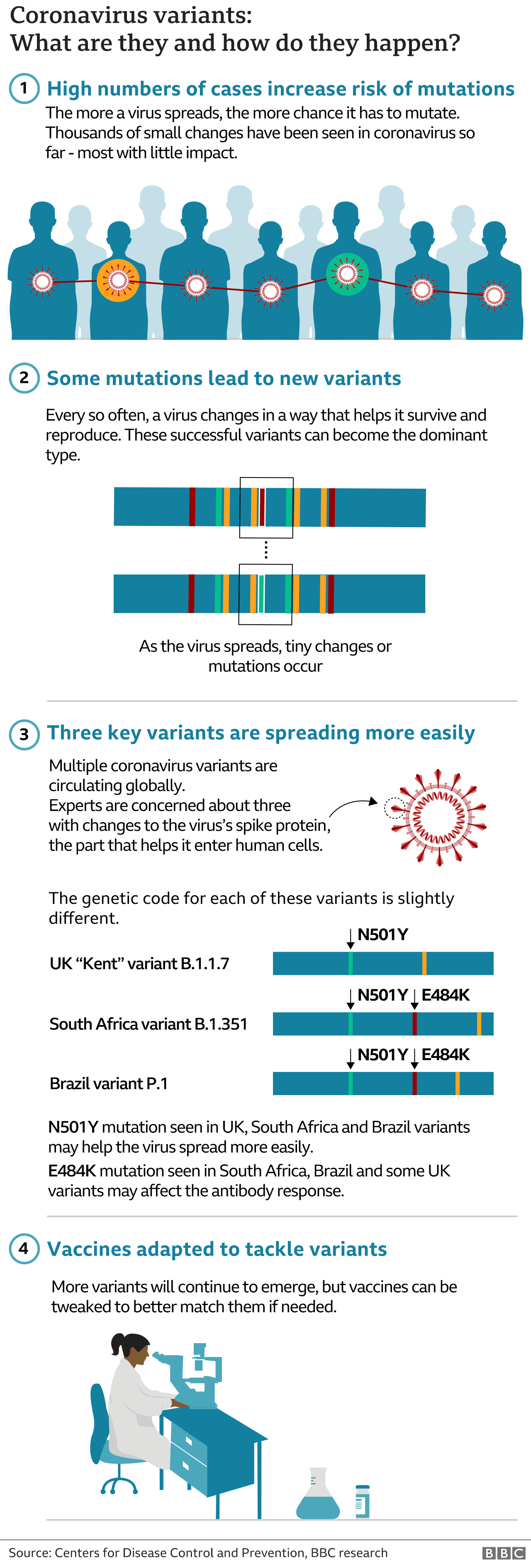
The UK, South Africa and Brazil variants could be much more contagious or easy to catch.
All three have undergone changes to their spike protein – the part of the virus which attaches to human cells.
As a result, they seem to be better at infecting cells and spreading.
The Brazil variant emerged in July and has this E484K mutation too.
The Brazil variant emerged in July and has this E484K mutation too.
Will vaccines still work?
Current vaccines were designed around earlier versions of coronavirus, but scientists believe they should still work, although perhaps not quite as well.
A recent study suggests the Brazilian variant may be resisting antibodies in people who should have some immunity because they have caught and recovered from an earlier version of coronavirus.
Variants could emerge in the future that are different again.
Even in the worst case scenario, vaccines could be redesigned and tweaked to be a better match – in a matter of weeks or months, if necessary, say experts.
As with flu, where a new shot is given each year to account for any changes in circulating flu viruses, something similar could happen for coronavirus.
What is being done about it?
More variants will emerge.
Scientists around the world are on the look-out and any important ones will be closely studied and monitored.
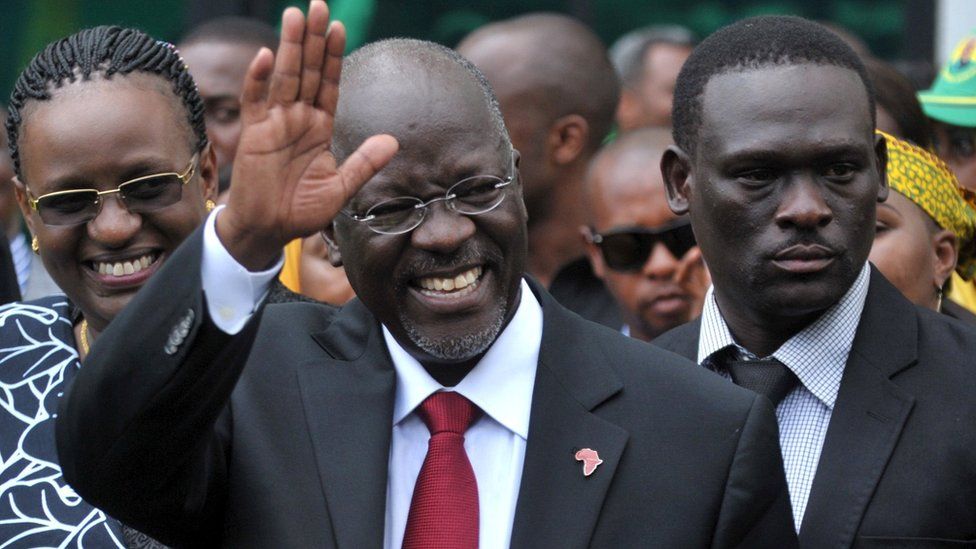
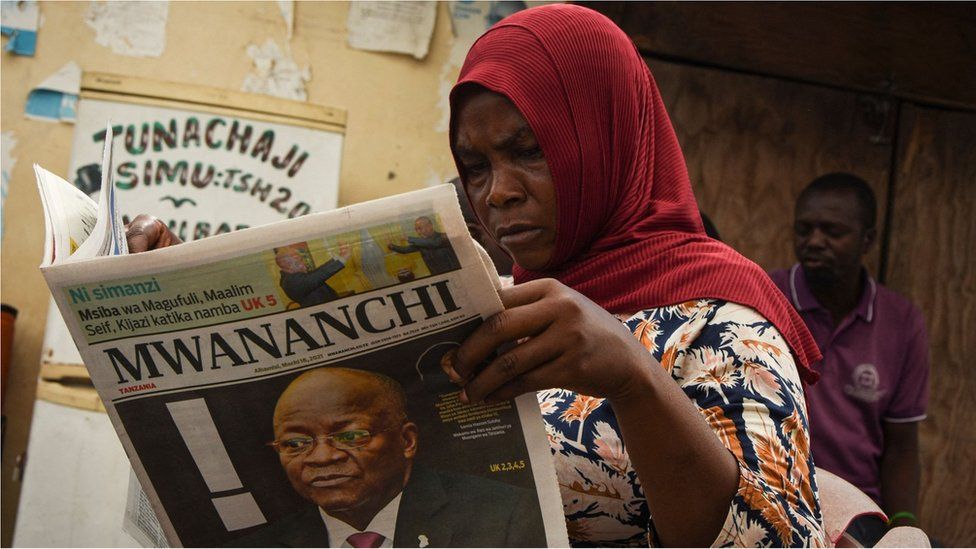
BBC- Tanzania’s President John Magufuli has died aged 61, the country’s vice-president has announced.
He died on Wednesday from heart complications at a hospital in Dar es Salaam, Samia Suluhu Hassan said in an address on state television.
Magufuli had not been seen in public for more than two weeks, and rumours had been circulating about his health.
Opposition politicians said last week that he had contracted Covid-19, but this has not been confirmed.
Magufuli was one of Africa’s most prominent coronavirus sceptics, and called for prayers and herbal-infused steam therapy to counter the virus.
“It is with deep regret that I inform you that today… we lost our brave leader, the president of the Republic of Tanzania, John Pombe Magufuli,” Vice-President Hassan said in the announcement.
She said there would be 14 days of national mourning and flags would fly at half mast.
According to Tanzania’s constitution, Ms Hassan will be sworn in as the new president within 24 hours and should serve the remainder of Magufuli’s five-year term which he began last year.
Magufuli was last seen in public on 27 February, but Prime Minister Kassim Majaliwa insisted last week that the president was “healthy and working hard”.
He blamed the rumours of the president’s ill-health on “hateful” Tanzanians living abroad.
But opposition leader Tundu Lissu told the BBC that his sources had told him Magufuli was being treated in hospital for coronavirus in Kenya.
John Magufuli at a glance
Magufuli was first elected president in 2015
Born in Chato, north-west Tanzania, in 1959
Studied chemistry and maths at the University of Dar es Salaam
Worked as a chemistry and maths teacher
First elected as an MP in 1995
Became a cabinet minister in 2000
First elected president in 2015
When Covid-19 arrived in Tanzania, Magufuli called on people to go to churches and mosques to pray. “Coronavirus, which is a devil, cannot survive in the body of Christ… It will burn instantly,” he said.
He declared Tanzania “Covid-19 free” last June, saying the virus had been eradicated by three days of national prayer.
He also mocked the efficacy of masks, expressed doubts about testing, and teased neighbouring countries which imposed health measures to curb the virus.
“Countries in Africa will be coming here to buy food in the years to come… they will be suffering because of shutting down their economy,” he said, according to the Associated Press.
Tanzania has not published details of its coronavirus cases since May, and the government has refused to purchase vaccines.
“To spread rumours that he’s sick smacks of hate,” Mr Majaliwa said at the time.
A legacy set for debate
Analysis by Dickens Olewe, BBC News
John Magufuli cultivated an image of a rambunctious action man, a departure from his predecessors’ demure and stately styles.
His interventionist leadership won him fans beyond Tanzania, especially in the East African region where he once inspired the #WhatWouldMagufuliDo Twitter hashtag that was shared by supporters of his no-nonsense approach to fighting corruption.
There will be vigorous debate about his legacy and whether his successor should stay the course or change direction.
But this discussion cannot be divorced from the current trend on the continent, where support for democracy remains strong but most people are increasingly disillusioned by the failure to deliver the promised dividends.
So while a significant number of Africans would prefer an action-driven leader like Magufuli, they equally want leaders who govern honestly and a government that respects them and does not hide information about their president’s health.
Magufuli’s death has been attributed to a long-standing heart condition, but many will still suspect that he succumbed to Covid-19.
It is an irony that the pandemic he so strenuously denied has outlasted him, turning his once-heralded presidency into a cautionary tale for the region and the continent.
Magufuli was declared president on his 56th birthday in October 2015. He was elected for a second term following a disputed poll last year.
He was hailed for his anti-corruption stance during his time in office, but he was also accused of cracking down on dissent and curtailing certain freedoms.
His critics agree that Magufuli contributed to Tanzania’s development. He invested in large infrastructure projects such as a standard-gauge railway to connect the country with its neighbours, major highways, and a bus system in the commercial hub of Dar es Salaam.
He also increased electricity production, reducing the need for power rationing.
But it is his approach to Covid-19 that many analysts say will define his legacy.
African leaders pay tribute
In Tanzania, people have reacted with grief and disbelief to the news of Magufuli’s death.
One, Joseph Petro, told the BBC he thought Magufuli was a “caring” leader, adding “he was helping people in one way or another”.
“I am really pained. I am personally pained,” he said.
image copyrightAFP
Another, Illuminata Abel, offered similar sentiments: “He was not my relative, but he was someone who listened to people’s problems, and he was down to earth.”
African leaders have also come out to pay tribute.
Kenya’s President Uhuru Kenyatta said: “I have lost a friend, colleague and visionary ally,” and declared a seven-day period of national mourning in Kenya.
Former Nigerian President Goodluck Jonathan called Magufuli a “partner in democracy” and a “patriot who loved his country”.
But Tanzanian opposition leader Tundu Lissu told the BBC that Magufuli’s “politics, policies and Covid denialism” had “driven the country towards disaster”.
Bloomberg analysed financial documents and other filings from May 2016 and January 2021 to calculate Mr Trump’s wealth before and after he became US president.
Mr Trump’s commercial real estate accounts for about three-quarters of his net worth. The office towers he owns or co-owns have seen big drops in valuations as more people work from home, a trend that could last in the long term.
Bloomberg, which provides financial news and data, estimates a 26% drop in the value of his main commercial property holdings.
He also owns, manages or licenses his name to about a dozen hotels and resorts, plus 19 golf courses.
Although golf has become popular during the pandemic as a socially distanced outdoor sport, Mr Trump’s two courses in Scotland have consistently lost money, filings show.
After the Capitol Hill siege in January, the Professional Golfers’ Association (PGA) of America ended an agreement to host its 2022 championship tournament at Mr Trump’s New Jersey golf course, saying it would hurt the group’s brand.
media captionTrump describes allegations he avoided taxes as “fake news”
Deutsche Bank, the only bank willing to lend to him after his bankruptcies in the 1990s, also said after the riots that it would not do business with him again.
Mr Trump also owns a fleet of planes that includes a Boeing 757. These planes are decades old and have been marked down in value over the years, according to financial disclosures seen by Bloomberg.
Seven planes were valued at around $59m in 2015 and five were valued at about $6.5m in 2020. The value of Mr Trump’s aircraft has dropped over the years, in part because he has sold some of his fleet.
Criminal investigation
During his presidency, Mr Trump’s finances were regularly in the spotlight and he has been very secretive about how much tax he pays.
Last month the Supreme Court ordered Mr Trump to hand over his tax returns and other financial records to prosecutors in New York.
For months they have been trying to obtain eight years’ worth of Mr Trump’s personal and corporate tax returns.
The investigation was originally started in 2018 to examine the Trump Organization’s role in hush-money payments made during the 2016 presidential campaign to two women who said they had had affairs with Mr Trump.
Book deal?
As a former president, Donald Trump can expect to sign some lucrative media deals to recover some of his lost wealth, such as a post-presidential memoir.
Barack and Michelle Obama reportedly got paid about $65m for their memoirs, while Bill Clinton earned a $15m advance for his 2004 book.
Bloomberg says the most obvious way Mr Trump can profit post-presidency is with a news channel or social media platform that would appeal to his 74m voters in the 2020 election.


 *****@
 *****@
 *****@

 *****@
 *****@
 *****@

 *****@
 *****@

 *****@
 *****@