Tag Archives: caribbean

Premier Brantley: Film production on Nevis already spurring economic activity

CHARLESTOWN, Nevis — The production of the ‘One Year Off’ movie Nevis is already spurring economic activity on the island, according to Hon. Mark Brantley, Premier of Nevis and Minister of Finance and Economic Planning in the Nevis Island Administration (NIA).

“I am pleased at the employment and economic multiplier being experienced from my government’s decision to encourage the start of a film industry here on Nevis,” said Hon. Brantley. “Thus far, some 30 Nevisians have been hired full time. An additional 11 have been hired as actors with speaking roles and 168 hired as supporting artistes.”

Brantley pointed out there is financial spinoff from having the cast and crew for the film staying on Nevis.

“We have seen local caterers, villa and hotel rentals, taxi operators, car rentals fully engaged,” said Brantley. “Forty-six non-nationals are also now resident on the island to support the filming of this movie.”

“This is an excellent start to our promised diversification of the island’s economy,” he said. “Nevis continues to be a safe and secure environment for investment and we welcome other film producers to consider our COVID-safe environment for their next film.”

MSR Media’s Philippe Martinez, the film’s producer, says the leading cast is already on the island. Locations around the island have been chosen, and filming is set to begin February 25.

MSR Media and the NIA recently signed off on a two-film production deal that will see the UK film company shooting two films on Nevis in 2021.

The post Premier Brantley: Film production on Nevis already spurring economic activity appeared first on The St Kitts Nevis Observer.

Caribbean American Congresswoman Helping Overhaul US Immigration Policy

Caribbean American Congresswoman Yvette Clarke on Thursday joined California Congresswoman Linda T. Sánchez and New Jersey Senator Bob Menendez in introducing the bicameral United States Citizenship Act of 2021 that seeks to overhaul America’s immigration system.

The Act is in keeping with US President Joe Biden’s “bold, inclusive and humane” plan for the future of the United States immigration system, opening up a pathway to citizenship for millions of Caribbean and other immigrants.

“I am the daughter of Jamaican immigrants, and I am uniquely familiar with the need for comprehensive immigration reform,” said Clarke, who represents the predominantly Caribbean 9th Congressional District in Brooklyn, New York.

“As chair of the Congressional Black Caucus Immigration Task Force, I have seen the glaring inequities, blatant racism, vicious xenophobia, and civil rights violations immigrants face, particularly in immigrant communities of African descent

“Our immigration system is broken, and I will not relent until our immigration system reflects a modern and equitable approach to this issue. Reversing the policies of the last four years is not enough. We must reimagine the immigration system in a manner that is humane, just, and fair.

“This bill is the Biden-Harris administration’s vision to fix our immigration system once and for all. The time has come for the values of our nation to be reflected in our immigration policies. I am proud to co-lead this paramount legislation,” Clarke continued.

The legislation would provide millions of hardworking, undocumented Caribbean and other immigrants a pathway to earned citizenship, including Dreamers, Temporary Protective Status (TPS) recipients and “essential workers who have made enormous sacrifices during the pandemic.”

The measure would also prioritize family reunification, keeping families together; and bolster the country’s long-term economic growth.

Additionally, the legislation would also equip the country to “responsibly and effectively manage the border with smart and effective investments”; address root causes of migration that force people to leave Central America; and restore the United States’ commitment to human rights.

Clarke said the US Citizenship Act of 2021 establishes “a moral and economic imperative and a vision of immigration reform that is expansive and inclusive.”

She said it creates an “earned roadmap” to citizenship for all 11 million undocumented Caribbean and other immigrants, providing Dreamers, TPS holders and some farmworkers with “an expedited three-year path to citizenship”, and giving all other undocumented immigrants who pass background checks and pay taxes with “an eight-year path to citizenship without fear of deportation.”

The congresswoman said the Act reforms family-based immigration system to keep families together by recapturing visas from previous years to clear backlogs, including spouses and children of green card holders as immediate family members, and increasing per-country caps for family-based immigration.

The Act also eliminates discrimination facing LGBTQ+ families, provides protections for orphans, widows and children, and allows immigrants with approved family-sponsorship petitions to join family in the US on a temporary basis while they wait for green cards to become available, Clarke said.

Additionally, she said the Act, among other things, “grows our economy by making changes to the employment-based immigration system, eliminating per-country caps, making it easier for STEM advanced degree holders from US universities to stay, improving access to green cards for workers in lower-wage industries, and giving dependents of H-1B holders work authorization, and preventing children of H-1B holders from aging out of the system.”

CMC

The post Caribbean American Congresswoman Helping Overhaul US Immigration Policy appeared first on The St Kitts Nevis Observer.

Massive Oil Spill Ruins Israel, Lebanon Beaches

NPR- A suspected oil tanker leak off the coast of Israel last week has led to Israel’s biggest maritime ecological disaster in many years, with authorities closing the country’s beaches and beginning a massive cleanup effort.

Chunks of sticky, black tar began washing up late last week. On Sunday, Israel’s Environmental Protection Ministry warned people to avoid going to beaches from the country’s northern border with Lebanon all the way to the south near the Gaza Strip. Tar exposure can make people sick and irritate the skin.

More than 4,000 volunteers from the Israeli nonprofit group EcoOcean have helped remove tar from beaches so far, according to the ministry.

The Israel Nature and Parks Authority warned that the “consequences will be seen for years to come.”

Israeli environmental minister Gila Gamliel said Saturday that there are no more oil slicks visible off Israel’s coast, “which is an encouraging condition.” However the ministry warned that large waves are forecast this week. The waves could carry chunks of sticky tar from beach to beach, complicating cleanup efforts.

Israeli and European authorities are investigating what happened. Israeli officials believe a ship spilled tens or even hundreds of tons of oil in the Mediterranean, beyond the country’s territorial waters.

The spill likely happened about a week ago, when stormy weather affected the region. It’s unclear which ship or ships are responsible. Israeli authorities are working with European officials to review satellite images of ships that passed through the area.

The European Union monitors the location of oil slicks in the Mediterranean using information from a network of weather satellites. When ships release oil into the water, much of the oil pools at the surface and is carried great distances by currents. Scientists can use ocean current and weather data to reverse engineer the source of the tar that washed up along Israel’s coastline.

Gamliel said Saturday that the ministry had zeroed in on fewer than a dozen ships, and was attempting to narrow it down further in the coming days, according to the Israeli newspaper Haaretz.

A woman holds a dead sea turtle covered in tar from an oil spill in the Mediterranean Sea that affected wildlife and closed beaches in Israel.                   Ariel Schalit/AP

The tar pollution has already affected wildlife. Volunteers rushed to rescue sea birds, turtles and fish that were covered in oily residue or had ingested oil. Israel’s National Sea Turtle Rescue Center confirmed that it was treating multiple turtles covered in tar.

One species that has ecologists particularly worried is a reef-building snail called Dendropoma petraeum. As the Mediterranean Sea heats up due to global warming, the snail’s population on the Israeli coast has plummeted. That makes the species particularly vulnerable to other ecological disasters.

Daniel Estrin contributed reporting from Jerusalem.

The post Massive Oil Spill Ruins Israel, Lebanon Beaches appeared first on The St Kitts Nevis Observer.

Boeing 777s Grounded Worldwide After Engine Failure

Boeing 777s have been grounded around the world after the US aviation regulator announced an investigation into the United Airlines flight that suffered an engine failure on Saturday, showering debris over homes in Denver.

The aircraft’s manufacturer recommended the grounding of all 777s using the same Pratt and Whitney 4000 engines, which includes scores operating across the US, Japan and South Korea.

United had already announced that it would voluntarily and temporarily remove 24 of its planes from active service while investigations are carried out.

And following the incident, which saw the afflicted aircraft return to land safely at Denver International Airport, Japan’s transport ministry also directed Japan Airlines (JAL) and ANA Holdings to suspend the use of 777s with P&W4000 engines.

A Japanese transport ministry statement noted that on 4 December 2020, a JAL flight from Naha Airport in Japan to Tokyo International Airport returned due to a malfunction in the left engine. The Boeing 777 plane in that case was similar to the 26-year-old aircraft involved in the new United Airlines incident.

Passengers on Saturday’s flight described a large explosion shortly after take-off, and video from inside the plane showed the right engine engulfed in flames.

Later, police in Colorado released pictures that showed large pieces of plane debris on the ground outside a home and in a field, where witnesses said they were forced to run inside to take cover.

The National Transportation Safety Board (NTSB) has said that an initial examination of the plane suggests most of the damage was confined to the right engine.

But the Federal Aviation Administration said that after reviewing all available safety data, a probe should be opened into all similar aircraft. “The inspection interval should be stepped up for the hollow fan blades that are unique to this model of engine, used solely on Boeing 777 airplanes,” said the agency.

Boeing said 69 such planes were in service, and recommended airlines suspend their use until the FAA inspection is complete.

The post Boeing 777s Grounded Worldwide After Engine Failure appeared first on The St Kitts Nevis Observer.

US Coast Guard Rescues 5 Asylum Seeking Cubans on Makeshift Raft

The U.S. Coast Guard rescued five men in a makeshift raft off the coast of Lake Worth.

The men said they had been at sea for 16 days after leaving Cuba, they left with hopes of seeking asylum in South Florida.

The Coast Guard picked them up about two miles off the Lake Worth Inlet.

The rescue came less than two weeks after the Coast Guard rescued three other Cuban migrants who were stranded on a deserted island in the Bahamas on their quest to reach the U.S.

The post US Coast Guard Rescues 5 Asylum Seeking Cubans on Makeshift Raft appeared first on The St Kitts Nevis Observer.

‘Go Deep’ by Antiguan Writer Rilzy Adams Wins Romantic Fiction Prize

What started out as a joke with a friend has turned into an award-winning novel for Antiguan writer Rilys Adams.

Adams – who uses the pen name ‘Rilzy Adams’ – was one of 12 talented writers from across the world whose excellence in romantic fiction was recognised as among the best of 2020 by a panel of industry experts.

Adam’s earned the ‘Ripped Bodice Award’ for her book ‘Go Deep’ which has sold thousands of copies on Amazon.

Each honoree is now US$1,000 richer and has also received US$100 to donate to a charity of their choice.

The 30-year-old explained how ‘Go Deep’ – a book about a writer who enlists sexual help from her best friend to revive her inspiration – came into being seven months ago.

“My friend was like, I want a ‘friend to lovers’ book and I said, let me write you one and she thought I was joking but I did for her birthday.

“It wasn’t even the book I was meant to work on. I did it as a joke for my friend…but then it just took on a life of its own,” she explained.

Some months later, she was surprised to receive an email indicating that she had been selected as one of the winners of the Ripped Bodice Award.

Adams grew up in the village of Liberta and began writing from a young age for fun.

“I had a cousin who was really good at art and used to want to do comic books, but I cannot draw at all and my mom said to me that I don’t need to have to draw to tell a story.

“And so, the stories that I wanted to tell as a comic, I started writing them. By the time I got to State College I was writing romance novels,” Adams shared.

“I would put them in folders and circulate them; one actually became the second in a six-book series,” she explained.

Then in 2017 she published her first contemporary romance novel, ‘The Gift’.

Adams has now self-published 17 novels of the same genre; 12 set in the United States and five set in Antigua.

Of all her books, Adams revealed that ‘The Gift’ is the book that has sold and been borrowed the most, followed by ‘Will You Be Mine’ and then ‘Go Deep’. But ‘Go Deep’ is significant, she said, because it has only been out for seven months.

“Writing comes as naturally as writing can come,” Adams said as she revealed that it typically takes her about two months to complete a book.

Adams is presently working on a sequel to ‘Go Deep’ called ‘Before We Fall’ with the hope of releasing it in April.

The post ‘Go Deep’ by Antiguan Writer Rilzy Adams Wins Romantic Fiction Prize appeared first on The St Kitts Nevis Observer.

Italy’s Congo Amassador Killed in UN Convoy Attack

Italy’s ambassador to the Democratic Republic of Congo has been killed in an attack in the east of the country, its foreign ministry has said.

Luca Attanasio died in hospital on Monday after the United Nations convoy he was travelling in came under fire near Goma, a statement said.

The convoy reportedly belonged to the UN’s World Food Programme (WFP).

An Italian military police officer travelling with the envoy and a third person were also killed, reports say.

“It is with deep sadness that the foreign ministry confirms the death, today in Goma, of the Italian ambassador,” the ministry’s statement said.

The attack is believed to have been an attempted kidnapping, according to officials at the nearby Virunga National Park.

Armed groups are known to operate in an around the park, which borders both Rwanda and Uganda.

Militias also clash regularly in the east of t=

The post Italy’s Congo Amassador Killed in UN Convoy Attack appeared first on The St Kitts Nevis Observer.

Associated Press World View- Virus & Big Chill

Russia speeds up vaccination drive; In Israel and beyond in Mideast, vaccines bring political power; With heavy hearts, Italians mark year of outbreak, pay tribute to dead

Russia’s rollout of its coronavirus vaccine is beginning to pick up speed in some of its more remote regions, but experts say the campaign is still moving slowly.

That’s why elderly residents of Ikhala, a snow-covered village near the border with Finland, from where Daria Litvinova reports, were relieved to hear they were finally going to get their shots.

The region was hit hard by the virus in December. Experts blame the slow rollout on limited supplies of the vaccine, logistical difficulties in distribution and continued hesitance among some Russians.

The country doesn’t regularly release data on its vaccination rates, but the number who have gotten at least the first shot appears to be between 2 million and 3.2 million

Israel Vaccines: Moving on from oil and arms? Vaccines are emerging as the newest currency of choice in the Middle East. The reopening of Israel’s economy, an Israeli government prisoner swap with Syria and the arrival of vaccines in Gaza all illustrate how those with access to vaccines have political power in the turbulent region. Israeli Prime Minister Benjamin Netanyahu has been at the forefront of this trend, using his vaccination campaign to win over voters and punish those who refuse to get inoculated, Josef Federman reports from Jerusalem.

The disparities between Israel’s successful vaccination push with its own population and the Palestinians have drawn criticism from U.N. officials and rights groups. They contend that Israel, as the occupying power, is responsible for vaccinating the Palestinians, while Israel has argued that under interim peace agreements it is not responsible. Israel’s vaccination campaign has included its own Arab population.

Britain Vaccinations: The government has said it’s aiming to give every adult in the country a first dose of vaccine by July 31, as it prepared to set out a “cautious” plan to ease the U.K.’s lockdown. In addition, the goal is for everyone over 50 or with an underlying health condition to get a shot by April 15, rather than the previous target of May 1. More than 17.2 million people in Britain have been given the first of two doses of vaccine. Britain has had more than 120,000 coronavirus deaths, the highest toll in Europe. Jill Lawless reports from London.

Italy One Year Later: ”It was like a war film. We were completely alone,” the mayor of  Vo, a wine-making town in the Veneto region, recalls. It was where the first known fatality from a locally transmitted case of the virus in the West occurred on Feb. 21, 2020, setting off alarm bells far and wide. In the days and weeks that followed, densely populated Lombardy would become the epicenter of Italy’s outbreak and, by the end of March, countries the world over would be under lockdowns to slow the spread of the virus that has now taken 2.4 million lives.

But Vo, from where Colleen Barry reports, as one of the first towns in the West to be isolated, has a unique story, providing some of the first scientific insights into the deadly virus. A year on, Italy has so far seen more than 95,000 known virus dead, the second-highest toll in Europe after Britain.

On Saturday, Pope Francis and Italy’s president marked a newly established annual day to honor doctors, nurses and other health care workers, exactly one year after the nation’s first known native case of COVID-19 emerged in Codogno in Lombardy.

With wreath-laying ceremonies, tree plantings and church services, Italians also marked one year since their country experienced its first known virus death on Sunday. Towns in Italy’s north were the first to be hard-hit by the pandemic and put under lockdown, and residents paid tribute to the dead.

Iraq’s New Surge: Doctors are confounded by widespread shirking of precautions even as cases surge dramatically in Iraq. The country is now under a new, government-imposed curfew. A month ago, new infections in Iraq were as low as 600 a day but have now surged, reaching nearly 4,000 and approaching the peak from last September. Many defy hospital rules requiring masks, putting their faith, they say, in God instead. And for weeks, markets, malls and stores have been packed with people. A sociologist says that after years of facing war, violence and instability, COVID-19 “may not stack up as a major problem” in the minds of many Iraqis. Abdulrahman Zeyad reports from Baghdad.

Asia-Pacific Vaccines: Australia has started its COVID-19 inoculation program days after its neighbor New Zealand, with both governments deciding their pandemic experiences did not require the fast tracking of vaccine rollouts that occurred in many parts of the world. Other countries in the Asia-Pacific region that have dealt relatively well with the pandemic either only recently started vaccinating or are about to, including Thailand, Taiwan, Vietnam, Cambodia and Singapore.

Alternate text

AP PHOTO/LM OTERO

Power failure: How a winter storm pushed Texas into an acute crisis; Hospitals in US South confront water shortages in aftermath

Two days before the winter storm began, Houston’s chief elected official warned her constituents to prepare as they would for a major hurricane.

Many took heed: Texans who could stocked up on food and water, while nonprofits and government agencies set out to help those who couldn’t.

But few foresaw the fiasco that was to come and they could not be prepared, Nomaan Merchant reports from Houston.

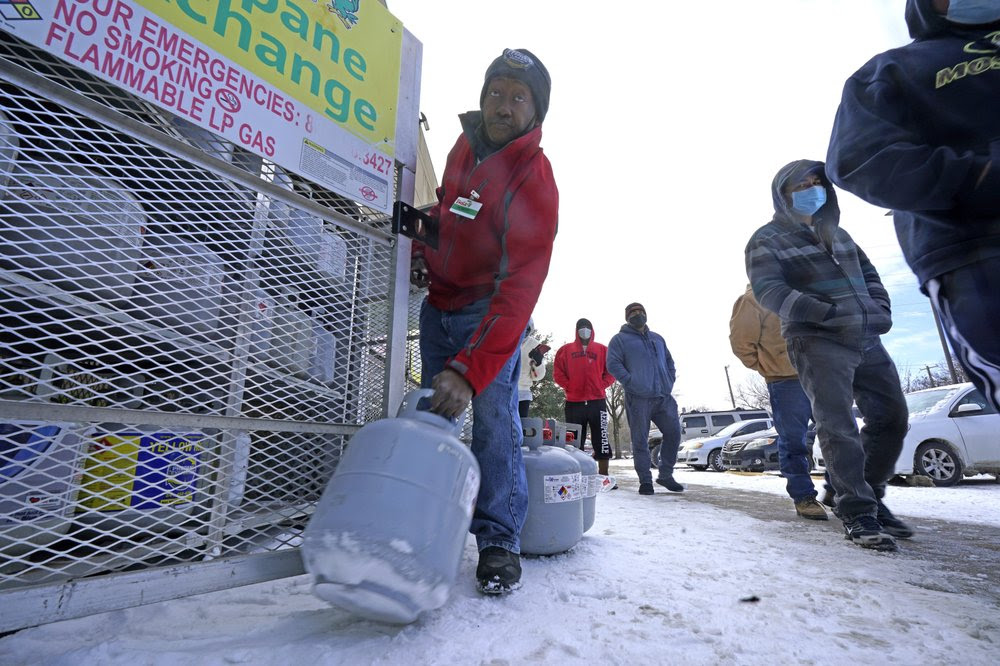
As temperatures plunged and snow and ice whipped the state, much of Texas’ power grid collapsed, followed by its water systems.

Tens of millions huddled in frigid homes that slowly grew colder, or fled for safety.

Images of desperate Texans circulated worldwide. To some, they evoked a less wealthy or self-regarding place. To others, they laid bare problems that have long festered.

More than 35 people in Texas have been confirmed dead. That number is expected to rise as roads cleared and relatives and first responders could check on missing loved ones.

How could this happen in a state that is the nation’s biggest energy producer and home to several of the world’s biggest energy companies?

The disaster can be traced to mistakes by Texas’ leadership and faults created by decades of opposition to more regulations and preparation.

Basically, the state is an island in the U.S. electrical system. There is one large grid covering the Eastern half of the country, another for the West, with Texas wedged between them.

Hospitals in U.S. South: They are grappling with water shortages as the region carries on with recovery efforts in the wake of the devastating winter storm. At the height of the storm, hospitals were left scrambling to care for patients amid record cold, snow and ice. The storm was especially damaging in parts of the country more accustomed to going through winter with light jackets and short sleeves. The icy blast ruptured water mains, knocked out power to millions of utility customers and contributed to at least 76 deaths. Juan Lozano, Jonathan Matisse and Adrian Sainz report.

EXPLAINER: Why some Texans are getting sky-high energy bills. The surge in pricing is hitting people who have chosen to pay wholesale prices for their power, which is typically cheaper than paying fixed rates during good weather, but can spike when there’s high demand for electricity. Many of those who have reported receiving huge bills are customers of electricity provider Griddy, which only operates in Texas.

Alternate text

AP PHOTO/ALEX BRANDON

The Biden Presidency

Joe Biden is a month into his presidency and one pattern is clear. He doesn’t want to talk about the man he’s called “the former guy,” Donald Trump.

But much of what Biden is doing is about breaking from Trump’s legacy on matters of policy, symbolism and style, report Jonathan Lemire and Calvin Woodward.

That began on his first day, when Biden appeared at the Resolute Desk in the Oval Office wearing a mask.

The Democrat framed his first month as a time to start to “heal the soul” of the nation and restore the White House as a symbol of stability and credibility.

Biden has set out to demonstrate that the days of a seat-of-the-pants presidency are over.

He wants to show that the inflationary cycle of outrage can be contained. That things can get done by the book. That the new guy can erase the legacy of the “former guy.”

From the Earth’s climate and the Iran nuclear deal to what’s not on his desk (Trump’s button to summon a Diet Coke), Biden has been purging Trumpism however he can in an opening stretch that is wholly unlike the turmoil and trouble of his predecessor’s first month.

Other Top Stories

Protesters gathered in Myanmar’s biggest city despite the ruling junta’s thinly veiled threat to use lethal force if people answered a call for a general strike opposing the military takeover. Hundreds had gathered at a major intersection in Yangon after a group advocating civil disobedience called for people to unite for a “Spring Revolution.” Roads were blocked in front of landmarks like the Myanmar Central Bank and U.S. Embassy, and trucks overnight blared warnings against public gatherings. A junta statement carried on state TV said the protesters were carrying people “to a confrontation path where they will suffer the loss of life.”

U.S. federal aviation regulators ordered United Airlines to step up inspections of all Boeing 777s equipped with the type of engine that suffered a catastrophic failure over Denver Saturday. Pieces of the casing of the engine rained down on suburban neighborhoods. United says it is temporarily removing those aircraft from service. Boeing has recommended aircraft with the engines be grounded pending a decision on inspections. The announcements came after United Airlines Flight 328 had to make an emergency landing at Denver International Airport after its right engine blew apart just after takeoff.

VIDEO: Plane drops debris during emergency landing.

The head of the United Nations’ nuclear watchdog says that Iran will begin offering its inspectors “less access” but will still allow the agency to monitor its atomic program. Rafael Grossi made the comments on arrival in Vienna late last night. He was careful to say that there still would be the same number of inspectors, but there would be “things we lose.” He did not offer many specifics, but Iranian Foreign Minister Mohammad Javad Zarif said that would include blocking the International Atomic Energy Agency from accessing footage on its cameras at nuclear sites.

New Zealand lowered its flags and made special note of those who couldn’t travel as it marked the 10th anniversary of the Christchurch earthquake that killed 185 people. Hundreds of people attended an outdoor service in Christchurch, which continues to rebuild from the magnitude 6.3 quake that destroyed much of the downtown. A separate service was also held in the northern Japanese city of Toyama, home to 12 students who died in the quake. Speaking at the Christchurch ceremony, New Zealand Prime Minister Jacinda Ardern said it was important to remember that 87 of the victims were foreigners and many of their families couldn’t be there because of coronavirus travel restrictions.

The post Associated Press World View- Virus & Big Chill appeared first on The St Kitts Nevis Observer.

US Deaths Top 500,000, UK Study-Vaccines ‘Spectacular’, World Stats


The U.S. death toll from the coronavirus topped 500,000 on Sunday, according to an NBC News tally — a milestone that underscores the grave threat the virus still poses even as more people are vaccinated.

The coronavirus has killed more than 2,462,000 people worldwide, according to data compiled by Johns Hopkins University. More than a fifth of all deaths worldwide have occurred in the the U.S., which has less than 5 percent of the global population.

NBC News’ tally showed that about 500,700 people had died of Covid-19 as of midnight Sunday ET. The number rivals the populations of Atlanta and Sacramento, California.

More than 28,206,600 cases have been confirmed in the U.S., according to the NBC News tally. The average number of daily new cases has declined in recent days, however. The number fell below 100,000 on Feb. 12 for the first time in months.

Image: Funeral for Humberto Rosales
Family and friends attend the funeral of Humberto Rosales, who died from Covid-19 complications, at Memorial Pines Cemetery in Santa Teresa, N.M., on Dec. 3.Paul Ratje / AFP via Getty Images

Public health experts and top government officials have said precautions must remain in place to slow the spread of the virus.

“We are still at about 100,000 cases a day. We are still at around 1,500 to 3,500 deaths per day. The cases are more 2½-fold times what we saw over the summer,” Dr. Rochelle Walensky, the director of the Centers for Disease Control and Prevention, said Sunday on NBC News’ “Meet the Press.”


The post US Deaths Top 500,000, UK Study-Vaccines ‘Spectacular’, World Stats appeared first on The St Kitts Nevis Observer.

Stung: Argentine Health Minister Resigns Over Vaccine Scandal

BUENOS AIRES, Argentina (AP) — President Alberto Fernández removed Argentina’s health minister Friday after a well-known local journalist said he had been given a coronavirus vaccination preferentially after requesting one from the minister.

The president “instructed his chief of staff to request the resignation of health minister” Ginés González García, who is in charge of the government’s COVID-19 strategy, said a government official, who was not authorized to release the information and spoke to The Associated Press on condition of anonymity.

The firing comes on the heels of reports in recent days that mayors, legislators, activists and people close to political power received vaccine shots despite not being in the priority group of doctors, health personnel and the elderly authorized to receive them.

In a Twitter post, González Garcia said he acceded to the president’s request to step down, but insisted he was forced out over a “misunderstanding.” He said that the “vaccinated people belong to the groups included within the target population of the current campaign.”

Carla Vizzotti, the No. 2 official at the ministry under González García, will take over as minister, the state news agency Télam said.

The stir in Argentina follows an uproar in Peru last week after it was confirmed that more than 400 political officials and other prominent people, including then President Martín Vizcarra, secretly received doses of the vaccine produced by the Chinese pharmaceutical company Sinopharm before health professionals.

González Garcia’s removal came after journalist Horacio Verbitsky, whose stories and columns on a website and on the radio are seen as pro-government, said he called the minister to request a vaccination and González García summoned him to the Health Ministry where he received a Sputnik V vaccine shot Thursday.

“I decided to get vaccinated. I started to find out where to do it. I called my old friend Ginés González García, whom I have known long before he was a minister,” Verbitsky told a local radio station. “I went to the ministry and the team of vaccinators was there.”

Fernández’s government has been harshly criticized for Argentina’s slow vaccination operation. So far, the South American country has received about 1.5 million doses, mostly Sputnik V but also AstraZeneca, insufficient to immunize a population of 40 million.

Argentina has had 2 million people infected by the coronavirus and 50,857 deaths from COVID-19.

The post Stung: Argentine Health Minister Resigns Over Vaccine Scandal appeared first on The St Kitts Nevis Observer.