Tag Archives: caribbean

After 30m COVID-19 inoculations, WHO points out ‘glaring inequalities’

GENEVA – More than 30 million inoculations for COVID-19 have already been administered in the 47 mostly high-income countries according to the World Health Organization (WHO). But, the global vaccine rollout has exposed glaring inequalities in access to this life-saving tool.

More than 2,800 scientists from 130 countries gathered on Jan. 15 in a virtual forum hosted by the WHO, to identify knowledge gaps and set research priorities for vaccines against COVID-19.

Experts discussed the safety and efficacy of existing vaccines and new candidates, ways to optimize limited supply, and the need for additional safety studies.

“The development and approval of several safe and effective vaccines less than a year after this virus was isolated and sequenced is an astounding scientific accomplishment,” Tedros Adhanom Ghebreyesus, WHO Director-General, said in his opening remarks. “The approval of the first few vaccines does not mean the job is done. Far from it. More vaccines are in the pipeline, which must be evaluated to ensure we have enough doses to vaccinate everyone.”

They agreed on the need for critical research on administering vaccines in different target populations, as well as on vaccination delivery strategies and schedules. This includes trials, modelling and observational studies, all of which would help to inform policy.

They discussed the impact of emerging SARS-CoV-2 variants on the efficacy of vaccines, the impact of vaccines on the transmission of infection, and the need to develop the next generation of vaccine platforms.

“The world needs multiple vaccines that work in different populations to meet global demand and end the covid-19 outbreak. Ideally, those will be single-dose vaccines that do not require a cold chain, could be delivered without a needle and syringe and are amenable to large-scale manufacture,” Mike Levine, Director of the Centre for Vaccine Development at the University of Maryland said.

The meeting concluded with an agreement to establish a WHO-hosted platform for global sharing and coordination of emerging vaccine research information on efficacy and safety. The forum would enable scientists to share and discuss unpublished and published data and research protocols to further our collective understanding of SARS-CoV-2 vaccines.

“The WHO will regularly convene experts from around the world, promote collaborative research, provide standard protocols and develop a platform for sharing the latest knowledge in the field,” Soumya Swaminathan, WHO Chief Scientist said.

The post After 30m COVID-19 inoculations, WHO points out ‘glaring inequalities’ appeared first on The St Kitts Nevis Observer.

Jamaican Sculptor: Atlanta’s Martin Luther King Statue “A Dream Come True”

Ahead of Martin Luther King Jr Day 2021, the City of Atlanta has unveiled the new statue of the civil rights activist, created by Jamaican-born artist Basil Watson.

The 12-foot-tall bronze sculpture, titled ‘Hope Moving Forward’, was unveiled on January 14 during a small ceremony attended by Atlanta Mayor Keisha Lance Bottoms, and other city officials.

The statue stands at the intersection of Northside Drive and Martin Luther King, Jr. Drive across from Mercedes-Benz Stadium.

Basil Watson, the renowned Jamaican sculptor who created the statue, said it was a “dream come true” when he was chosen by the City of Atlanta to create a larger-than-life statue.

“You start your career dreaming of possibly doing something significant that impacts the world but you never really think about what it can be or if it can really happen. This is like a dream come true because it not only affects my world. I think this will have an impact on the world in general,” Watson shared.

He was chosen from a pool of 80 talented artists for the project. The statue took two years to complete and features Dr King releasing a dove. Watson said the work is a representation of his concept of MLK.

“It was an evolution in terms of my concept of what Martin Luther King represents and the key message that he wanted to present to the world,” Watson said.

While many Jamaican-Americans in Georgia are being introduced to Watson’s work for the first time, those living on the island know his statues well. He is the hands behind several major statues, including monuments of sprinters Usain Bolt, Shelly-Ann Fraser-Pryce, Merlene Ottey, Herb McKenley, Asafa Powell and Veronica Campbell-Brown, all at the National Stadium.

Last year, his monument of Louise “Miss Lou” Bennett-Coverley was unveiled in Gordon Town, St Andrew. Another statue of Usain Bolt, to be erected his hometown of Falmouth, Trelawny, later this year, was also done by Watson.

A long-time resident of Georgia, Watson plans to return to Jamaica where he will open an art academy to assist young Jamaican artists.

Watson was awarded the Order of Distinction (Commander Class) in 2016 by the Jamaican government for his contributions to Jamaican art and culture.

The post Jamaican Sculptor: Atlanta’s Martin Luther King Statue “A Dream Come True” appeared first on The St Kitts Nevis Observer.

When cruises begin again, after an absence of almost a decade, Royal Caribbean Cruises has put Trinidad and Tobago back on its itinerary.

Royal Caribbean’s Grandeur of the Seas will return to the ports of Port of Spain and Scarborough as part of the Southern Caribbean itinerary for the 2021/2022 cruise season.

The world’s second-largest cruise firm’s decision to add this country’s ports to its itinerary follows discussions between the Minister of Tourism, Culture and the Arts Senator Randall Mitchell; Charles Carvalho, shipping agent; and principals of Royal Caribbean held at the Florida Caribbean Cruise Association’s (FCCA) Conference and Trade Show in November 2018.

“We’re excited our destination is once again on the itinerary of Royal Caribbean International. These itineraries are planned years in advance. Both our islands are beautiful, warm and welcoming with a few undiscovered gems along the way. Now, passengers using Royal Caribbean International will experience them once again, and we will prepare to heavily incorporate our distinct and rich culture in our offerings to distinguish our destination from our Caribbean neighbours,” said Minister Mitchell.

“This development is certainly an encouraging one, and while it remains conditional on the re-opening of our borders and the decision to recommence receiving cruise ships, it shows continued interest in destinations Trinidad and Tobago,” he added.

Globally, cruises have been halted on account of the COVID-19 pandemic and the cruise industry is collectively hopeful and preparing for the restart of cruising, and for the Caribbean-wide re-opening of borders with the concomitant health protocols.

In preparation for the border re-opening, Trinidad and Tobago’s Ministry of Tourism, Culture and the Arts is developing health protocols for the tourism industry, which will be in place when visitors return to the twin-island republic.

Over 91,000 cruise passengers came to Trinidad and Tobago in 2019. That figure reflects an increase over the previous years, except for 2018 during which there was the closure of several regional ports because of the hurricane season.

Prior to COVID-19, the cruise industry was the fastest-growing segment of the worldwide leisure travel market and demand had increased by close to 21 percent in the past five years. According to industry data, cruise passengers are willing to spend more on activities such as beach tours, off-road/scenic tours, or in duty-free shopping on many island nations.

The post appeared first on The St Kitts Nevis Observer.

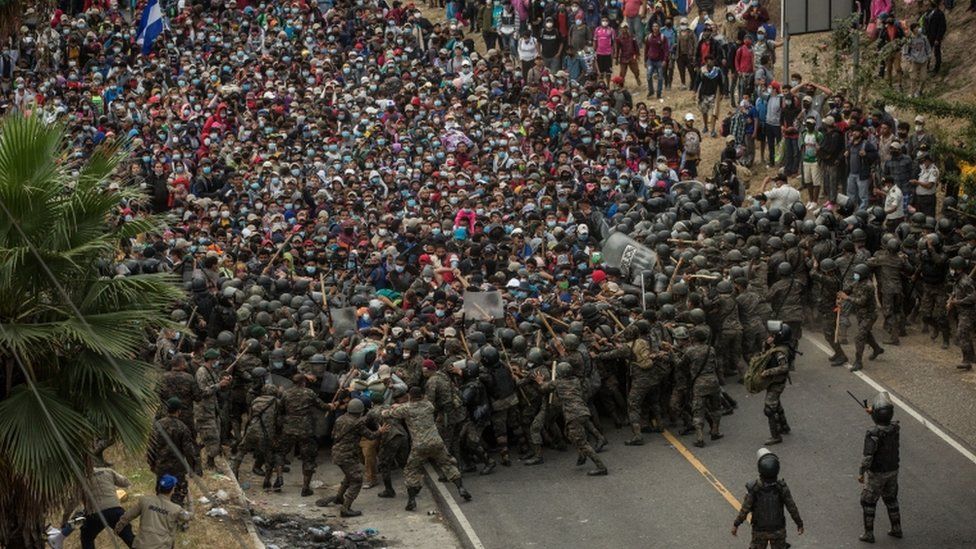
Huge US Bound Migrant Caravan Stopped in Guatemala

A group of US-bound Central American migrants has been met with truncheons and tear gas in Guatemala, where security forces blocked their path.

Thousands of people were intercepted on a road near the border with Honduras on Sunday. The government said it would not accept “illegal mass movements”.

An estimated 7,000 migrants, mostly from Honduras, have entered in recent days, fleeing poverty and violence.

They hope to travel on to Mexico, and then the US border.

Every year, tens of thousands of Central American migrants attempt this perilous journey to try and reach the US, often on foot, in groups known as “caravans”.

President-elect Joe Biden, a Democrat, has vowed to end the strict immigration policies of his predecessor, Donald Trump, a Republican.

But the Biden administration, which will take office on Wednesday, has warned migrants not to make the journey, as immigration policies will not change overnight.

What happened when the group entered Guatemala?

As the migrants trekked across Guatemala towards its border with Mexico, they were slowed down by security forces near the south-eastern village of Vado Hondo.

A group of soldiers and police officers blockaded a road, stopping many of them from advancing. Some people still attempted to force their way through, prompting security forces to push them back. Several people were injured.

Several Guatemalan soldiers clash with Honduran migrants at a police control in the city of Chiquimula, Guatemala


About 7,000 migrants, mostly from Honduras, are estimated to have arrived in Guatemala since Friday.

Many migrants retreated, with some waiting nearby to make a new attempt later. Others fled into nearby mountains.

“Fortunately the security forces established a contingency plan… and contained this battle,” said Guillermo Díaz, head of Guatemala’s migration agency.

A statement from the Guatemalan president’s office said: “Guatemala’s message is loud and clear: These types of illegal mass movements will not be accepted, that’s why we are working together with the neighbouring nations to address this as a regional issue.”

The government later said 21 migrants who had sought medical assistance tested positive for Covid-19.

Why are so many people coming now?

The migrants say persecution, violence and poverty are a daily reality in their home countries. Conditions have been made worse by the devastation wrought by two huge hurricanes that battered Central America last November.

“There is still mud everywhere there, everything got knocked down, we lost everything,” Ismael Eliazar told the Associated Press news agency.

Hondurans taking part in a new caravan of migrants set to head to the United States, take a break in Vado Hondo, Guatemalaimage copyrightReuters
image captionThe migrants are fleeing poverty and violence in their home countries

So, in search of a better life, they want to reach the US in the hope of finding work and safety.

Dania Hinestrosa, a 23-year-old travelling with her daughter, told the AFP news agency: “We have no work, nor food, so I decided to go to the United States.”

The promise of new immigration policies under Mr Biden’s administration is also thought to have spurred some migrants to make an attempt to reach the US border.

What is the incoming US administration saying?

Members of Mr Biden’s team have warned Central American migrants not to make dangerous journeys to the border.

Speaking to NBC News, an unnamed senior Biden administration official said migrants attempting to claim asylum in the US “need to understand they’re not going to be able to come into the United States immediately”.

The Biden administration will prioritise undocumented immigrants already living in the US, not those heading to the country now, the official said.

“Processing capacity at the border is not like a light that you can just switch on and off,” Susan Rice, one of Mr Biden’s policy advisers, told the Spanish language news agency Efe in December.

“Migrants and asylum seekers should absolutely not believe those in the region selling the idea that the border will suddenly be fully open to process everyone on day one. It will not.”

Mark Morgan, acting commissioner of US Customs and Border Protection, last week urged would-be migrants at the southern border not to “waste your time and money”.

The US commitment to the “rule of law and public health” is not affected by the change in administration, he said in a statement.

More than a dozen of similar groups, some with thousands of migrants, have set off from Central America in recent years. One of the largest came from Honduras in October 2018, provoking President Trump to brand it “an invasion”.

But all have run up against resistance under Mr Trump, who put pressure on Mexico, Guatemala, Honduras and El Salvador to crack down on illegal north-bound migration.

The post Huge US Bound Migrant Caravan Stopped in Guatemala appeared first on The St Kitts Nevis Observer.

Deadline USA: Fears for Violence at Unique Inauguration

Donald Trump leaves office Wednesday (Jan. 20) and Joe Biden moves into the White House in an inauguration like no other in history. Trump won’t attend the event and, thanks to the pandemic, neither will the throngs of people normally on hand to celebrate a new president taking office.
What authorities are concerned about is a massive crowd of anti-Biden protesters clashing with police and national guard troops assembled to guard the capitol to prevent another riot and invasion of the capitol building.

The National Guard is playing a leading role as the country confronts a domestic terrorism threat following the deadly insurrection at the U.S. Capitol.

The Capitol is now crawling with more troops than in the United States’s main theaters of war in Afghanistan, Iraq and Syria combined as the National Guard fortifies key areas around Washington, D.C., for President-elect Joe Biden’s inauguration.

The Secret Service is even referring to the new perimeter around the Capitol as the “Green Zone” — the same name used for secure zones in Iraq and Afghanistan’s capital cities.

And it’s not just D.C. Amid FBI warnings of the potential for violence at all 50 state Capitols, governors in roughly a dozen states have called up their National Guards to bolster law enforcement.

But there are also worries the military is part of the problem, as several veterans have been arrested in connection with the Capitol riots. And at least one person arrested is a current member of the National Guard in Virginia.

Following heavy criticism of the Guard’s response to last summer’s racial justice protests in the city, D.C. and Pentagon officials had originally sought to minimize its role in security surrounding the inauguration.

In June, hundreds of guardsmen from around the country poured into the nation’s capital at President Trump’s request, despite objections from local authorities. A National Guard helicopter also hovered over protesters in the way the military does to insurgents overseas as a show of force, a move that drew widespread scrutiny and rebuke.

After that, as officials anticipated protests when Congress met to certify Biden’s electoral victory, D.C. officials requested and the Pentagon approved just 340 unarmed guardsmen to help the city with traffic control. Defense officials have said Capitol Police turned down offers of Guard help before the riots.

That all changed after the Capitol siege

As of Friday, more than 7,000 guardsmen from across the country were in Washington, D.C., with up to 25,000 from all 50 states, three territories and D.C. expected to be in the city by Inauguration Day.

Troops have erected 7-foot “non-scalable” fences around the Capitol and other nearby government buildings and set up checkpoints with military vehicles and concrete barriers on streets throughout the area.

With Army Secretary Ryan McCarthy’s approval, guardsmen at the Capitol are armed, with scores of troops seen inside and outside the building with M4 semi-automatic rifles.

The Pentagon, D.C. officials and Capitol Police have traded accusations about who is to blame for the Guard’s slow response after rioters stormed the Capitol on Jan. 6. But the Pentagon is projecting confidence now that it is well prepared for any threats to come.

“At this point, there’s a machine that’s cranking on that,” acting Defense Secretary Christopher Miller said Thursday of preparations for inauguration security. Miller was speaking to reporters traveling with him after a visit to U.S. Northern Command in Colorado, where he and commander Gen. Glen VanHerck discussed the preparations.

Troops deployed to the Capitol are reportedly preparing for threats as extreme as improvised explosive devices, suicide aircraft, remote controlled drones and shootings at dignitaries.

Outside D.C., more than 2,125 guardsmen are protecting state Capitols and key infrastructure around the country, according to the National Guard.

In Washington state, Gov. Jay Inslee (D) called up his state’s National Guard after the perimeter of the governor’s mansion was breached by pro-Trump protesters the same day as the U.S. Capitol assault.

As of Friday, governors in Ohio, Minnesota, Oregon, Massachusetts, North Carolina, California, Virginia, Maryland, Georgia, Pennsylvania, Michigan and Delaware have also activated their National Guards or put them on standby in case of violence in their states.

“I will not allow what happened at our nation’s capital to happen here,” Pennsylvania Gov. Tom Wolf (D) said in a statement Thursday. “That is why I am taking the necessary measures to ensure everyone’s safety and security across our great commonwealth.”

The National Guard was already stretched thin over the last year, as it was called upon to help respond to the COVID-19 crisis; support local law enforcement during racial justice protests; respond to hurricanes, wildfires and other natural disasters; and bolster cyber defenses and local poll workers during the elections.

Even as it steps up deployments for domestic terrorism threats, the National Guard still has 21,650 troops helping states with COVID-19, including administering vaccines and tests.

And for many states responding to extremist threats, guardsmen are splitting their help between their own states and D.C.

“I am pleased to be able to offer the services of our National Guard, but I regret that we have over 2,000 of them in Washington, D.C., right now protecting our nation’s capital from Americans,” Virginia Gov. Ralph Northam (D) said at a news conference Thursday. “That should bother everybody. It should bother everybody when you walk out of this building and see boards across the windows of our state Capitol.”

Neither the guardsmen staying in their states nor those being sent to D.C. have been federalized, meaning they remain under the command of the governors, or in D.C.’s case, the Army secretary. They are also not barred from conducting law enforcement activities like federalized guardsmen or active-duty troops would be.

Still, pictures of armed service members policing the Capitol, a symbol of democracy, have jarred the country and evoked images of troops quartering in the federal building during the Civil War.

“The National Guard has long played a role in restoring calm after major disruptions, whether caused by nature or by human action,” said Peter Feaver, a civil-military relations expert at Duke University who was a White House adviser to former President George W. Bush. “Of course, it is striking to see these images in the Capitol, and the proximate cause of them — an insurrection attempt by supporters of the outgoing president who sought to prevent the incoming president from assuming his constitutional powers — is without precedent in modern times.”

Further adding to the unease is concern about any threat coming from within military ranks.

In a nod to that concern, every member of the Joint Chiefs of Staff released a statement this past week denouncing the Capitol attack and reminding troops that “any act to disrupt the constitutional process is not only against our traditions, values and oath; it is against the law.”

The Virginia National Guard confirmed Thursday one of the men arrested in connection with the riot is a guardsman. The man, Jacob Fracker, was not among those deployed to D.C. for the inauguration, the Guard stressed.

Fracker, who is also a Marine veteran and an officer with the Rocky Mount Police Department, was arrested along with another Rocky Mount officer after they were photographed inside the Capitol making an obscene gesture in front of the John Stark statute. The two men were each charged with one count of knowingly entering or remaining in any restricted building or grounds without lawful authority and one count of violent entry and disorderly conduct on Capitol grounds.

In addition to Fracker, several other veterans have been arrested or connected to the insurrection. A retired Air Force lieutenant colonel was arrested after being photographed on the Senate floor wearing tactical gear and carrying plastic zip ties used by law enforcement as handcuffs, and the self-proclaimed “QAnon Shaman” who was arrested is a Navy veteran.

The woman who was fatally shot by Capitol Police while trying to breach the door to the Speaker’s Lobby was an Air Force veteran.

And at least one active-duty service member, an Army psychological operations officer, is under investigation by the Army for her involvement in the rally that preceded the riot, though she insists she did not enter the Capitol. She also was already in the process of separating from the Army because of an earlier incident.

After Rep. Jason Crow (D-Colo.) requested a “review of troops deployed for the inauguration to ensure that deployed members are not sympathetic to domestic terrorists,” the Army said it was working with the Secret Service to determine which members being deployed needed additional background screening.

The Pentagon this week also acknowledged a “resurgence” of white supremacy in recent years, though it declined to say how many troops it is monitoring for extremist activity or provide information on troops or veterans involved in the Capitol attack.

“We clearly recognize the threat from domestic extremists, particularly those who espouse white supremacy or white nationalist ideologies,” a senior defense official told reporters Thursday. “We are actively involved in always trying to improve our understanding of where the threat is coming from as a means of understanding and taking action.”

The post Deadline USA: Fears for Violence at Unique Inauguration appeared first on The St Kitts Nevis Observer.

Biden Inauguration: Troops Being Vetted for Loyalties

WASHINGTON (AP) — U.S. defense officials say they are worried about an insider attack or other threat from service members involved in securing President-elect Joe Biden’s inauguration, prompting the FBI to vet all of the 25,000 National Guard troops coming into Washington for the event.

The massive undertaking reflects the extraordinary security concerns that have gripped Washington following the deadly Jan. 6 insurrection at the U.S. Capitol by pro-Trump rioters. And it underscores fears that some of the very people assigned to protect the city over the next several days could present a threat to the incoming president and other VIPs in attendance.

Army Secretary Ryan McCarthy told The Associated Press on Sunday that officials are conscious of the potential threat, and he warned commanders to be on the lookout for any problems within their ranks as the inauguration approaches. So far, however, he and other leaders say they have seen no evidence of any threats, and officials said the vetting hadn’t flagged any issues that they were aware of.

”We’re continually going through the process, and taking second, third looks at every one of the individuals assigned to this operation,” McCarthy said in an interview after he and other military leaders went through an exhaustive, three-hour security drill in preparation for Wednesday’s inauguration. He said Guard members are also getting training on how to identify potential insider threats.

About 25,000 members of the National Guard are streaming into Washington from across the country — at least two and a half times the number for previous inaugurals. And while the military routinely reviews service members for extremist connections, the FBI screening is in addition to any previous monitoring.

Multiple officials said the process began as the first Guard troops began deploying to D.C. more than a week ago. And they said it is slated to be complete by Wednesday. Several officials discussed military planning on condition of anonymity.

“The question is, is that all of them? Are there others?” said McCarthy. “We need to be conscious of it and we need to put all of the mechanisms in place to thoroughly vet these men and women who would support any operations like this.”

In a situation like this one, FBI vetting would involve running peoples’ names through databases and watchlists maintained by the bureau to see if anything alarming comes up. That could include involvement in prior investigations or terrorism-related concerns, said David Gomez, a former FBI national security supervisor in Seattle.

Insider threats have been a persistent law enforcement priority in the years after the Sept. 11, 2001, attacks. But in most cases, the threats are from homegrown insurgents radicalized by al-Qaida, the Islamic State group or similar groups. In contrast, the threats against Biden’s inauguration have been fueled by supporters of President Donald Trump, far-right militants, white supremacists and other radical groups. Many believe Trump’s baseless accusations that the election was stolen from him, a claim that has been refuted by many courts, the Justice Department and Republican officials in key battleground states.

The insurrection at the Capitol began after Trump made incendiary remarks at the Jan. 6 rally. According to McCarthy, service members from across the military were at that rally, but it’s not clear how many were there or who may have participated in the breach at the Capitol. So far only a couple of current active-duty or National Guard members have been arrested in connection with the Capitol assault, which left five people dead. The dead included a Capitol Police officer and a woman shot by police as she climbed through a window in a door near the House chamber.

Gen. Daniel R. Hokanson, chief of the National Guard Bureau, has been meeting with Guard troops as they arrive in D.C. and as they gather downtown. He said he believes there are good processes in place to identify any potential threats.

“If there’s any indication that any of our soldiers or airmen are expressing things that are extremist views, it’s either handed over to law enforcement or dealt with the chain of command immediately,” he said.

The insider threat, however, was just one of the security concerns voiced by officials on Sunday, as dozens of military, National Guard, law enforcement and Washington, D.C., officials and commanders went through a security rehearsal in northern Virginia. As many as three dozen leaders lined tables that ringed a massive color-coded map of D.C. reflected onto the floor. Behind them were dozens more National Guard officers and staff, with their eyes trained on additional maps and charts displayed on the wall.

The Secret Service is in charge of event security, but there is a wide variety of military and law enforcement personnel involved, ranging from the National Guard and the FBI to Washington’s Metropolitan Police Department, U.S. Capitol Police and U.S. Park Police.

Commanders went over every aspect of the city’s complicated security lockdown, with McCarthy and others peppering them with questions about how the troops will respond in any scenario and how well they can communicate with the other enforcement agencies scattered around the city.

Hokanson said he believes his troops have been adequately equipped and prepared, and that they are rehearsing as much as they can to be prepared for any contingency.

The major security concern is an attack by armed groups of individuals, as well as planted explosives and other devices. McCarthy said intelligence reports suggest that groups are organizing armed rallies leading up to Inauguration Day, and possibly after that.

The bulk of the Guard members will be armed. And McCarthy said units are going through repeated drills to practice when and how to use force and how to work quickly with law enforcement partners. Law enforcement officers would make any arrests.

He said Guard units are going through “constant mental repetitions of looking at the map and talking through scenarios with leaders so they understand their task and purpose, they know their routes, they know where they’re friendly, adjacent units are, they have the appropriate frequencies to communicate with their law enforcement partners.”

The key goal, he said, is for America’s transfer of power to happen without incident.

“This is a national priority. We have to be successful as an institution,” said McCarthy. “We want to send the message to everyone in the United States and for the rest of the world that we can do this safely and peacefully.”

___

Associated Press writer Eric Tucker contributed to this report.

The post Biden Inauguration: Troops Being Vetted for Loyalties appeared first on The St Kitts Nevis Observer.

Death Toll Climbs in New Sudan Tribal Violence

CAIRO (AP) — The death toll from tribal violence between Arabs and non-Arabs in Sudan’s West Darfur province climbed to at least 83, including women and children, a doctor’s union and aid worker said, as sporadic violence continued Sunday.

The ruling sovereign council met Sunday and said security forces would be deployed to the area.

The deadly clashes grew out of a fistfight Friday between two people in a camp for displaced people in Genena, the provincial capital. An Arab man was stabbed to death and his family, from the Arab Rizeigat tribe, attacked the people in the Krinding camp and other areas Saturday.

Among the dead was a U.S. citizen. Saeed Baraka, 36, from Atlanta, had arrived in Sudan less than two months ago to visit his family in Darfur, his wife, Safiya Mohammed, told The Associated Press over the phone.

The father of three children rushed to relieve a neighbor amid the clashes in the Jabal village in West Darfur, when he was shot in his head Saturday, his brother-in-law Juma Salih said.

Baraka’s wife said the U.S. Embassy in Khartoum phoned her to offer condolences. The embassy did not return phone calls and emails from AP seeking comment.

The violence led to local authorities imposing a round-the-clock curfew on the entire province. Besides the 83 killed, at least 160 others were wounded, according to Sudan’s doctors’ committee in West Darfur. It said there were troops among the wounded.

It said clashes subsided by midday on Sunday and the security situation started to improve.

The committee is part of the Sudanese Professionals Association, which spearheaded a popular uprising that eventually led to the military’s ouster of longtime autocratic president Omar al-Bashir in April 2019.

The clashes pose a challenge to efforts by Sudan’s transitional government to end decades-long rebellions in areas like Darfur, where most people live in camps for the displaced and refugees.

Sudan is on a fragile path to democracy and is being ruled by a joint military-civilian government.

U.N. Secretary-General Antonio Guterres “is deeply concerned” about the violence and “calls on the Sudanese authorities to expend all efforts to de-escalate the situation and bring an end to the fighting,” his spokesman, Stephane Dujarric, said.

The bout of violence came two weeks after the U.N. Security Council ended the joint U.N.-African Union peacekeeping force’s mandate in the region. The UNAMID force, established in 2007, is expected to complete its withdrawal by June 30.

It also puts into question the transitional government’s ability to stabilize the conflict-ravaged Darfur region.

Salah Saleh, a physician and former medical director at the main hospital in Genena, said clashes renewed Sunday morning at the Abu Zar camp for internally displaced people, south of the provincial capital.

He said most of the victims were shot dead, or suffered gunshot wounds.

Adam Regal, a spokesman for a local organization that helps run refugee camps in Darfur, said there were overnight attacks on Krinding. He shared footage showing properties burned to the ground, and wounded people on stretchers and in hospital beds.

Authorities in West Darfur imposed a curfew beginning Saturday that includes the closing of all markets and a ban on public gatherings. The central government in Khartoum also said Saturday a high-ranking delegation, chaired by the country’s top prosecutor, was heading to the province to help re-establish order.

A database by the U.N. Office for the Coordination of Humanitarian Affairs, OCHA, showed that inter-communal violence across Darfur region doubled in the second half of 2020, with at least 28 incidents compared to 15 between July and December 2019.

West Darfur province experienced a “significant increase” of violence last year, with half of the 40 incidents reported in the entire Darfur region, OCHA said Sunday.

The post Death Toll Climbs in New Sudan Tribal Violence appeared first on The St Kitts Nevis Observer.

Bleak Outlook for World Airports in Face of Pandemic

From today, arrivals to the UK from all destinations will be required to quarantine in an effort to prevent the spread of any new variants of the virus. Travellers will also need to show proof of a negative test taken in the previous 72 hours before travelling.

Karen Dee, chief executive of the Airport Operators Association, said: “The closure of travel corridors is understandable from a public health perspective but this adds to the current near-complete shutdown of the UK’s airports, which are vital for our post-pandemic prosperity. This is making a devastating situation for UK airports and communities relying on the jobs and economic benefits that aviation brings, worse.

“The UK and devolved governments now need to set out as a matter of extreme urgency how they will support airports through this deepening crisis. Business rate support, announced last year and in England not yet even open to applications, is no longer sufficient to ensure airports can weather the difficult months ahead.”

Dee adds that airports are currently keeping their infrastructure open to support vital and critical services, such as post, freight, emergency services, military and coastguard flights, as well as supporting flights to offshore oil, gas and wind operations. “Airports are doing so while running on empty – there is only so long they can run on fumes before having to close temporarily to preserve their business for the future. Government needs to help cover airports’ operational costs by, for example, urgently providing relief from regulatory, policing, air traffic and business rates costs in the current and the coming tax year.”

The outlook for aviation globally is equally bleak. The International Air Transport Association warns that between US$70-80bn of government support is needed to see the world’s airlines through until June, on top of the US$170bn that has already been granted. The association says that a 61% fall in air travel demand last year has led to total losses in 2020 of US$118bn.

Meanwhile, rail operator Eurostar has suggested that it is under existential threat following a 95% fall in passenger numbers as a result of the pandemic. It has also asked for a support package, while a letter from a number of business leaders has called on the UK government to save the service, warning that it could run out of funds to continue operating the service from London St Pancras to Paris and Brussels.

The post Bleak Outlook for World Airports in Face of Pandemic appeared first on The St Kitts Nevis Observer.

U.K. Steps Up Mass Vaccination as Travel Corridors Close

By: Emily Ashton | Jan 18 2021 at 03:26 AM | Air Cargo News

The U.K. will step up its mass coronavirus vaccination program this week, offering shots to millions more people, as the country shuts its borders to anyone who hasn’t tested negative.

Vaccines will be offered to people aged 70 and over, and those deemed “clinically extremely vulnerable” from Monday—the third and fourth priority groups. Prime Minister Boris Johnson called it a “significant milestone” in the vaccination effort.

The government aims to offer the vaccine to all U.K. adults by September, Foreign Secretary Dominic Raab said Sunday. So far, almost 3.9 million people have received their first dose, according to the government.

Meanwhile, ministers will close travel corridors with other countries from Monday, meaning that all visitors from overseas will require a negative test result within 72 hours of travel to enter Britain. Health officials will step up checks to make sure they self-isolate at home for the next 10 days.

The government hasn’t ruled out setting up quarantine hotels or using GPS trackers to make sure people stay put. Raab told Sky News it would consider “all possibilities” to enforce Covid rules and prevent any new variants of the virus derailing the U.K.’s vaccination efforts.

Forcing travelers to stay in dedicated hotels on arrival would still put the U.K. many months behind other countries, including Australia which introduced the policy last March.

Lockdown

England is in its third national lockdown, with schools closed and people ordered to stay at home as the government attempts to control the surge in cases over the winter. There are currently more than 37,000 coronavirus patients hospitalized, and the daily death toll remains high—with another 671 deaths recorded Sunday.

Johnson’s government is pinning its hopes on the vaccination program to end the crisis. The National Health Service will begin rolling out the shot to the two new groups this week because some areas of England have already vaccinated the top two priority groups: the over-80s and frontline health and care workers.

Ten new mass vaccination centers will open this week—including at a racecourse, cathedral and rugby ground—taking the total in England to 17, with more to follow. There are also 1,200 hospitals and GP-led sites offering vaccinations.

‘Challenges Ahead’

“We have a long way to go and there will doubtless be challenges ahead—but by working together we are making huge progress in our fight against this virus,” Johnson said in a statement.

The current lockdown is set to be reviewed in mid-February, but ministers have warned there will be no quick return to normality. Raab said restrictions would only begin to be lifted by the “early spring” and that it would be a gradual process rather than a “big bang.” On Monday, Vaccines Minister Nadhim Zahawi suggested the government might be able to start relaxing lockdown rules in the first half of March.

“There will be a point at which we can begin to gradually lift the non-pharmaceutical interventions,” Zahawi told Times Radio. Using the mid-February target for vaccinating the highest priority groups and adding 2-3 weeks for the shots to take effect, “you’re talking about the first, second week of March,” he said.

The profound impact of 10 months of restrictions on businesses and workers means that Chancellor of the Exchequer Rishi Sunak is under increasing pressure to do more to help the poorest families.

Benefits Row

The U.K.’s main opposition Labour party will turn up the heat Monday by forcing a vote in the House of Commons on extending a boost in benefit payments—worth more than 1,000 pounds ($1,355) a year—beyond March 31. Raab said the uplift to Universal Credit was a “temporary measure” and March’s Budget would set out support.

The Times reported Saturday that Sunak plans to give a one-time payment of 500 pounds to benefit recipients instead. But a powerful group of Conservative lawmakers, the Northern Research Group, has warned this would be not enough—and insisted Sunak must extend the benefits uplift.

Ministers are also facing calls to do more for sectors of the economy hardest hit by the virus restrictions—the British Chambers of Commerce warned last week that many businesses are “on their knees.”

A new government grant program for airports and their ground operations to help with the costs of closing travel corridors was welcomed by the British Airline Pilots Association—but they warned that the situation for aviation was “becoming desperate” and called for a wider recovery plan.

For Eurostar International Ltd., whose passenger trains link London with Paris, Brussels and Amsterdam, the outlook is equally bleak. Its traffic plunged 95% even before the latest measures, prompting the London First lobby group to write to Sunak urging he act swiftly to safeguard the operator’s future.

The post U.K. Steps Up Mass Vaccination as Travel Corridors Close appeared first on The St Kitts Nevis Observer.

Brazil: COVID-19 Surge Overwhelms Amazonas Health Care System

CNN)Brazil’s President Jair Bolsonaro said Friday that “all means” are being made available to help the country’s largest state, Amazonas, where hospitals are running out of beds and oxygen tanks amid soaring coronavirus infections.

His claim came a day after Brazilian Health Minister Eduardo Pazuello described the healthcare system in the Amazonas state capital, Manaus, as being in “collapse.”

“I would say yes, there is a collapse in healthcare in Manaus. The line to get a hospital bed has grown a lot, today we have about 480 people waiting in line. And the reality is that there is a lower supply of oxygen — not an interruption, but a lower supply of oxygen,” he said during a Facebook live with Bolsonaro on Thursday.

Doctors and nurses have been quoted in local news reports as saying patients are dying of asphyxiation in the city’s hospitals because of a lack of oxygen.

Bolsonaro posted on his official Facebook page Friday that “all means have been made available to the population of Manaus.”

Pazuello has been in Manaus for three days, the President said, and the federal government has provided “oxygen, supplies and patient transfers to federal hospitals.”

The Brazilian air force delivered six cylinders of liquid oxygen, totaling 9,300 kilograms, to Manaus early Friday. It also flew out nine patients and five doctors from Manaus to the city of Teresina, in the northeastern state of Piauí.

Speaking in Brasilia, Brazilian Vice President Hamilton Mourão said there was no way to foresee the collapse in the public health system and blamed a new variant of coronavirus that is circulating in the city.

“You cannot predict what would happen with this strain that is occurring in Manaus. Totally different from what had happened in the first half,” said Mourão.

Last September, research led by the Oswaldo Cruz Foundation (Fiocruz) recommended a lockdown after confirming that Manaus was experiencing a second wave of the disease. The government of Amazonas denied the second wave of Covid cases at that time.

Manaus, globally known as the gateway to the Amazon region, also suffered badly in the first wave of the pandemic between April and May, when its public health and funeral systems collapsed.

Brazil’s Covid-19 death toll is the second highest in the world, behind only that of the United States. According to data from Johns Hopkins University, there have been more than 207,000 deaths from Covid-19 in Brazil and more than 8.3 million reported cases of coronavirus.

A Human Rights Watch (HRW) report published Wednesday accused Bolsonaro of having “tried to sabotage public health measures aimed at curbing the spread of Covid-19” earlier in the pandemic.

The Amazonas state government announced emergency measures Thursday — including a nighttime curfew, ban on mass transit and the airlifting of patients to other Brazilian states — as it grapples with the latest crisis.

“Today we are in the most critical moment of the pandemic, one that has no precedent in the state of Amazonas. We are facing a lot of difficulty in getting medical supplies. And as everyone is following, our main difficulty now has been getting oxygen,” Amazonas Gov. Wilson Lima told a news conference Thursday.

Demand for oxygen is up fivefold over the past 15 days, according to the state government.

Some 235 patients will be airlifted to five other Brazilian states, the state government tweeted Thursday. It said the transfers were necessary due to the state’s oxygen shortages.

Venezuelan Foreign Minister Jorge Arreaza said Thursday he had spoken with Lima and had offered immediately to send oxygen tanks. “Latin American solidarity above all!” he tweeted. Lima responded: “The people of Amazonas thank you!”

Minister: Vaccinations to start ‘in January’

Covid-19 vaccinations have yet to get underway in Brazil, despite its strong track record on national vaccination programs.

Speaking Thursday, Pazuello said Brazil would begin to inoculate people in January but did not specify a date. 

“In January we will start vaccinating. In the beginning with 2, 6, or 8 million doses,” the health minister said. “And in February, we will have mass production, and our National Vaccination Program, which we’ve been doing for 45 years, will get ahead of everyone in the whole world, including the United States.”

The Brazilian Health Regulatory Agency (ANVISA) will meet on Sunday to decide whether to give emergency approvals to the Oxford/AstraZeneca and Sinovac vaccines, according to the official news agency, Agencia Brasil.

Bolsonaro has publicly second-guessed the urgency of immunization, disparaging “the rush for a vaccine” in comments made last month.

“The pandemic is really reaching its end, the numbers have showed this, we are dealing with small rises now,” he said, according to CNN Brasil. “But the rush for the vaccine is not justified because you are playing with people’s lives.”

In its World Report 2021, Human Rights Watch recalled how the right-wing President repeatedly downplayed the danger posed by the coronavirus, by calling it “a little flu” and by spreading misleading information about the pandemic

Bolsonaro “refused to take measures to protect himself and the people around him; disseminated misleading information; and tried to block states from imposing social distancing rules,” said the report

“His administration attempted to withhold Covid-19 data from the public. He fired his health minister for defending World Health Organization recommendations, and the replacement health minister quit in opposition to the president’s advocacy of an unproven drug to treat Covid-19.”

Anna Livia Arida, Brazil’s associate director at Human Rights Watch, also recognized the role of other government institutions such as the Supreme Court and Congress in helping to “block many, although not all, of Bolsonaro’s anti-rights policies.”

Ministry defends record on rights

According to CNN Brasil, the country’s Ministry of Women, Family and Human Rights issued a statement Wednesday arguing that the HRW report “ignores measures taken by the government to protect human rights during the pandemic.” 

The post Brazil: COVID-19 Surge Overwhelms Amazonas Health Care System appeared first on The St Kitts Nevis Observer.