It's the aeroplane seat design that launched a thousand memes, kickstarted a media storm and became a byword for innovation in aviation, for better or for worse.
And now the double-level airplane seat is back – only this time, with a twist.
Designer Alejandro Núñez Vicente remains a fervent believer that two-level seating is the future of flying. He's spent his twenties – all five years of them so far – perfecting his vision for economy class dual-level seating. Now he's focused on the next iteration of his dream: a luxury version for first-class and business-class passengers.
"Now that we know economy works, and now that's moving forward, we thought, 'Why not go to the other end of the cabin and do a business-class/first-class hybrid?' says Núñez Vicente, speaking to CNN Travel at the Aircraft Interiors Expo in Hamburg, Germany, one of the world's biggest aviation shows, where he's showcasing the latest iteration of his design.
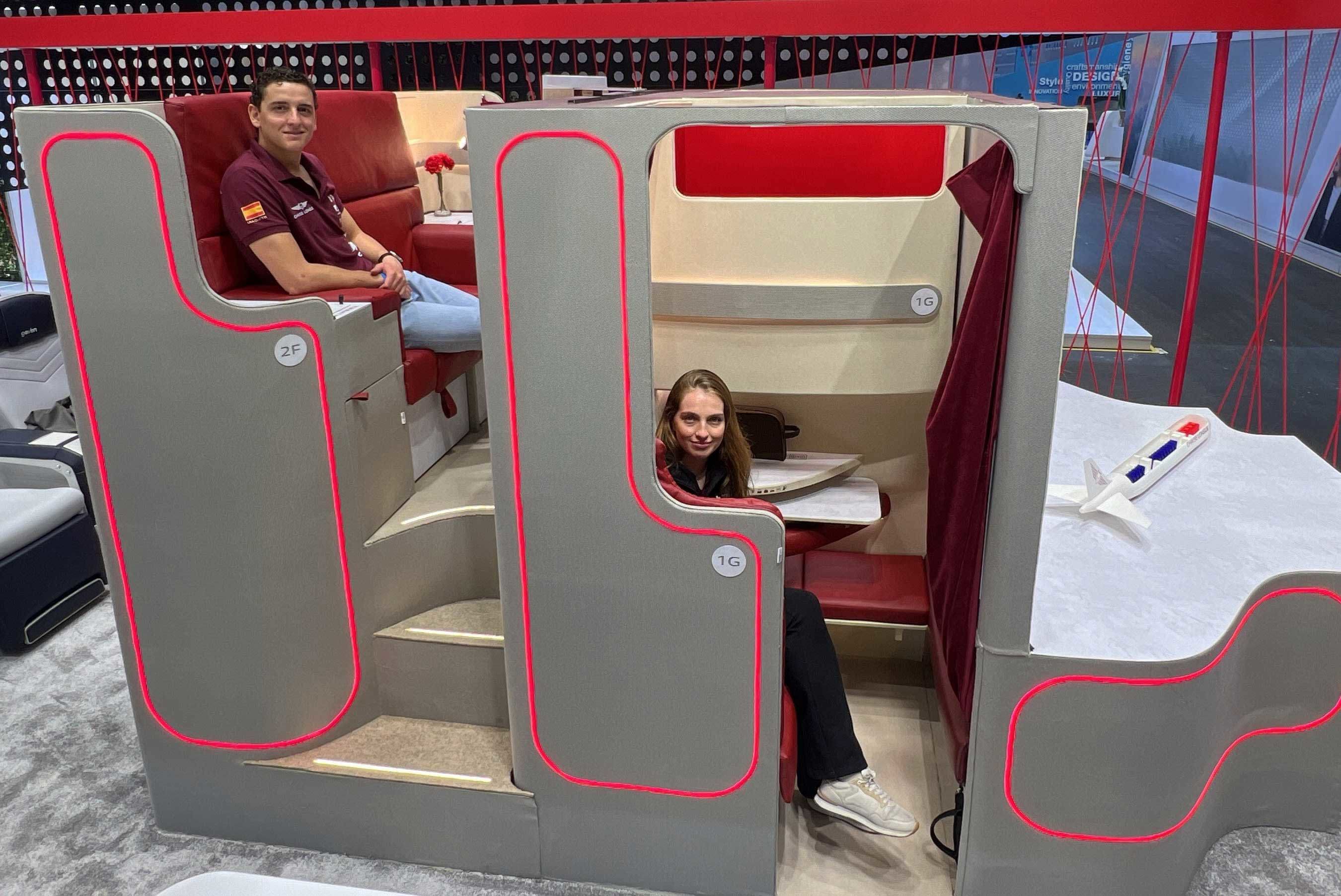
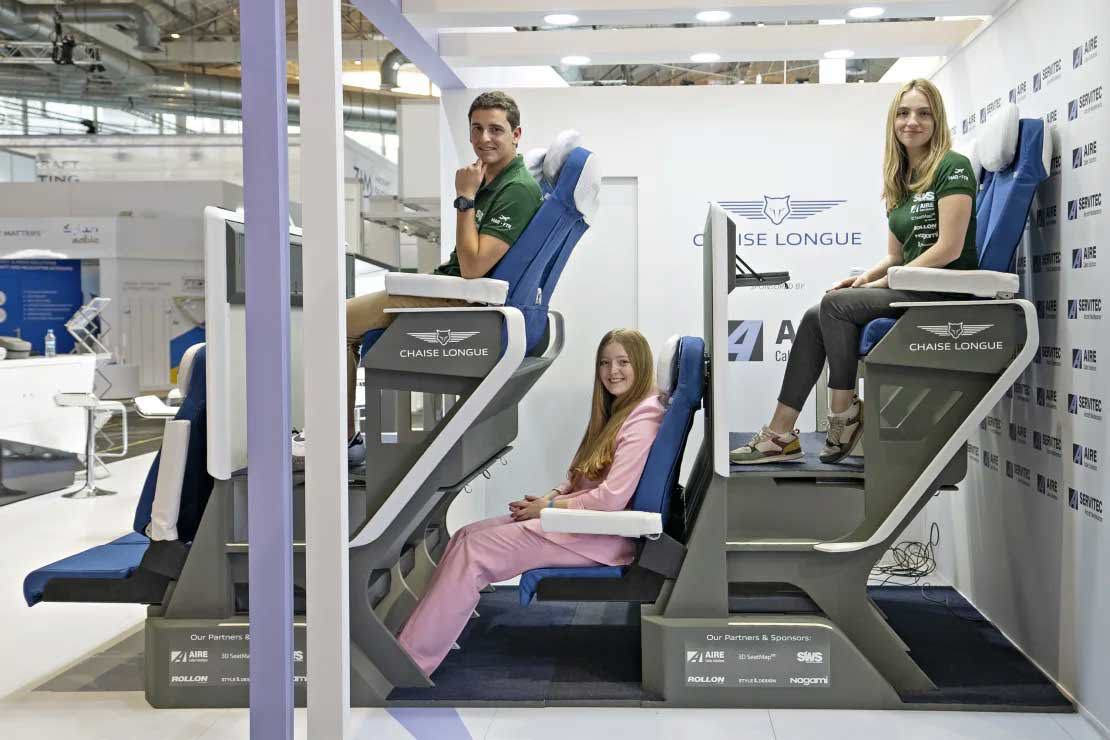
The crux of Núñez Vicente's vision remains the same: removing the overhead locker to create two levels of airplane seating in one cabin – with one passenger seated directly below another.
But while the economy class concept imagines three seats on the top and bottom rows, this new concept, called "elevated class," envisages just one seat on the bottom row, and two on the top in a couch-style configuration. Each row is designed to be secluded, private and include the luxury trappings of elite travel – lie-flat bed, privacy and copious leg room.
The goal, according to Núñez Vicente?
"To make more space for more seats in the airplane. But also give the passengers an even better experience than they get today in business or first class."
'No such thing as bad publicity'
This is Núñez Vicente's third time showcasing his vision at AIX in Hamburg. Following CNN Travel exclusives in 2022 and 2023, the economy iteration of his design attracted a lot of attention, chatter and controversy.
On late-night chat shows and message boards alike, would-be passengers debated fears of claustrophobia, questions about safety and accessibility – and just generally recoiled at the idea of being in close physical proximity to another traveler.
But Núñez Vicente remains unperturbed by criticism, a steadfast believer in the old adage that "there's no such thing as bad publicity."
"Most of the things that changed the world are normally from radical people that come with a crazy idea – like Steve Jobs with the iPhone," says Núñez Vicente.
A lot of the comments were in jest, he suggests, rather than serious or constructive criticism. They were mostly about what would happen if passengers passed wind.
And while Núñez Vicente appreciates that the average "person on the street," might think he's "crazy" – within the aviation industry, his reputation is growing.
Núñez Vicente won't name any names, but he says a handful of "big players" are seriously interested in developing the economy concept (that's why there's no economy prototype on display at this year's AIX – Núñez Vicente says any further development will happen behind closed doors).
Meanwhile Núñez Vicente and his business partner and girlfriend Clara Service Soto are regularly approached with "dream job" offers from airlines and seat manufacturers (all turned down – they're committed to making the original vision a reality).
And at this – his third Aircraft Interiors Expo – Núñez Vicente's latest prototype neighbours some of the biggest players in the airplane seat world – Recaro and Safran. Plus, Chaise Longue is now sponsored by Tapis – a company that supplies high-quality fabrics for aircraft interiors – and this year's prototype is kitted out in luxury materials.
"We're talking to the biggest players," says Núñez Vicente."They know this is going to happen sooner or later."
First class travel
While his detractors suggest his sole goal is to make airlines more money and cram more seats on planes, Núñez Vicente insists he's always been on a quest for "more comfort."
While Núñez Vicente is now on his way to becoming an aviation insider, Chaise Longue is still a start-up, run by Nunez Vicente and Service Soto with help from their supportive families. And it's not long since Núñez Vicente first entered the industry as a 21-year-old student – the original Chaise Longue was simply a college project inspired by a slew of uncomfortable economy flights.
At 1.88 metres, Núñez Vicente was used to cramped airplane journeys in which he struggled for legroom and struggled to sleep. He figured by removing the seat row directly in front, and putting it on top instead, travellers could stretch out their legs in front of them and enjoy more leg room.
The fact this concept could also "give the airline a new revenue stream or a new way to make more money out of those passengers or put more seats in" is a bonus – although Núñez Vicente is aware it's an attractive bonus for airlines.
He's also aware that airlines historically invest money in premium products – not economy class. It's not for nothing that every airline's economy class is more or less identical, whereas business class and first class come in all sorts of swanky forms – from Singapore Airlines' double bed suite in the sky to Emirates' virtual reality windows.
Enter Chaise Longue's "elevated class" which Núñez Vicente calls a "first-class experience with a business-class layout." It's part of Núñez Vicente's quest to "revolutionize the entire aircraft" – first economy, now the premier cabins.
He's also trying to move away from the "double decker" and "double level" label, suggesting the concept could be referred to as "3D seating." While Núñez Vicente envisages a future where dual level seating exists throughout the aircraft, he's not proposing airlines get rid of regular seats altogether. He imagines the Chaise Longue seats in the middle of each cabin, flanked by regular seating on either side.
Testing out the concept
At AIX 2024, CNN Travel was the first to test out the newest Chaise Longue prototype. It's smaller than last year's prototype – only three seats on display versus last year's twelve. At first glance, the concept seems more conventional – although the dual level concept remains integral to the design and strikingly different from anything you're currently experiencing on an aircraft.
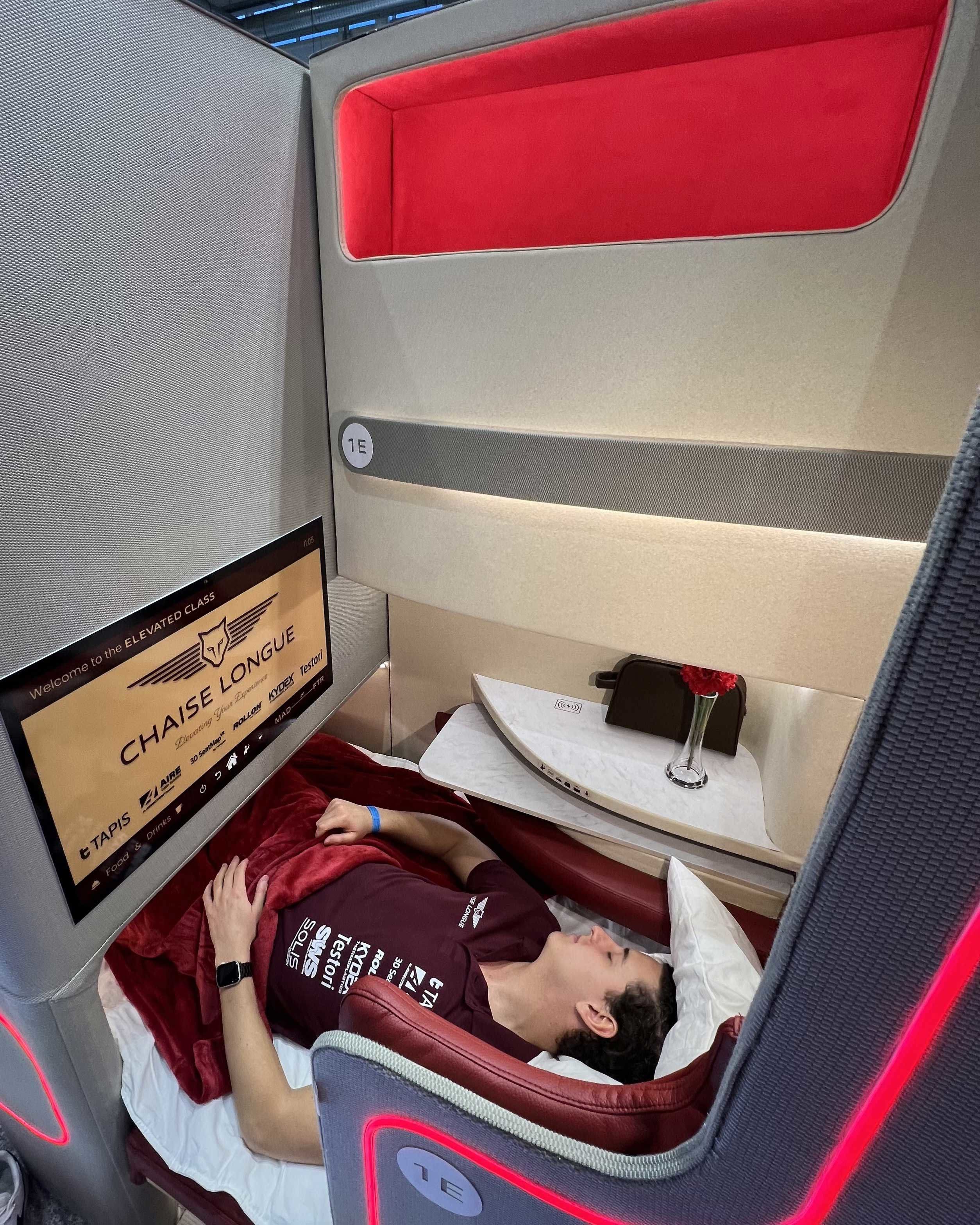
First up: trialling the lower level. The aim for this bottom seat, says Núñez Vicente, was to create "a fully private space that can be completely enclosed all the way from the top to the bottom." It's a spacious seat that converts into a lie-flat bed – and like the economy iteration, there's a roomy footwell allowing you to stretch out your legs in front of you underneath the upper level.
While last year's economy prototype's lower level felt pretty claustrophobic – this concept leans more towards secluded and private than narrow and oppressive. Of course, it's hard to actually judge how you'd actually feel knowing someone was seated directly above you – but the spaciousness and seclusion of having your own compartment makes it seem like it'd be pretty easy to switch off and get some sleep on a long-haul flight. There's also less of a sense of the upper level being directly in your eyeline – instead, there's a wall with space for a TV screen, which is a good couple of metres away.
The Chaise Longue concept involves eradicating the overhead lockers – a concept which seems less outrageous in a premium class, where alternative storage areas like closets are more common. In Núñez Vicente's design, there's plenty of space underneath the seat and underneath the footwell to store large suitcases.
Next up, the upper level – which offers an extra-wide seat, lie-flat seat that could accommodate one passenger looking for a bit more space, or two passengers who are happy getting cozy. It's a couch-style set-up that could be ideal for travellers traveling with a plus-one.
"We wanted to make the experience as homey as possible," says Núñez Vicente of this upper level. "The amount of real estate that you're getting is so much bigger than the one you would get in any business or first class."
Núñez Vicente is aware the upper level, which is reached by walking up steps, won't be appropriate for some passengers, but says the spacious lower level has been designed to be accessible to wheelchair users, anyone with reduced mobility and people traveling with service animals. He also insists the upper level would be safe, despite the proximity to the ceiling, and encourages passengers to wear seatbelts.
It's hard to judge whether the top or bottom level seat is more appealing. From trialing both options, it seems like the lower level might be more suitable for sleeping on a long-haul flight, while the top level could be more appealing for a daytime flight spent watching movies and relaxing on the coach-style seat.
Still, some might argue neither seat is as appealing as a straightforward, swanky first-class or business-class suite in a regular cabin configuration – where all the seats remain on one level. As a designer, Núñez Vicente says he would "never put a price" on either seat row, suggesting that's an airline's job.
Awaiting feedback
Núñez Vicente is excited to get feedback from airlines at AIX ("up to 85 percent of the seat is customisable," he says, and any airline who invested in the product could put their own stamp on the design). He knows the Chaise Longue's quest for airworthiness might be a long road, but he's confident it could be a reality one day – and airline feedback is integral to that.
He's still passionate about improving the experience for economy flyers, and says even if the "elevated class" Chaise Longue makes it off the ground first, he'll continue to work to make the economy class a reality.
He's also curious to hear what the general public has to say on the concept too. He hopes this premium version will be less maligned, but admits that you never do know.
"We will put our reputation on the line, again, and see how it turns out," he says. "Every year that passes we are putting our reputation, our name in the aviation industry on the line to see if we can really make a change."