Tag Archives: oceania

Expert’s price warning for shoppers despite fiery Senate inquiry

A day after Australia's major supermarket bosses were questioned about price-gouging allegations, their conduct towards suppliers and, in one case, threatened with jail time, shoppers have been warned to not expect price drops anytime soon.

Woolworths chief executive Brad Banducci had the threat of being found in contempt during his fiery Senate hearing yesterday morning, before Coles counterpart Leah Weckert's far milder appearance before the same committee in the afternoon.

While both CEOs discussed the importance of providing competitive prices, Swinburne University corporate governance expert Helen Bird said the hearings are unlikely to lead to any drop in prices in store – even if the explanations by the supermarkets about their pricing practices are welcome.

READ MORE: 'Last chance, Mr Banducci': Woolies boss threatened with jail time

A staff member wipes down the checkout area at Woolworths

"Sunlight is always the best disinfectant," Bird said

"But memories are short and in due course we'll go back to the behaviours that they've happily engaged in for many years.

"It's not going to change things, they're just going to feel uncomfortable for a while.

"There's nothing here at this point that's going to make prices drop."

Both Banducci and Weckert were grilled on pricing practices yesterday, with the Coles boss admitting her supermarket could improve.

"We have, in good faith, worked with suppliers to make sure they are getting paid fairly and in a large number of cases that has flowed on to higher prices for customers," Weckert said.

"If you think across our 850 stores, every store has 20,000 products in it with a ticket on it, and have we necessarily kept up with every ticket change that has resulted from those cost price increases? Probably not.

"There are plenty of examples on social media where people have called that out.

"There is no bad intent there, but we definitely could execute against it better, and we are working towards holding ourselves to a higher level of account on that."

She also said Coles would discuss ways to tell customers when shrinkflation – smaller product sizes sold at the original or higher price – was occurring.

READ MORE: Millions face grocery bill financial stress, data finds

Senate Select Committee on Supermarket Prices. Coles CEO Leah Weckert during the senate committee hearing

"It would be a reasonable thing to do, wouldn't it, if you valued your customers, to let them know when the size of an item has decreased, when shrinkflation is happening," Greens senator Nick McKim said.

"Why wouldn't you do that?"

"I think it's a very valid perspective," Weckert replied.

"I'm happy that we take it away and have a discussion internally about how we might be able to communicate it to customers."

Banducci, for his part, denied allegations of price-gouging, saying Woolworths tries to help its customers.

"We don't agree with the assertions that we are price gouging," he said.

"We are working very hard on an everyday basis to provide value for consumers… and our goal is to help them."

EXPLAINED: What does the supermarket code of conduct actually do?

Senate Select Committee on Supermarket Prices. CEO of Woolworths Group CEO Mr Brad Banducci during the senate committee hearing, Tuesday 16th of April 2024.

He also said Woolworths would support the voluntary supermarket code of conduct being made mandatory – as long as it's expanded beyond major grocery providers to include other major retail chains.

"I am a grocer, not a lawyer, so I'll give you my grocer answer… we are very supportive of it being mandatory," he said.

"We do think it is a grocery code and that therefore it should apply to all people who sell meaningful amounts of groceries in the country.

"That includes all of the other parties we talked about earlier, whether it's Bunnings in household care or pet care, whether it's Amazon… because it is in personal care as well as household care, or whether it's Chemist Warehouse in personal care.

"In saying that, it's not us deflecting, because it would therefore include (Woolworths Group-owned) Big W and force our Big W team to also lift to the same standard."

The Senate inquiry is due to deliver its final report by May 7.

Israel pledges it will retaliate against Iran despite risks

Israel is vowing to retaliate against Iran, risking further expanding the shadow war between the two foes into a direct conflict after an Iranian attack over the weekend sent hundreds of drones and missiles toward Israel.

Israeli officials have not said how or when they might strike. But as countries around the world urge Israel to show restraint and the threat of a multi-front war mounts, it's clear that a direct Israeli attack on Iranian soil would lead to major fallout.

Iran says it carried out the strike to avenge an Israeli airstrike that killed two Iranian generals in Syria on April 1. It has pledged a much tougher response to any Israeli counterattack attack on its soil.

READ MORE: Despite weather glitch, the Paris Olympics flame is lit at the Greek cradle of ancient games

With Israel focused on its war against Hamas in Gaza, and already battling Iranian-backed Hezbollah militants in Lebanon every day, the United States. has urged Israel to show restraint.

US officials say President Joe Biden has told Israeli Prime Minister Benjamin Netanyahu that the US. will not participate in any offensive action against Iran, and the president made "very clear" to Netanyahu "that we do have to think carefully and strategically" about the risks of escalation.

Israel's war cabinet has spent the last two days debating their next move. Here are some considerations key to their decision.

Increasing Israeli isolation

Israel's successful air defence on Saturday night — conducted in tandem with the US, Britain, France and Jordan — bought the country a brief moment of international support and sympathy after months of mounting international isolation over the Gaza war.

The six-month offensive has killed nearly 34,000 Palestinians, according to local health officials, and unleashed a humanitarian catastrophe.

A coalition of international partners helped Israel defend itself effectively. Israel's military says 99 per cent of the weapons were intercepted, with few reaching Israeli airspace. The attack caused only minor damage and wounded one person: a seven-year-old girl.

READ MORE: High Court challenge could result in 200 immigration detainees being released

This coalition worked under the leadership of the US Central Command, which oversees American forces in the region. It works closely with Israel and moderate Arab countries to form a unified front against Iran.

Jordan, a country whose population is predominantly pro-Palestinian, joined the effort, despite being at odds with Israel over the war in Gaza, calling its participation self-defence.

It also appears likely that help may have come from regional powerhouse Saudi Arabia, which does not have official relations with Israel.

A map released by Israel shows many of the Iranian missiles flying through Saudi airspace.

Israel has been careful not to identify its Arab partners, but an Israeli air force official, speaking on condition of anonymity to discuss the mission, said Israeli warplanes needed to fly "east of Israel" to shoot down missiles.

Yoel Guzansky, a senior researcher at the Institute for National Security Studies, a Tel Aviv think tank, said Israel would be risking this goodwill if it acts alone.

READ MORE: Summer El Niño event over, Bureau of Meteorology says

"Israel can take advantage of this and buy itself a lot of credit right now, if it does not launch a massive retaliatory attack," he said. "But if it does attack, a lot of credit is lost."

The tacit support of Arab states does not mean they would assist Israel in a counterattack on Iran.

Any air or missile response other than ballistic missiles — which would arc over neighbouring countries' airspace rather than through it — would require overflights of surrounding countries, which technically would require Israel obtain permission from those Arab neighbours, said Daniel Byman, a senior fellow with the Washington-based Centre for Strategic and International Studies.

"With Saudi Arabia and Jordan, there's kind of a route and access questions," in terms of whether they would grant Israel overflight clearance.

"From Iran's point of view, that would be seen as a hostile act," Byman said. "And even though these countries don't like Iran, they're not terribly eager to be seen on the side of Israel doing that."

Fears of multi-front war

A major retaliatory strike on Iranian soil risks sparking a full-scale regional war, so any response must be carefully calculated.

A direct strike on Iranian soil would almost certainly result in a brutal counterattack and risk prompting Hezbollah to launch further attacks.

The Iranian-backed Lebanese group has a far more powerful arsenal than Hamas, but has so far shown hesitancy about engaging in an all-out war.

READ MORE: Solomon Islands election: Plenty at stake for Australia and the Pacific

Some 60,000 citizens in northern Israel already have been forced to evacuate their homes due to ongoing exchanges with Hezbollah.

Heavier fighting would likely force them to spend even more time away from home.

A direct conflict would also further stretch Israel's military, remove its focus from Gaza and hamper Israel's war-wearied economy.

Any major attack on Iranian soil could also undermine shaky US support for the war.

Two US officials said Israel has not yet told the US how it intends to respond. But the officials, speaking on condition of anonymity to describe diplomatic discussions, said Israel has signalled that whatever it does will be designed to prevent a worsening of the already tense regional security situation.

That could point to a more limited action, such as a strike on Iranian proxies across the region or a cyber attack on Iran.

Military capacity

Israel's army is vastly superior to others in the region. It possesses a range of high-tech weaponry, including F35 fighter planes that can launch long-range munitions.

Experts say it has the ability to directly strike Iran or its proxies in the region.

Fabian Hinz, a weapons expert and research fellow at the International Institute for Strategic Studies in London, said the Iranian air force is "not even remotely comparable."

He said the force is composed of a collection of planes from the 1980s and 90s, with some dating back to the reign of the Shah Mohammad Reza Pahlavi who ruled the country until 1979.

The extent of the Islamic republic's air defence system is less known, he said. Many of Iran's missile sites and nuclear installations are deep underground, making them difficult to hit, Hindz added. Israel might also need the agreement of Gulf Arab countries to use their airspace — something that is not guaranteed.

"I don't think it's going to be a full-scale Israeli attack against many targets all over Iran," said Raz Zimmt, another senior researcher at Israel's INSS. "It will probably be limited against one or two, perhaps inside Iran."

Brothers tackle momentous 100-day cross country challenge for cancer research

Two Australian brothers have embarked on a remarkable 100-day cross-country run to raise $100,000 for cancer research.

Inspired by losing their grandmother to breast cancer eight years ago and having another grandmother survive cancer a year ago, Stefan Lamble, 25, and Lachlan Lamble, 22, set off from Perth in February.

The pair are now days away from Adelaide after battling extreme weather conditions and pushing their bodies to the limit.

READ MORE: Who is Bishop Mar Mari Emmanuel?

Stefan Lamble, 25, and Lachlan Lamble, 22, are doing a 100-day cross country run.

"One day reached 46 degrees and the soles of our shoes literally melted," Lachlan said.

Their unwavering commitment has garnered widespread support, with a legion of fans across the country cheering them on. 

Cancer advocate Kellie Finlayson joined the brothers to support them in Dublin.

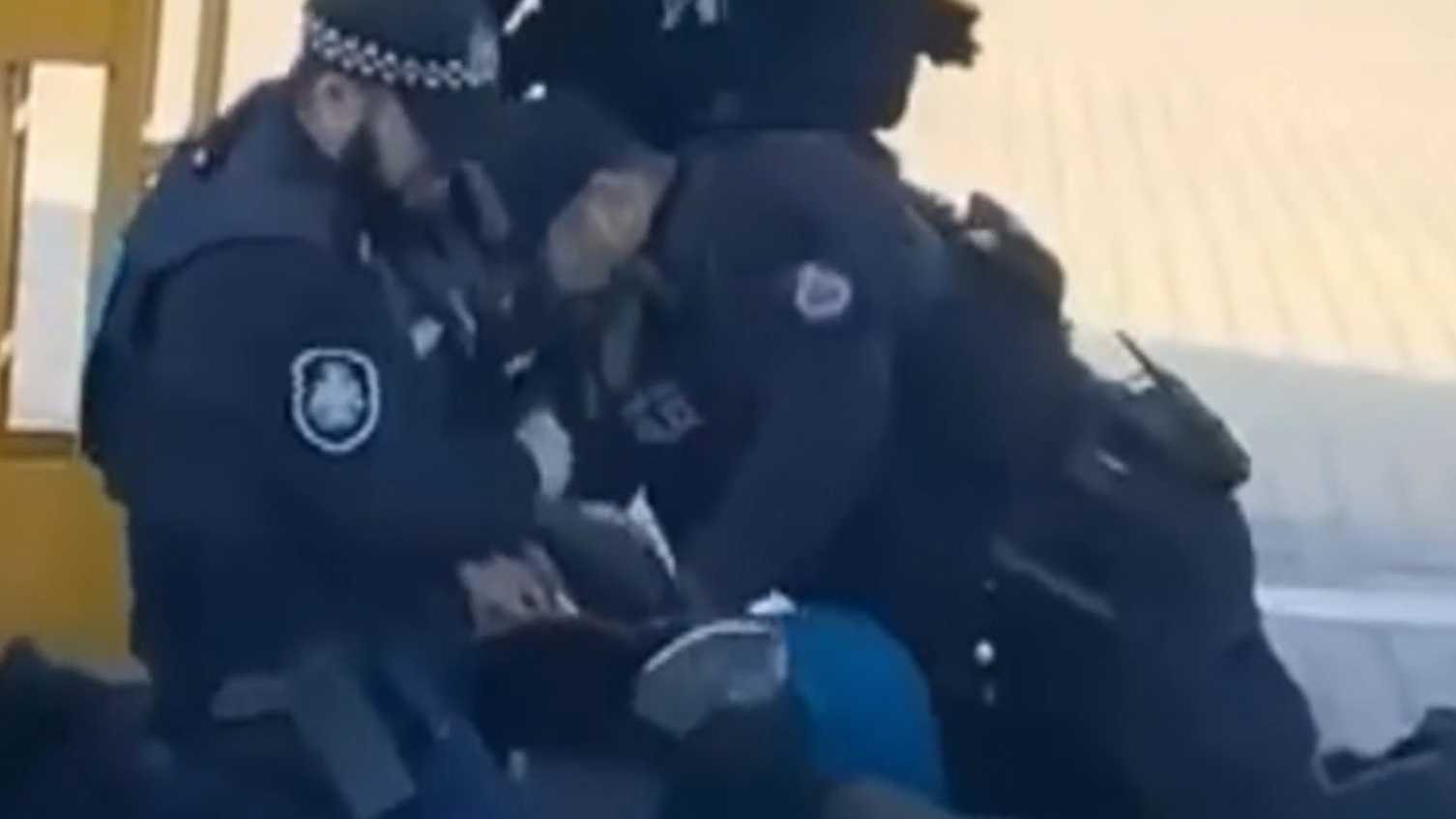
READ MORE: Police declare stabbing of Bishop at Western Sydney church a 'terrorist act'

Stefan Lamble, 25, and Lachlan Lamble, 22, are doing a 100-day cross country run.

"It gives us a bit of hope that there might be some new research, and that's all we can really hope for," she said.

The brothers have now been running for 66 days straight, with their journey to end in Melbourne.

They have already surpassed their initial fundraising goal of $100,000 and hope to reach $1 million by the year's end.

"We are doing it for everyone back home that has been impacted by cancer, so please find it in your hearts to donate at ACRF.com," Stefan said.

This article was produced with the assistance of 9ExPress.

Gig workers spark warnings after riding delivery bikes in busy motorways

Delivery e-bike riders are increasingly dicing with death and slowing down traffic by traveling on high-speed motorways and inside tunnels.

Exclusive CCTV from Transurban shows multiple examples of riders in the Burnely Tunnel in Melbourne and other parts of the road network coming dangerously close to drivers.

The toll-way operator's head of road safety, Liz Waller, said the number of monthly incidents has doubled compared to the same time last year.

READ MORE: Iconic Melbourne furniture showroom turns into triple-storey brewery

Gig workers Melbourne motorwaysGig workers Melbourne motorways

"We have to close the lane, we reduce the speed, we then send our instant response out there and of course that slows everybody down," she told 9News.

"Not only is it dangerous, it's also illegal."

The behaviour comes despite the risk of significant penalties.

Davis Clayton from Gig Workers' Hub said a number of factors could be behind the rise.

"A lot of these workers are in a rush because they're only making four, five or six dollars a delivery," he said, adding the delivery platforms also need to improve their software and do a better job at integrating map systems.

"Quite often we can see delivery workers getting car directions when they're supposed to be getting bike directions."

Baby girl injured in Bondi Junction stabbing improves, moved out of ICU

The baby girl injured in a stabbing rampage that killed her mother is recovering and has been moved out of the intense care ward.

The nine-month-old was stabbed during Joel Cauchi's deadly spree through Westfield Bondi Junction Shopping Centre in Sydney's east on Saturday.

The child's mother, Ashlee Good, was one of six people murdered before Cauchi was shot dead by a police officer.

READ MORE: What we know about the victims of the Bondi Junction stabbing spree

Today Good's daughter was moved out of ICU and into a ward at the Sydney Children's Hospital.

She is in a serious but stable condition after being upgraded from critical yesterday.

Yesterday, NSW Health Minister Ryan Park said he was "delighted" by the news the little girl was recovering and said it was "a big change and a significant improvement".

Bondi Junction stabbing victims Yixuan Cheng, Pikria Darchia, Faraz Tahir, Ashlee Good, Dawn Singleton, Jade Young

Seven other patients wounded in the Saturday attack remain in care.

Initially 12 patients were taken to hospital in the aftermath of the attack.

Today Westfield resumed its vehicle retrieval process for shoppers who were forced to abandon their cars, but the centre remains closed.