Barry McLeod claims his new neighbour is “trying to steal our land’.
Tag Archives: oceania
'Not for faint-hearted': Warning as WA gas workers vote for strike
There are warnings strikes at two liquified natural gas (LNG) plants in Western Australia this week could impact the state's energy supply.
The workers at Chevron's Wheatstone and Gorgon gas facilities voted to continue the industrial action starting on Thursday.
The move came after the giant energy company and trade unions appeared at the Fair Work Commission last week.
READ MORE: Gaza conditions a 'complete catastrophe' as Israel gets set for offensive
The Offshore Alliance, which represents the workers, said on social media that it held a secret ballot of members over the past weekend and 91 per cent from the 410 members who participated backed strike action.
Last month, an in-principle agreement between Chevron and the workers at the two plants was reached following strikes.
But the Offshore Alliance claimed Chevron was backpedalling on some parts of the deal.
9news.com.au has contacted Chevron for comment.
The two Chevron plants in the Pilbara supply about 44 per cent of WA's domestic gas supply and 6.6 per cent of the world's LNG stocks.
Energy market analyst EnergyQuest said the Wheatstone and Gorgon facilities produce an estimated $76 million in daily revenue.
READ MORE: PM 'warned': Dutton says Voice could've succeeded

"The Chevron industrial negotiations are not for the faint-hearted. They put at risk a third of Australia's LNG exports and almost half of Western Australia's domestic gas supply," EnergyQuest CEO Rick WIlliamson said.
The two WA projects also export LNG to Japan and China.
"Japan, as Australia's largest buyer of LNG, now has 16 per cent of its national LNG supply caught up in one industrial dispute in Western Australia," Williamson said.
Police searching for man who threw flare at Opera House protest
NSW Police have released footage of a man appearing to throw a flare during last week's pro-Palestinian protest at the Sydney Opera House.
Police say they want to speak to the man after they established a strike force to investigate unlawful protest behaviour at the rally in Sydney last Monday.
"The man is described as being of medium to heavy build, with short dark hair and beard, and, at the time, he was wearing spectacles," police said in a statement.
READ MORE: Map shows where 1.1 million Palestinians have been urged to flee
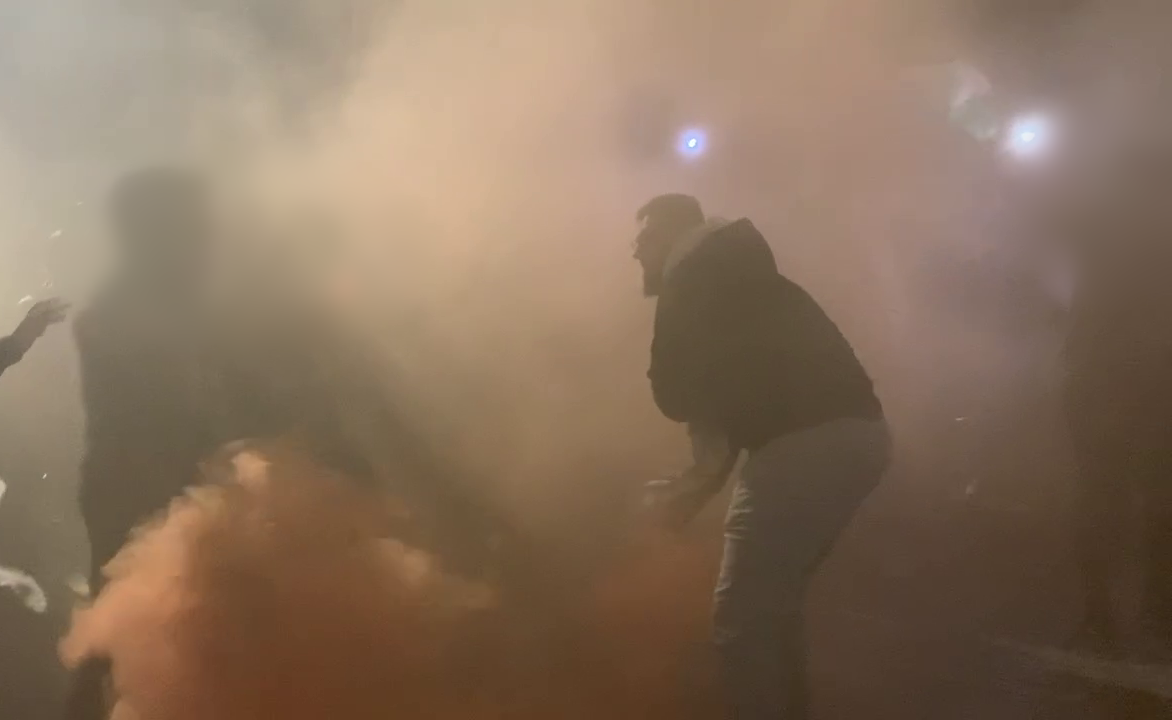
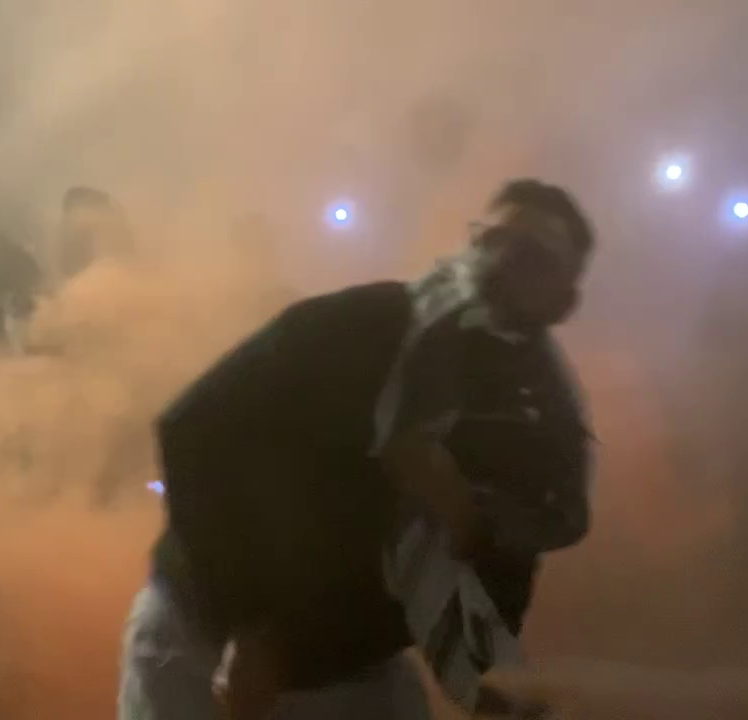
"The man is depicted in the vision wearing a black hooded jacket, grey pants, black shoes, and a black and white scarf."
The pro-Palestine rally was marred by abhorrent antisemitic chants and the burning of an Israeli flag by a small group near the Opera House.
The rally's organisers roundly condemned that behaviour, which they said was carried out by a tiny minority of attendees.
A rally organised by the same group at Hyde Park yesterday went ahead peacefully, with no arrests made after more than 6000 people attended.
Similar peaceful demonstrations were held elsewhere around the country in support of the Palestinian people as humanitarian conditions worsen in the Gaza Strip.
Victoria Police said about 10,000 people attended a rally in Melbourne, while Brisbane and Adelaide also hosted similarly peaceful events.
Golf clubhouse destroyed in ferocious blaze in Victoria's Yarra Valley
A large golf clubhouse has been destroyed in a ferocious blaze in Victoria's Yarra Valley.
The 180-square-metre building at Eastern Golf Club on Victoria Road in Yering, about 38km north-east of Melbourne's CBD, has been gutted by a fire that broke out about 1.43pm.
The fire started in a storage room, where electric buggies and batteries are kept, according to the club's management.
READ MORE: More than 1000 dairy workers to walk off the job in Victoria


It quickly spread and burnt out the multimillion-dollar building's pro shop, offices lounge and function and dining rooms, helped by 45km/h winds in the area.
Firefighters from the surrounding area rushed to the scene, bringing 11 units, as did paramedics, police and the club's power and gas providers.
Meanwhile, the building was successfully evacuated, with the club's staff and members forced to watch on as the building burnt.
The entire structure was already fully engulfed in flames by the time firefighters arrived.


A community advice warning was issued for smoke in the area.
The golf club described itself as "an exciting meeting and events destination with six dedicated rooms with capacity for up to 250 guests" on its website.
It only opened the building in 2015.
Owners of flood-damaged Auckland homes fear buyouts will leave them in debt
Many residents will have to pay for a mortgage on a house they no longer own.
Man killed by his own dog in attack at home
A man aged 66 has died after being attacked by his own dog at a home in what police have described as a "very rare" and "tragic" incident in Tasmania.
Police were called to a house at Allens Rivulet, a rural area near Hobart, at 10.40pm on Sunday.
Police said the dog attacked the man and a woman aged 64.
LIVE UPDATES: Israel fires missiles into Lebanon

The man died after suffering serious injuries to his lower legs.
The woman was rushed to hospital, where she is in a stable condition.
Inspector Colin Riley from Tasmania Police said the man was pronounced dead at the house.
"The woman was transported to the Royal Hobart Hospital with serious injuries to her lower limbs," Riley said.
"Our thoughts are with the man's loved ones at this difficult time."
He added it was a "very rare" incident.
"Obviously this is a family that had a loved pet and unfortunately that animal has turned on them and it's had tragic outcomes," Riley said.
A neighbour called the police after hearing a commotion and five police officers, an ambulance crew and two local Kingborough Council animal control officers went to the property.
Police said they would investigate what happened before the dog attacked but would not identify the breed.
There are two other dogs at the home, police said.
According to the council, at least one is of the same breed.
The dog was euthanised at the scene by an animal management officer.
Kingborough Council General Manager Gary Arnold said it was "the most tragic incident" to have happened during his 10 years there.
He said the council officers involved are "a bit shaken".
Arnold said the dog did not appear to be registered with the council, which owners are encouraged to do, he said.
Police said a report would be prepared for the coroner.
The 'Gaza metro': The mysterious subterranean tunnel network used by Hamas
The myriad tunnels under Gaza are best known as passageways used to smuggle goods from Egypt and launch attacks into Israel.
But there exists a second underground network that the Israel Defence Forces colloquially refer to as the "Gaza metro".
It's a vast labyrinth of tunnels, by some accounts several kilometres underground, used to transport people and goods; to store rockets and ammunition caches; and house Hamas command and control centres, all away from the prying eyes of the IDF's aircraft and surveillance drones.
LIVE UPDATES: Israel claims Hamas commander killed in strike

Hamas in 2021 claimed to have built 500 kilometres worth of tunnels under Gaza, though it is unclear if that figure was accurate or posturing.
If true, Hamas' underground tunnels would be a little less than half the length of the New York City subway system.
READ MORE: Golf clubhouse destroyed in ferocious blaze
"It's a very intricate, very large – huge – network of tunnels on a rather small piece of territory," Daphne Richemond-Barak, a professor at Israel's Reichman University and expert on underground warfare, said.
It's unclear how much the tunnel network would have cost Hamas, which governs the impoverished coastal strip.
The figure is likely significant, both in terms of manpower and capital.
Gaza has been under a land, sea and air blockade by Israel, as well as a land blockade by Egypt, since 2007 and is not believed to possess the type of massive machinery typically used to build tunnels deep underground.

Experts say that diggers using basic tools likely burrowed deep underground to dig the network, which is wired with electricity and reinforced by concrete.
Israel has long accused Hamas of diverting concrete meant for civilian and humanitarian purposes toward the construction of tunnels.
Hamas' critics also say that the group's massive expenditures on tunnels could have instead paid for civilian bomb shelters or early warning networks like those across the border in Israel.
The asymmetric advantage
Tunnels have been an attractive tool of warfare since medieval times.
Today they offer militant groups like Hamas an edge in asymmetric warfare, negating some of the technological advantages of a more advanced military like the IDF.
What makes Hamas tunnels different from those of al Qaeda in the mountains of Afghanistan or the Viet Cong in the jungles of South East Asia is that it has constructed a subterranean network below one of the most densely populated areas on the planet.
Nearly 2 million people live in the 227 square kilometres that make up Gaza City.
"It's always difficult to deal with tunnels, don't get me wrong, in any context, even when they are in a mountainous area, but when they are urban area, then everything is more complicated – the tactical aspects, strategic aspects, the operational aspects, and of course, the protection that you want to ensure for the civilian population," Richemond-Barak, who is also a senior fellow at the Lieber Institute for Law and Land Warfare and the Modern War Institute at West Point, said.
READ MORE: Gaza conditions a 'complete catastrophe,' as Israel gets set for offensive
Since the October 7 terror attack in Israel in which at least 1400 people, mostly civilians, were killed, the IDF has repeatedly alleged that Hamas is hiding inside these passages "underneath houses and inside buildings populated with innocent Gazan civilians," effectively turning them into human shields.
Israeli military airstrikes have since killed at least 2670 Palestinians, the Ministry of Health in Gaza said in a statement on Sunday.

The IDF is expected to go after the network in its forthcoming ground incursion into Gaza, as it has in recent years gone to extreme lengths to eliminate Hamas' tunnels.
Israel launched a ground assault on Gaza in 2014 to try and eliminate the underground passages.
READ MORE: US sending second nuclear-powered aircraft carrier to Middle East
On Friday, Israel warned about 1.1 million living in Gaza to move south ahead of its likely operation, according to the United Nations.
Critics said such an order was impossible to carry out on short notice in the middle of a war zone.
The top UN human rights official said the evacuation call "defies the rules of war and basic humanity."
Moving civilians out of Gaza City would help make it safer to eliminate tunnels, but such operations will be dangerous, Richemond-Barak said.
The IDF can either render the tunnels temporarily unusable or destroy them.
According to Richemond-Barak, bombing the underground passages is typically the most efficient way to eliminate them, but such strikes can impact civilians.
READ MORE: Australian passengers relieved as repatriation flights leave Israel
What is clear is that technology alone won't be enough to stop the subterranean threat.
Israel spent billions of dollars attempting to secure the border with a smart system that boasts advanced sensors and subterranean walls, yet Hamas was still able to launch its October 7 assault by land, air and sea.
Richemond-Barak said a holistic approach is required, one that employs visual intelligence, border monitoring and even asking civilians to keep an eye out for anything suspect.
"There is no foolproof solution to deal with a tunnel threat," Richemond-Barak said.
"There's no Iron Dome for tunnels."
Emergency warnings for three bushfires in NSW, residents told it's 'too late to leave'
There are three bushfires burning at emergency level in New South Wales, with some residents warned told it's too late to leave.
A fire at Willi Willi National Park and Boonanghi Nature Reserve, near Kempsey and north of Port Macquarie, is threatening dozens of homes.
The blaze is moving in multiple directions, and westerly winds have caused the fire to spread across Toorumbee Road.
READ MORE: Golf clubhouse destroyed in ferocious blaze

People in the area have been instructed by the New South Wales Rural Fire Service (NSW RFS) to seek shelter as it's too late to leave.
"If you are in the Torumbee Road area your life is at risk. Seek shelter in a solid structure such as a house. Do not be caught in the open in the path of the fire," the latest emergency warning reads.
Anyone east of Moparrabah along Willi Willi Road with a clear path is instructed to head east towards Kempsey.
A southerly change is expected this evening which will see the fire move in a more northerly direction, the NSW RFS said.
READ MORE: See how your electorate voted in the Voice referendum

Another blaze burning further inland, near Gulgong, north of Mudgee, is also at emergency level.
The fire at Springwood Park Road, Cope, is moving in an easterly direction.
For residents west of Ulan Road in the vicinity of Cooks Gap and Ulan areas, or in the area of Springwood Park Road and Cope Road, it is too late to leave.
"Embers will be blown long distances ahead of the main fire front starting spot fires, these may impact your home earlier than the main fire front," the NSW RFS warned.
The most timely and accurate information is available on the NSW RFS website or app.

Further north, a third bushfire is at emergency level near Byron Bay, where blazes have been shrouding the beach town in smoke for days.
A blaze in the Upper Horseshoe Creek area, 11 kilometres north-east of Kyogle and west of Nimbin, is threatening homes.
People in the areas of Sargents Road, Horseshoe Creek Road and Wainwrights Road have been told it's too late to leave.
Earlier, another large bushfire burning near Byron Bay, which started on Saturday, was brought under control.
Despite the fire conditions improving today, the RFS has urged residents in the area to keep monitoring the situation, as increasing winds may change the fire's behaviour.
A total fire ban remains in place for large parts of New South Wales, including the Greater Sydney, Greater Hunter, Far North Coast, North Western, Northern Slopes, and New England regions.
“I’m out, not down!” Ousted Hauraki-Waikato Labour MP Nanaia Mahuta upbeat about future after 27 years in Parliament
“Hana is in and I’m out and I’m going to move on”.
Election 2023: What gets axed under the National-led Government?
Now that National looks set to govern, here’s what they’ve promised to get rid of.