The Helena Bay hill slip is expected to take 15,000 truckloads to clear.
Tag Archives: oceania
Election 2026: The Opportunity Party reveals candidates, promises more on the way
The party has unveiled its ‘first tranche’ of candidates to contest the election.
Father asked if son ‘wanted to be red’ before killing him in attempted murder-suicide
Paranoid beliefs of covert police surveillance and fears that his son would be taken away led a drug-abusing father to brutally murder his three-year-old.
The 48-year-old took the child into the bathroom of his aunt's Sydney apartment in May 2023, one-and-a-half hours after learning his partner had made a domestic violence complaint to police about him.
Having to unlock the door of the bathroom with a butter knife, his aunt found the pair lying in a pool of blood in an attempted murder-suicide.
READ MORE: More than five million Aussies to receive cash boost from today
The boy, who was three years and nine months old, could not be revived.
In a phone call from jail after his arrest, the man told his partner he "did himself" first and then asked his son what colour he saw.
"The boy said red," he said.
"Do you want to be red too? (He) said 'yes' and then I did it," he told his partner.
The 48-year-old also told prison staff he had killed his son because he wanted them to become two ghosts.
The man, whom AAP has chosen not to name to protect the victim's identity, was jailed for up to 28-and-a-half years in the NSW Supreme Court on Friday after pleading guilty to murder.
Justice Paul McGuire imposed a non-parole period of 18 and a half years, expiring on November 30, 2041.
"By killing his own infant, the offender has perversely and egregiously breached the trust, protection and love that (the boy) deserved," he said on Friday.
READ MORE: The telltale sign Aussies are in for a world of pain
The boy's biological mother died of natural causes in April 2021.
The father recommenced a relationship with his ex-girlfriend six months later and soon started using methylamphetamine.
The couple had previously split in 2014 over his violent behaviour and drug use.
Days before the murder, he accused his partner of infidelity, smashing her phone and assaulting her in the bathroom of his home.
He also expressed delusions that police were watching him, including thinking two loss prevention officers at a supermarket were police in disguise.
Unable to contact his mother, he abandoned his home west of Sydney, taking his partner and son to his aunt's apartment.
While he was out looking for a place to live, his girlfriend packed her bags and left, calling police to make the domestic violence complaint.
After his arrest while in hospital, he told staff he knew he would be arrested but had no family members to help take care of his son.
He said he tried to kill himself and his son so that the Department of Family and Community Services would not put the child into foster care.
LIVE UPDATES: Narelle bears down on coast with 'very destructive' 285km/h wind gusts
On Friday, Justice McGuire found the man was experiencing bizarre beliefs spurred by paranoia that his son was better off dead than being cared for by someone else.
The man had only made very limited expressions of contrition and remorse.
Recent claims to a forensic psychiatrist that he heard voices telling him to "kill everything he loved" at the time of the murder were inconsistent with statements made to police and hospital staff soon after, the judge noted.
Justice McGuire reduced the non-parole period, however, after finding the man's time in custody would be more onerous because of his mental illness.
He was also likely to spend it in protective custody because of the nature of his crime.
The judge expressed his condolences to the boy's family, noting the impact of the murder.
The child's grandparents described the man's behaviour as horrific and selfish, while his sister could not comprehend his cruel and heartless actions.
LIVE UPDATES: Trump drops Pearl Harbour reference in meeting with Japanese PM
Support is available from the National Sexual Assault, Domestic and Family Violence Counselling Service at 1800RESPECT (1800 737 732)
NEVER MISS A STORY: Get your breaking news and exclusive stories first by following us across all platforms.
- Download the 9NEWS App here via Apple and Google Play
- Make 9News your preferred source on Google by ticking this box here
- Sign up to our breaking newsletter here
Australia urged to crack down on blind boxes due to gambling fears
Australia has been urged to crack down on blind boxes as some experts fear they could be linked to gambling.
Blind boxes are sealed packages that contain a figure or toy from a set inside. Buyers do not know which item they will receive.
These boxes have surged into a billion-dollar industry in recent years, driven by brands like Chinese toy maker Pop Mart and viral products like Labubus and Smiskis, with people spending hundreds to thousands of dollars on them.
READ MORE: ACCC to investigation allegations of anti-competitive conduct by regional fuel retailers
Alliance for Gambling Reform spokesperson Mark Kempster said the blind boxes use the same tactics as the gambling industry.
"When you're buying something with an unknown outcome, it's the same as gambling on something that has no outcome on it as well," he said.
"It's definitely a form of gambling. We see it a lot in trading cards and things along those lines as well. It's quite a big thing in Australia."
Singapore's Gambling Regulatory Authority recently announced it was working to mitigate the gambling risks posed by blind boxes.
"These pose risks to our youth in particular as they are exposed to gambling early," Singapore's Gambling Regulatory Authority board member Cecilia Chu wrote in an opinion piece in The Straits Times in November.
Kempster called for Australia to follow with education programs in schools so that young people are aware of the different forms of gambling.
"You need to understand the pitfalls of it and the issues that can come from it if you fall into it at a young age," he said.
"It's this gambling culture we build in society, thanks to the way the gambling is advertised in Australia, that's doing this, and then it's filtering down to all these other parts of life."
How exactly are blind boxes a form of gambling?
READ MORE: Some Jetstar customers booted from Qantas lounges under new rules
QUT consumer behavioural expert Gary Mortimer explained that buyers, regardless of age, experience a "powerful rush of dopamine" when they tear open a blind box.
This is from the anticipation they feel with not knowing what is inside and the joy and satisfaction after opening the box.
"Everyone can relate to that excitement of ripping open a birthday or Christmas present or the anticipation before discovering what a package in the post contains," he said.
"In fact, the rush of good feeling is very similar to what gamblers experience."
Mortimer said that rush is based on Burrhus Skinner's theory of Operant Conditioning – changes in behaviour due to either positive or negative reinforcement.
"In the case of blind boxes, the reinforcement is positive," he said.
"However, Skinner also found that one of the most powerful forms of positive reinforcement (getting subjects to do what you want them to do) occurs when there is a 'variable ration of reinforcement', more commonly referred to as 'reward uncertainty', and this is where the analogy with gambling comes in.
"Simply, if you give customers a predictable set of rewards, then they lose interest quite quickly. If it's unpredictable, they tend to establish behaviour which is very hard to extinguish."
READ MORE: Astronauts had to battle for survival after spacecraft lands in deeply remote forest
ANZ analysis found that unpredictability led to higher sales as buyers made decisions based on how much they had already spent on blind boxes.
"Because of blind boxing, people don't know which one they'll get, so they keep buying until they find the one they want," the bank said in August.
"If they don't find it in the first few boxes, they may feel that they can continue buying further, since they already have bought a few."
9news.com.au has contacted Pop Mart for comment.
NEVER MISS A STORY: Get your breaking news and exclusive stories first by following us across all platforms.
- Download the 9NEWS App here via Apple and Google Play
- Make 9News your preferred source on Google by ticking this box here
- Sign up to our breaking newsletter here
Date set for first step in cop killer’s sentencing
A man who pleaded guilty to the shooting murder of an experienced police officer at his rural property is edging closer to learning his fate.
Constable Keith Smith, 57, was killed at North Motton, in northwest Tasmania, on June 16 while he and another officer were delivering a court-ordered repossession notice.
Leigh Geoffrey Sushames was charged three days later with murder, attempted murder and aggravated assault.
LIVE UPDATES: Trump drops Pearl Harbour reference in meeting with Japanese PM
The 46-year-old pleaded guilty to the murder and aggravated assault in January.
Sushames appeared via video link from prison in the Supreme Court of Tasmania on Friday.
A sentencing hearing, part of the process during which statements from people who knew the victim are often heard, was set for May 14 in Burnie.
Sushames will be brought to court for the hearing.
He has pleaded not guilty to the attempted murder of Sergeant Gavin John Rigby, who accompanied Const Smith to the property.
Constable Smith was farewelled with full ceremonial police honours and a street procession, and remembered as a dedicated community-focused officer.
LIVE UPDATES: Narelle bears down on coast with 'very destructive' 285km/h wind gusts
His death was the first fatal shooting of an officer in Tasmania in more than a century.
The beloved cop received several honours, including the Commissioner's Medal in 2011 and the National Police Service Medal in 2016.
Sushames is also facing 10 gun and drug offences, including possessing an unregistered firearm and a silencer.
NEVER MISS A STORY: Get your breaking news and exclusive stories first by following us across all platforms.
- Download the 9NEWS App here via Apple and Google Play
- Make 9News your preferred source on Google by ticking this box here
- Sign up to our breaking newsletter here
Denmark sent blood, explosives to Greenland in case US invaded: reports
Danish troops brought extra blood and enough explosives to destroy airport runways inGreenland in case the US tried to invade, according to reports.
Citing 12 sources, Danish news outlet DR said Denmark was prepared for a military response if America tried to seize the territory.
DR said the Danish had prepared to destroy runways in the towns of Nuuk and Kangerlussuaq.
READ MORE: Greenland issues pamphlet to locals to 'prepare for crisis'
The move would prevent US aircraft from landing in Greenland's two biggest population centres.
The blood supplies were in anticipation of soldiers being wounded in an American attack.
The report is the clearest signal that Denmark was anticipating a violent confrontation with the US, and was willing to fight back.
DR also reported Denmark was negotiating with other European countries to ward off a US invasion of Greenland.
France had reportedly committed several hundred soldiers, while Germany and unnamed Nordic countries were also involved.
"We have not been in such a situation since April 1940," a Danish defence source was quoted as saying, referencing the German invasion of Denmark in World War II.
"The US would have to carry out a hostile act to get Greenland," another was quoted as saying.
READ MORE: Trump berates allies as he finds himself alone on Iran war
France, Germany, the UK, Norway and Sweden all sent troops to Greenland in January in a signal of military cooperation against the US.
Greenland had been heavily in Donald Trump's sights that month, with the US president initially not ruling out military action to seize the island.
But his rhetoric on the Danish autonomous territory has eased off after NATO Secretary-General Mark Rutte arranged "the framework of a future deal" with the president.
In the weeks since Trump initiated the war with Iran, Greenland appears to have dropped off the president's radar.
Trump sought to annex the island to become part of the United States.
Greenland has substantial strategic value because of its location, as well as a plethora of rare earths which have been, up to this point, very difficult to access.
Just 56,000 people live on the island, the world's largest.
READ MORE: Trump compares Iran attack to Pearl Harbor in front of Japan's PM
NEVER MISS A STORY: Get your breaking news and exclusive stories first by following us across all platforms.
- Download the 9NEWS App here via Apple and Google Play
- Make 9News your preferred source on Google by ticking this box here
- Sign up to our breaking newsletter here
Police release footage of alleged home invaders on NSW Central Coast
Police have released CCTV in the hunt for the culprits of a Central Coast home invasion last month.
Footage shows three masked men armed with a gun and a baseball bat forcing entry into a home on Heritage Street in Kanwal at about 2.20am last Sunday.
Police were later told the unknown men threatened the occupants of the home, two women and one man, demanding money and drugs before stealing multiple items and escaping on an e-bike.
READ MORE: More than five million Aussies to receive cash boost from today
The matter was later referred to Strike Force Bancroft, an operation created to investigate the alleged crime linked to the Nomads Outlaw Motorcycle Gang.
Anyone with information should call Crime Stoppers on 1800 333 000 or make an online report.
NEVER MISS A STORY: Get your breaking news and exclusive stories first by following us across all platforms.
- Download the 9NEWS App here via Apple and Google Play
- Make 9News your preferred source on Google by ticking this box here
- Sign up to our breaking newsletter here
Trump compares Iran attack to Pearl Harbor in front of Japan’s PM
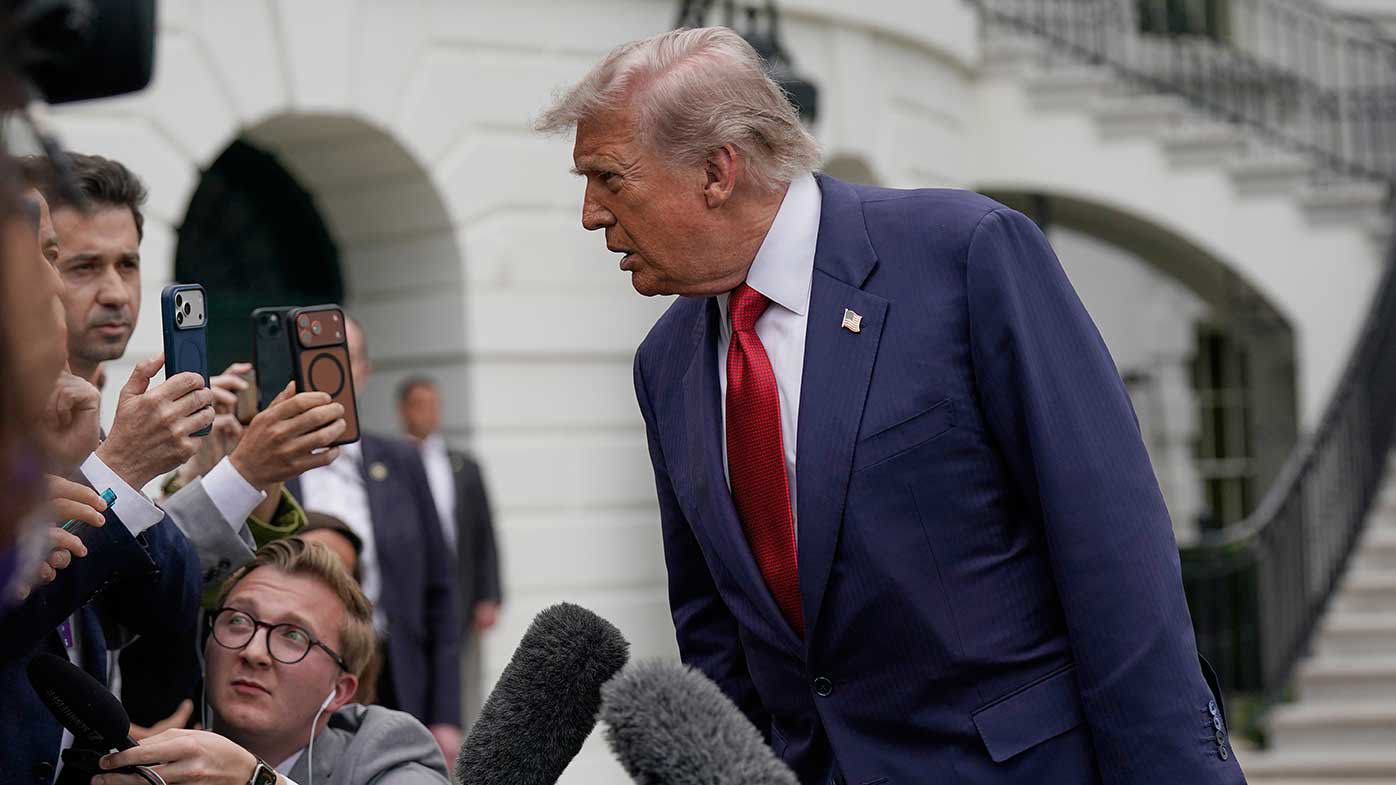
Donald Trump has defended his surprise attack on Iran by comparing it to Pearl Harbor while he sat next to Japan's prime minister.
At an Oval Office press event, Trump was asked by a Japanese reporter why he didn't inform his allies about his war with Iran ahead of time.
"Who knows better about surprise than Japan?" Trump said.
READ MORE: Trump berates allies as he finds himself alone on Iran war
"Why didn't you tell me about Pearl Harbor?
"No, you believe in surprise, I think much more so than us, and we had to surprise them and we did."
Sitting next to him, Prime Minister Sanae Takaichi shifted in her seat and appeared to wince.
Neither Trump nor Takaichi were alive at the time of the Pearl Harbor attack.
Trump's son Eric posted video of the exchange on X with two laughing emojis.
"One of the great responses to a reporter in history!" Eric Trump wrote.
Trump's reference to Pearl Harbor has been widely reported in Japanese media this morning.
He made the comment as he pressed Japan to "step up" in support for the US's war in Iran.
READ MORE: 'Dead by June': Trump announces congressman's private diagnosis
"We have 45,000 soldiers in Japan," Trump said.
"We have, we spend a lot of money on Japan so, and we've had that kind of relationship, so I expect, I'm not surprised, that they would step up."
Takaichi offered vague words of support but stopped short of any concrete commitments.
"Only you … can achieve peace across the world," she said to Trump."
"I am ready to reach out to many of the partners in the international community to reach our objectives together."
So far none of America's major allies have committed military support for the US operations in Iran.
Japan's surprise attack on Pearl Harbor, a military base in Hawaii, marked America's entry into World War II.
The attack would prove to be a sore point between the two countries long after the war ended.
READ MORE: Missing a train saved Tetsuko's life. 140,000 others weren't so lucky
NEVER MISS A STORY: Get your breaking news and exclusive stories first by following us across all platforms.
- Download the 9NEWS App here via Apple and Google Play
- Make 9News your preferred source on Google by ticking this box here
- Sign up to our breaking newsletter here
Missile lands metres from reporter crossing live on Russian TV from Lebanon
A missile has landed metres from a reporter crossing live for a Russian network on the war in Lebanon.
RT correspondent Steve Sweeney can be seen beginning to duck for cover as the noise of the incoming missile is heard in the background of his broadcast on Thursday.
Within a second, the projectile hits the ground close behind him, causing an explosion that sends dirt, dust and shrapnel into the air and apparently knocks over both the reporter and cameraman Ali Rida.
READ MORE: Trump threatens to 'blow up' world's largest gas field
https://x.com/M_Simonyan/status/2034586390395023699
They'd been reporting on the destruction of a bridge in southern Lebanon, which Israel has been bombing in its war with the Iranian-backed Hezbollah militant group.
In a later video for RT, Sweeney claimed the missile was "an Israeli precision strike from a fighter jet".
"We've been treated in hospital for our injuries," the Briton said.
"I had a shrapnel wound in my arm, deeply embedded in the bustle here that's been taken out, and here it is in this pot here."
RT, formerly known as Russia Today, was banned in the European Union in 2022 for systematically broadcasting disinformation about Russia's invasion of Ukraine.
The strikes in Lebanon have displaced more than 1 million people — roughly 20 per cent of the population — according to the Lebanese government.
LIVE UPDATES: Trump drops Pearl Harbour reference in meeting with Japanese PM
It says more than 1000 people have been killed and Israel says it has killed more than 500 Hezbollah militants.
In Israel, 15 people have been killed by Iranian missile fire.
Four people were also killed in the occupied West Bank overnight by an Iranian missile strike, according to officials.
Iran intensified its attacks on oil and natural gas facilities around the Gulf on Thursday, raising the stakes in a war that is sending shock waves through the global economy.
READ MORE: Tears after sex with student she should have been teaching
https://x.com/RichardEngel/status/2034606247182311694
The strikes, in retaliation for an Israeli attack on a key Iranian gas field, sent fuel prices soaring and risked drawing Iran's Arab neighbours directly into the conflict.
Tehran's targeting of energy production further stressed global supplies already under pressure because of Iran's stranglehold on the Strait of Hormuz, a strategic waterway through which a fifth of the world's oil is transported.
Since the US and Israel launched the war on February 28, Iran's top leaders have been killed in airstrikes and the country's military capabilities have been severely degraded.
Still, Iran — now led by the son of the supreme leader killed in the war's opening salvo — remains capable of missile and drone attacks rattling its Gulf Arab neighbours and a global economy dependent on the energy they produce.
– Reported with Associated Press
NEVER MISS A STORY: Get your breaking news and exclusive stories first by following us across all platforms.
- Download the 9NEWS App here via Apple and Google Play
- Make 9News your preferred source on Google by ticking this box here
- Sign up to our breaking newsletter here
Experts warn of 50 per cent food price spike as fuel crisis deepens
Australians are being warned to brace for a massive surge in food prices as the escalating conflict in the Middle East chokes global oil supplies and threatens to dismantle the nation's "just-in-time" logistics networks.
The grim forecast, driven primarily by an elastic shock to the supply and cost of diesel used by food trucks, depends on how long the conflict lasts.
As the blockade of the Strait of Hormuz enters a critical phase, leading academics say that the knock-on effect of soaring diesel costs is no longer just a headache at the petrol pump – it is becoming a threat to national food security.
READ MORE: PM's blunt message for Aussies making petrol prices worse
While the sight of $3-a-litre petrol has rattled commuters, the real danger lies in the fuel that powers the nation's heavy machinery.
Associate Professor Devika Kannan, from the University of Adelaide, warns that surging diesel prices could soon lead to some very painful supermarket bills.
"High fuel costs may compromise both food security and the resilience of domestic logistics infrastructure," Professor Kannan told the Science Media Centre.
"Surging diesel prices threaten a 50 per cent spike in food costs and the potential collapse of just-in-time logistics networks."
Associate Professor David Ubilava of the University of Sydney echoed this concern, noting that energy costs are baked into every stage of the food chain.
"Energy costs that are directly or indirectly linked to crude oil prices are a substantial component of the price we pay for a loaf of bread or a box of cereal," he said.
READ MORE: Is Australia headed for a recession? The latest job data paints a grim picture
Panic buying a "self-fulfilling prophecy"
Professor Ben Fahimnia of the University of Sydney said disruptions or sudden changes in demand tended to become amplified as they move through supply chains, a phenomenon known as the "bullwhip effect"
"A small movement at the handle can create a much larger crack at the tip," Professor Fahimnia told the Science Media Centre.
Fahimnia is among the experts who are pleading with the public to stop "panic buying," which can worsen the situation.
Economist Dr Scott French, from UNSW, described panic buying as a "self-fulfilling prophecy."
While it may seem prudent for an individual to fill up today, the collective action "overwhelms the system and creates the shortage that was feared."
READ MORE: What are the best ways to save fuel? Five tips to help Aussies save money on petrol
Is Rationing Next?
Australia's fuel resilience is under the microscope, with the country currently holding only 29 to 36 days of stock – well below the International Energy Agency's 90-day mandate.
Professor Kannan noted that if the Hormuz blockade exceeds 30 days, the Liquid Fuel Emergency Act 1984 could be triggered, ushering in formal transaction limits and fuel rationing. Already, nearly 20 percent of reserves have been released to support independent retailers in regional areas.
However, Dr Lurion De Mello of Macquarie Business School says the immediate focus should be on diesel, rather than petrol.
"Our diesel supply depends heavily on refineries in South Korea, Japan, and Singapore," De Mello said. "In the short term, limiting the filling of jerry cans at petrol stations could help stabilise demand."
If there is a silver lining, experts suggest this crisis may be the final push Australia needs to break its oil dependence.
"Every major geopolitical shock in an oil-producing region quickly becomes an energy and transport crisis," Professor Hussein Dia of Swinburne University said.
"Moving away from oil is as much about stability and security as it is about climate action."
NEVER MISS A STORY: Get your breaking news and exclusive stories first by following us across all platforms.
- Download the 9NEWS App here via Apple and Google Play
- Make 9News your preferred source on Google by ticking this box here
- Sign up to our breaking newsletter here