Tag Archives: oceania

Cheeky baby elephant interrupts Kenyan TV report

A Kenyan reporter has delivered a masterclass on how to keep your cool during a live TV cross, despite the best efforts of one cheeky baby elephant.

Adorable footage has emerged online of journalist Alvin Kaunda filming a piece to camera from an elephant orphanage in southern Kenya.

Kaunda begins his report describing the importance of conservation when the curious baby can be seen approaching from behind.

Watch the full video in the player above. 

READ MORE: Leaders call emergency meeting as missiles strike NATO country

The reporter manages to maintain his composure for the majority of the segment while the inquisitive infant runs its trunk along his head, shoulders and face. 

Standing in front of a group of three of the animals, it's not until about 20 seconds into the footage when Kaunda finally loses it.

When the elephant eventually places its trunk on Kaunda's mouth, the reporter couldn't help but erupt in laughter.

Students found dead in a house near US uni campus named

Four University of Idaho students who were found dead Sunday night in a house near campus have been identified, the city of Moscow's police department said in the US.

The slain students were 20-year-old Ethan Chapin of Conway, Washington; 21-year-old Madison Mogen of Coeur d'Alene, Idaho; 20-year-old Xana Kernodle of Avondale, Arizona; and 21-year-old Kaylee Goncalves of Rathdrum, Idaho.

Moscow police said they are investigating the deaths as homicides, but did not provide any other information about what happened. As of midday Monday local time, no suspect was in custody. Anyone with information about the case has been asked to contact police.

READ MORE: Russia rejects reports of missile strike on Poland as NATO allies respond

"The Moscow Police Department and the City of Moscow is deeply saddened for the families of these individuals, fellow students and friends, and our community during this time," the police department said.

"Our heartfelt sympathies go out to each and every person affected by this incident."

Moscow Mayor Art Bettge called the students' deaths "senseless acts of violence."

"This tragedy serves as a sobering reminder that senseless acts of violence can occur anywhere, at any time, and we are not immune from such events here in our community," the mayor said.

READ MORE: Trump prepares to launch third campaign for the White House

"Today, we grieve for those were lost and those they leave behind. Let us come together in support of each other, and be there for each other, as we mourn as a community."

Police have indicated "there is no ongoing threat," the university tweeted Sunday without elaborating.

Officers responded to a call about an unconscious person shortly before noon Sunday and discovered the four bodies, the Moscow Police Department said in a news release.

"It is with deep sadness that I share with you that the university was notified today of the death of four University of Idaho students living off-campus believed to be victims of homicide," university president Scott Green said in a statement to the campus community.

The slain students were also involved on campus, according to the university. Chapin was a freshman majoring in recreation, sport, and tourism management who was also a member of Sigma Chi fraternity. CNN has reached out to Sigma Chi.

LIVE UPDATES: Defence expert reveals 'best thing Russia can do'

Kernodle was a junior majoring in marketing and was also a member of Pi Beta Phi sorority, the university said. CNN has reached out to Phi Beta Phi.

Mogen was a senior majoring in marketing and Goncalves was a senior majoring in general studies, according to the university.

Counseling will be provided on campus for students and employees through Tuesday, the school said.

The tragic discovery came as another US college campus – the University of Virginia in Charlottesville – is reeling as three students were fatally shot Sunday. The alleged gunman, identified as a UVA student, was been taken into custody Monday morning after an hours-long manhunt.

At the University of Idaho, in-person and online classes Monday are canceled and set to resume Tuesday.

"We are grateful for the support of the community and the ongoing efforts of the Police Department. The university is committed to supporting students and families during this difficult time," Green said.

CNN has reached out to the university and to the police department for more details.

Extreme weather to strike Australia decades earlier than expected

Climate change is likely to change eastern Pacific weather patterns within the decade, a new study has found, meaning Australia needs to start preparing for "extreme" flooding and drought events sooner than anticipated.

The paper, published today in Nature Communications, predicts climate-change-related variation in El Nino–Southern Oscillation (ENSO) events will be detectable in the region by 2030.

This is four decades earlier than previously thought.

READ MORE: Leaders call emergency meeting as Russian missiles strike NATO country

Galahs attracted to the feed on the ground for sheep at sheep and crop farmer Rowan Cleaver's property at Duck Creek near Nyngan, NSW. Large parts of NSW are facing severe drought conditions and have been in drought since 2017. fedpol Photo: Alex Ellinghausen Wednesday 6 November 2019. (AFR for Tom McIlroy)Drowned sheep in central Cowra Flooding damage as waters drop in Cowra. on November 15, 2022.

ENSO events include the warm El Nino, which is typified by drought, and cold La Nina events, typified by the prolonged rain seen in Australia in recent years.

Dr Wenju Cai, a climate scientist with the CSIRO, told 9news.com.au Australia would be one of the countries worst affected by changes in either event.

"Australia is one of the most affected countries in the world when it comes to extreme weather," he said.

"(We can expect) more frequent, longer and more intense drought; and more frequent, stronger La Ninas.

"When it rains it will rain a lot harder. It rains cats and dogs.

"In dry conditions, during El Nino … we will enter drought earlier, it will last longer and it will be harder to get out of. It will be more severe."

READ MORE: Two missing from flood-hit town as disaster continues in NSW

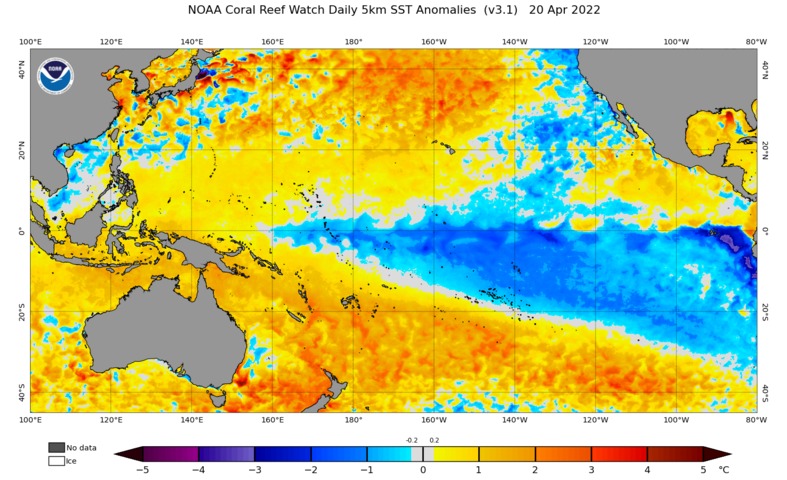
Current sea surface temperature anomalies in the Pacific Ocean, showing a distinctive La Niña pattern with cooler-than-average water in the central and eastern equatorial Pacific Ocean and warmer-than-average water in the western equatorial Pacific Ocean. Summer sea surface temperature rankings for Australia are seen during 2016, an El Nino year.

Cai and colleagues poured over 70 years of ENSO dataand used some of the newest climate models to estimate when increased ENSO variability will be detectable in the eastern or central Pacific.

"By 2030 we will be able to say that climate change has induced a substantial change to El Nino," he said, explaining that impacts were currently "masked".

"We will be able to say clearly climate change has had an impact and that impact is detectable, with climate change making El Nino and La Nina more extreme.

"The most suitable place to find evidence for this is in the oceanic sea surface temperature in the eastern equatorial Pacific."

EXPLAINED: What to do when you find mould in your home

Australia is currently battling its way through its third consecutive La Nina, which has caused record-breaking floods across multiple states.

Video shared yesterday showed a "wall of water", akin to an inland tsunami, racing through NSW's central west.

More than 220 people were rescued from flooding over a period of 24 hours.

Tribute to 'loving', 'creative' Aussie social worker who died in Seoul

A second Australian has died in South Korea from injuries sustained in a horrific crowd crush at Halloween festivities in Seoul.

Justina Cho, 28, spent two weeks in hospital before succumbing to her injuries.

On the night of the incident, she was celebrating with Australian film producer, Grace Rached, 23, who was also killed.

READ MORE: Christmas tree scam warning over dodgy Facebook sellers

Justina Cho, top left, spent two weeks in hospital before succumbing to her injuries. Grace Rached, bottom right, also died.

READ MORE: Australian-born boy faces deportation because of his condition

Justina died on Sunday, surrounded by her immediate family who'd flown to her bedside.

Justina's younger sister, Julia, issued a statement on behalf of her family, saying the social worker had moved to Korea a little more than three months ago to pursue her dream of starting her own fashion label.

"Her life was changed overnight due to an incident that could've so easily been prevented," Julia said.

"Her doctor said it was a miracle that her heartbeat returned once in hospital and that she must have wanted to wait until her family could come see her before she said goodbye forever."

Julia remembered Justina as a creative person who would always put others first and said she and her friends would continue to honour her memory.

"We know she is so deeply loved by so many people and it shows just how big her heart was," Justina said, asking for people to respect her family's privacy.

"She will always be remembered as the loving, caring, wise, creative, expressive, gentle, and free-spirited soul she is."

At least 156 people died when a huge Halloween party crowd surged into a narrow alley in a nightlife district.

Almost 200 more were injured.

Witnesses said that people fell on each other like dominos, screamed, suffered severe breathing difficulties and lost consciousness while crammed into a sloped, narrow alley.

The pair who died were pictured together in fancy dress on the night with two other friends, including Australian man Nathan Taverniti.

He was on holiday with Rached and blamed "mismanagement' for the tragedy.

A second Australian has died in South Korea from injuries sustained in a horrific crowd crush at Halloween festivities in Seoul.Justina Cho, 28,  spent two weeks in hospital before succumbing to her injuries.A second Australian has died in South Korea from injuries sustained in a horrific crowd crush at Halloween festivities in Seoul.Justina Cho, 28,  spent two weeks in hospital before succumbing to her injuries.

"It was a slow, agonising crush. This crush was not caused by drunk people. It was lack of planning, police force and emergency services," Taverniti said.

"And nobody was willing to help. I watched as people filmed and sang and laughed while my friends were dying, along with many other people.

"I was there trying to pull people out because there was not enough police officers and nobody was doing anything to make the crowd stop."

READ MORE: Mum furious after Optus brings back pain of son's death

Police officers work at the scene of the fatal crowd surge, in Seoul, South Korea.

President Yoon Suk Yeol later acknowledged that South Korea lacks studies on crowd management and ordered officials to formulate effective crowd control methods based on high-tech resources such as drones.

Police also said they don't have guidelines to deal with crowd surges at events that have no official organisers, like the Halloween festivities in Itaewon.

– Reported with AP.

As climate warms, a China planner advocates 'sponge cities'

To cushion the impact of extreme weather due to climate change, a Chinese landscape architect has been making the case for China and other countries to create so-called "sponge cities".

Yu Kongjian, who spoke to The Associated Press in Beijing, uses sweeping language to express his vision for cities that can withstand variable temperatures, drought and heavy rainfall. The challenges for implementing this vision at a time of ambitious economic development in China are multifold.

Yu criticises much of Asia's modern infrastructure for being built on ideas imported from Europe, which he says are ill-fitted to the monsoon climate over much of the Asian continent. He points to recent floods that have wreaked havoc in many Asian cities, which he says are caused by this architectural mismatch.

READ MORE: Christmas tree scam warning over dodgy Facebook sellers

"There's no resilience at all," Yu says of the concrete and steel infrastructure of major cities, and of using pipes and channels to funnel away water. "Those are useless, they will fail and continue to fail."

Instead, Yu proposes using natural resources, or "green infrastructure" to create water-resilient cities. It's part of a global shift among landscape design and civil engineering professionals toward working more in concert with the natural environment. By creating large spaces to hold water in city centres — such as parks and ponds — stormwater can be retained on site, helping prevent floods, he says. Sponge infrastructure also, in theory, offers ways for water to seep down and recharge groundwater for times of drought.

"The idea of a sponge city is to recover, give water more space," Yu said.

A turning point in China's awareness of climate change and urban adaptation came a decade ago, Yu said. A devastating flood hit the capital city of Beijing in July 2012.

READ MORE: Australian-born boy faces deportation because of his condition

Beijing's biggest downpour in 61 years overwhelmed drainage systems, swamped downtown underpasses and sent flash floods roiling through the city's outskirts. At least 77 people died.

Yu at the time sent a letter to Beijing's party secretary, Guo Jinlong, calling for a change in how the government approaches city infrastructure. He continued to send letters to high-ranking officials and top leadership, including China's leader Xi Jinping.

At a government working conference the next year, China incorporated the idea of sponge cities as a national strategy, "giving full play to the absorption, storage and slow release of rainwater by ecological systems."

In 2014, the central government issued a directive: Recycle 70 per cent of rainwater runoff in 20 per cent of urban areas by 2020, and in 80 per cent of such areas by 2030.

READ MORE: Mum furious after Optus brings back pain of son's death

The following year it launched 16 pilot sponge city projects, adding 14 more in 2016. Officials also said they would award 600 million yuan ($126.78 million) each year for three years to municipal cities, 500 million yuan ($105.65 million) to provincial capitals, and 400 million yuan ($84.52 million) to other cities.

The top-down mandate and subsidies spurred a boom in water-absorbing infrastructure, including in large cities including Beijing, Shanghai and Shenzhen.

Cities around the world are similarly trying to integrate "bioswales" along the sides of roads, protect remaining marsh areas to absorb water, and increase the capture of roof rainwater.

AN EXPERIMENT UNDERWAY

In China, one demonstration park is located in the northeast corner of the city of Nanchang, southern China. In mid October, engineers were putting finishing touches on a lush, picturesque 126-acre park designed to cushion the impact of both floods and droughts.

Formerly a coal ash dump site, the "Fish Tail" sponge park is built in a low-lying section of the city and intended to regulate water for surrounding neighbourhoods and business districts. The fly ash, a byproduct of coal combustion, was mixed with soil to create mini-islands in the lake that allow water to permeate. Fang said the mixture, held in place by plant roots, prevents the ash from flowing into the water.

During dry periods, the water could be withdrawn, purified and used for plant irrigation.

Fang Yuan, an engineer at Yu's design institute, Turenscape, said the park serves as "an ecological aquarium," capable of retaining 1 million cubic metres of water during floods and means the water can be used, instead of just discharging it into the sewage system.

The park also serves as a habitat for plants and wildlife disrupted by extreme weather such as drought.

AN UNCERTAIN FUTURE

At times, the sponge city concept has been difficult to implement in China. Misallocation of funds, lack of expertise in sponge city planning, and other snags have doomed some projects.

In April, the Ministry of Housing and Urban-Rural Development announced some cities had "insufficient awareness, inaccurate understanding, and unsystematic implementation of sponge city construction."

The notice also warned against using funds earmarked for sponge city construction for other general infrastructure projects, such as buildings and roads.

Those guidelines were issued after massive rainfall and catastrophic floods in the city of Zhengzhou killed 398 people last summer. Floodwater inundated a section of the city's subway, trapping hundreds of commuters. Rescuers flocked to the scene, but 14 people died in the subway disaster.

Notably, Zhengzhou was one of the pilot sponge cities, with a planned investment of 53.58 billion yuan ($11.32 billion). Some questioned whether sponge city projects work at all.

But an investigation by the State Council released in January, found that funds had been misspent. Only 32 per cent of the 19.6 billion yuan ($4.14 billion) that was invested went to what the government defined as sponge city concepts.

"Even at the critical moment when the whole country mobilised forces to support Zhengzhou's rescue and disaster relief, they were still "building flower beds," the State Council report said.

Yu acknowledges there is an oversight problem. "Many of the cities just use it as propaganda — just to get a lot of money from the central government," but then invest the funds in other projects.

POYANG LAKE

While problems implementing absorptive cities are worked out, China's vulnerability to extreme weather is clear. A prolonged drought since July has dramatically shrunk China's biggest freshwater lake, Poyang.

In the village of Tangtou, on the lake's normally water-blessed northeast corner, residents scooped buckets of water from a village pond to tend their vegetables.

Since July, villagers say they've hardly seen any rainfall, let alone water in their corner of the lake.

"The whole lake was completely dry, and even the Yangtze River was dry," said 73-year-old Duan Yunzhen, as he scattered pond water onto his crops.

"We planted rice, cotton, sesame, and sweet potato — they are all suffering from drought," said 62-year-old Hong Zuhua.

Floodwaters hit Forbes as Lachlan River expected to peak overnight

Forbes is being inundated by floodwaters as the Lachlan River rises to its expected peak of 10.8 metres.

Flood warnings are in place across 25 areas in Central West New South Wales as locals in Eugowra, and surrounding towns near Orange, begin a mammoth clean-up mission.

The entire township of Forbes has evacuated as flooding divides the town into three: the north, CBD and south.

READ MORE: Elderly Eugowra resident rescued after being trapped in washed-away home

Residents have been ordered to stay in the area they are in right now and remain there for several days or until floodwaters recede.

The Bureau of Meteorology (BoM) is expecting the Lachlan River to peak overnight and into tomorrow morning, which is a similar reading to the 1952 flood for the second time in as many weeks.

NSW residents can stay up to date with the latest emergency warnings at the SES website.

If waters reach the record height, 500 to 600 homes are expected to be flooded.

Waters at Canowindra were at 14.3 metres, a metre higher than the flooding last November.

Cowra also recorded its highest daily rainfall total in 118 years on the weekend, with 121mm.

READ MORE: Tugboat debacle at Aussie ports may cause Christmas chaos

Forbes mayor Phyllis Miller said locals were fully prepared.

"The houses that were damaged in the last flood two weeks ago, fortunately not too many people had moved back in," Miller told 9News.

"It's just a waiting game… the water comes down from Wyangala and we just sit and wait to be washed off the map.

"I have spoken to a few personally and it's tough on them… they had the big driers in (their homes) and they were looking forward to being able to move back in but of course that's not going to happen again."

Earlier NSW Emergency Minister Steph Cooke said in the past 24 hours, there had been more than 900 calls for help to the SES, and 222 flood rescues.

"We now have 70 local government areas that are the subject of a natural disaster declaration as a result of this event, which is now in its 63rd day," Cooke said.

READ MORE: Australian-born boy faces deportation because of his condition

NSW Premier Dominic Perrottet warned of a difficult period over the next couple of days for Eugowra and Forbes.

"In Eugowra and Forbes, there is a continued focus at the moment on the response, on rescues, on keeping people safe," Perrottet said.

"Clean-up and recovery is now in the early stages in Molong, in Canowindra, and the ADF are providing assistance there."

READ MORE: Christmas tree scam warning over dodgy Facebook sellers

An extra 100 defence personnel are on the ground helping with the flood response.

Perrottet says his government is committed to raising the Wyangala Dam, which is currently spilling 230 gigalitres a day into the Lachlan River.

"You've got a situation right now where that catchment is spilling," he said.

"There's a lot of water coming out of it and we need to make sure that in years to come, when we're facing the same situation, that we've made the decision and made the investment to protect those communities and that's what we're going to do."

SES Commissioner Carlene York said the organisation would look at its resources to make sure it could meet future challenges, as international help arrives.

"The NSW SES are leading what would be the biggest operation in relation to flood response across NSW in its history," she said.

New Zealand fire and emergency services have sent 12 people to help in the crisis.

Earlier, locals in Cudal told 9News the water in a creek behind their homes rose so quickly it caught them off guard.

"If I had have stayed in bed… I would have been a bit muddy," resident Nick said.

Helicopters and boats were used to carry out over 150 rescues in the inundated town of Eugowra, where people were forced to make for their roofs as floodwaters rose.

Those residents have started a register system to ensure everyone has made it safely to a friend's place or to an evacuation shelter.

The LifeFlight helicopter has rescued 18 people and 14 pets from floodwaters in the NSW Central West.

Video shows a "wall of water" bringing devastation to New South Wales towns, which comes as the Wyangala Dam spilled record amounts of water, after 100mm rain fell in just a few hours.

Floods have ripped up the road and destroyed a bridge into the town of Canowindra, while the Wyangala Dam is spilling 80,000 gigalitres a day into the Lachlan River.

The first rescue occurred at Ophir Reserve Campground near Orange after floodwaters quickly submerged the area, surprising campers.

READ MORE: Taxi trend that's 'ripping people off'

Three people and a dog were rescued from the site.

"The campers told the crew it wasn't raining when they went to bed last night, but they awoke early this morning to water rising halfway up caravans," LifeFlight said in a statement.

"The crew provided care to keep them warm as they were suffering hyperthermia-like symptoms."

The group was then transferred to an ambulance at Orange Airport.

READ MORE: Australia still among worst climate performers despite new targets, report finds

The LifeFlight helicopter has rescued 18 people and 14 pets from floodwaters in the NSW Central West.

The helicopter continued on its rescue mission to Eugowra where two neighbours were trapped by surrounding fast-flowing floodwaters.

"The LifeFlight paramedic, who is also a qualified rescue crew officer, was first winched down to a woman waiting in her house and brought her up to safety before rescuing the neighbour from the back of a ute," LifeFlight said.

Residents in and around Eugowra remained under directions to move to higher ground with those in other small towns in the area such as Gooloogong and Canowindra told to evacuate.

READ MORE: Four arrested over alleged suspicious betting on Brownlow Medal

Further upstream, the helicopter found a woman whose home had been destroyed after floodwaters blew out the windows due to the shear force of the torrents.

"She had made it out onto dry ground so the crew was able to land the Land Rover LifeFlight Special Mission helicopter in a nearby paddock to collect her," LifeFlight said.

The LifeFlight helicopter has rescued 18 people and 14 pets from floodwaters in the NSW Central West.

The biggest operation was in Eugowra where 12 people, 10 dogs, two cats and a pet turtle were winched to safety.

It comes as floodwaters in the state's Central West reach record-breaking levels and show no sign of ceasing.

The LifeFlight rescues are among hundreds in the area.

Urgent nationwide poppy seed recall over fears of 'severe poisoning'

An urgent nationwide recall of Hoyts poppy seeds has been issued after the product was found to contain a "severely poisonous" chemical.

Sold at both Coles and Woolworths around the country and produced by Hoyts Food Manufacturing, the seeds could prove very harmful if ingested in high doses.

"The recall is due to the potential presence of a chemical (thebaine) due to unsafe poppy seeds entering the food supply," Food Standards Australia and New Zealand said.

READ MORE: 'Wall of water' devastating NSW towns in flood crisis

"Food products containing thebaine may cause illness if consumed. Severe poisoning soon after ingestion has occurred in some people who have consumed large amounts of poppy seeds.

"Consumers should not eat these products and should return to the place of purchase for a full refund and safe disposal.

READ MORE: Shocking footage reveals moments after Adelaide shark attack

"Any consumers concerned about their health should seek medical advice."

Last week, NSW Health issued an alert warning Aussies over the consumption of high volumes of the seeds.

"At least eight people in NSW presented to hospital with severe poisoning soon after ingestion," NSW Health said on social media.

"More cases have been reported interstate.

"The investigation is ongoing and there have been no cases of poisoning in people who have eaten poppy seeds as part of a baked food product." 

https://twitter.com/NSWHealth/status/1590958184965214210?s=20&t=k48I42WX6K03LifZjvaNcg

Just days ago, a recall was issued for a device designed to administer insulin to people with diabetes, with fears it may swell, leak fluid, overheat or catch on fire.

The Omnipod DASH personal diabetes manager (PDM) is the hand-held companion to a wearable device, which assists in providing up to three days of insulin delivery without the need for injections.

But Product Safety Australia has warned if the battery pack of the smartphone-looking product overheats, it could result in a fire "which can cause serious injury or death".

Albanese and Xi hold meeting in Bali

Anthony Albanese and Chinese President Xi Jinping have arrived for their meeting on the sidelines of the G20 in Bali.

The bilateral talks are the first between Xi and an Australian prime minister in six years and come at a time when the relationship between the countries is at a bitter low.

The pair smiled as they shook hands in front of cameras.

READ MORE: Second Australian dies after South Korea Halloween crush

https://twitter.com/AlboMP/status/1592436720733388801

Xi addressed the meeting first. A translation of his remarks was not immediately available.

Albanese acknowledged the countries "have had our differences" but said he was hopeful of "a constructive exchange and dialogue today".

"I am very pleased that we are having this meeting here today," Albanese said.

"It comes at a time of great global uncertainty. We're facing challenges of COVID and the recovery, dealing with climate change, and also supply chain shocks. As we manage these challenges, we need to work towards a stable, prosperous and peaceful Indo-Pacific, and an international system that is governed by international law and the principles that are enshrined in the United Nations charter.

"We have had our differences, and Australia won't resolve from our interests or our values, but our bilateral relationship is an important one. Both sides have worked to stabilise the relationship based upon mutual respect and mutual benefit."

READ MORE: Hopes Albanese-Xi meeting can unlock $20 billion in trade

Albanese reflected on the 50-year milestone of diplomatic relations between the two countries, first established by former Labor prime minister Gough Whitlam in 1972.

"We agreed (in 1972) on principles to guide the relationship based on equality, mutual respect and benefit, and a commitment to co-exist peacefully, and these principles remain important today," Albanese said.

"President Xi, I look forward to a constructive exchange and dialogue today. I thank you."

Ahead of the meeting, Albanese had been cautiously optimistic about what he hoped to achieve.

"Having the meeting is a successful outcome," he said on Monday night.

"Because for six years, we have not had any dialogue. And it is not in Australia's interest to not have dialogue with our major trading partners.

"So, having the meeting, there are no preconditions for the meeting."