A person is in hospital with serious burns after a fire broke out at a house in South Auckland overnight.Fire crews and emergency staff were called to a property on Nina Place, in Manurewa, after reports of a fire about 12.10am….
Tag Archives: oceania
Subduction zone secrets: Is this how NZ forecasts 'megaquakes'?
Mysterious, silent earthquakes could be key to forecasting the next catastrophic rupture on New Zealand’s largest fault: the gigantic Hikurangi Subduction Zone . A newly-funded, million-dollar study will draw on a trove of data…
Earthquake shakes Melbourne's south-east
Officials say there is no tsunami threat after an earthquake was recorded in Melbourne early this morning.
The 2.4 magnitude tremor was recorded at 5.40am on Sunday, near Frankston in the city's south-east.
By 8.30am, more than 200 felt reports were received Geoscience Australia.
READ MORE: Melbourne police officer injured in hit-and-run on school grounds
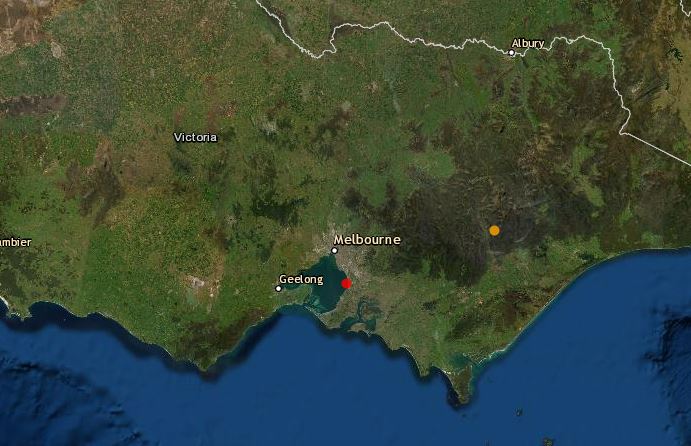
Users on Twitter reported feeling the earthquake early this morning, with one person saying "it felt like a bang".
"It was a wild minute or two when the house rocked," another user said.
The Victorian SES said no damage was reported and they had not received any calls for assistance.
There have been no reports of any aftershocks.
Dog attack: Rotorua dog missing after being bitten at park
A Rotorua couple are devastated after their small dog was attacked by a larger one at a dog park – and later vanished.Heather Kelly and her husband Ken fear the worst after their 4.5kg Chinese crested papillon cross, 14-year-old…
Covid 19: How did Pfizer vaccine fare against Omicron in New Zealand?
New Zealand confronted Omicron as one of the most vaccinated populations on the planet – so what difference did that make in blunting the worst impacts? That’s what researchers plan to find out in a new study exploring the effectiveness…
A giant 'bullseye' on the Nullarbor Plain was created by ancient sea life
Environments across the planet are changing dramatically in response to human population growth and climate change. Some scientists even say human activity has pushed Earth into a new geological epoch: the Anthropocene.
Amid this rapid transformation, some special places, protected by fortuitous geography and geology, change so slowly they preserve evidence of Earth's past over unfathomable timescales.
One such place is the flat, dry expanse of the Nullarbor Plain in southern Australia, where traces still remain of events millions of years in the past. Using high-resolution satellite imaging we have begun to map out some of these traces.
In new research published earlier this month in Earth Surface Processes and Landforms, we report the discovery of an enigmatic "bullseye" structure more than a kilometre across. We believe it is the remains of an ancient reef, created by microbes some 14 million years ago when the Nullarbor was at the bottom of the ocean.
EXPLAINED: Magpie swooping season is upon us – here's how to avoid attack
No trees, no water, but not boring
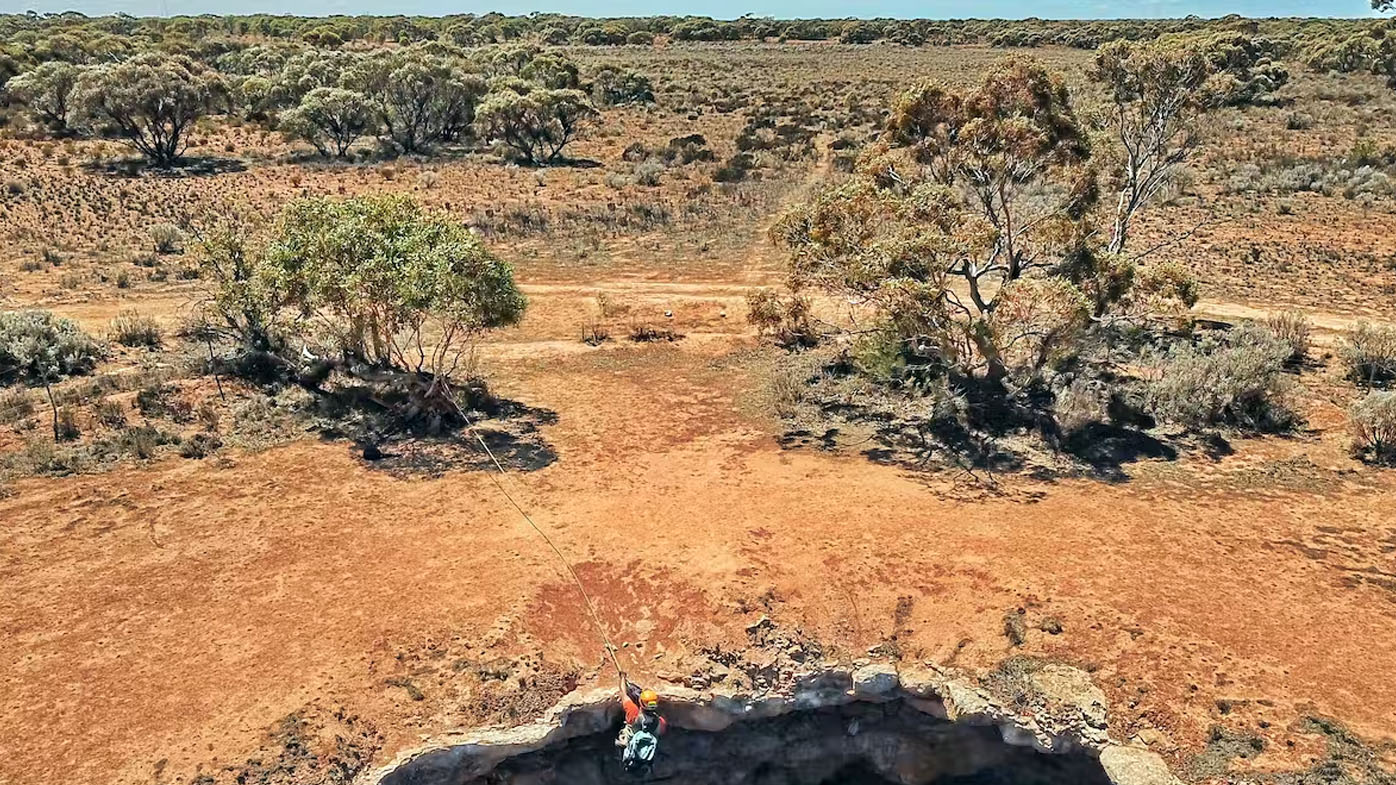
Named the Nullarbor Plain (meaning "treeless") during colonisation, and Oondiri (meaning "waterless") by some of the First Nations people of the area, the region is notoriously dry, flat and barren. The exceptional overall flatness of the plain (the average slope is much, much less than 1 degree) is one of the first indicators of the region's stability.
The rocks beneath the Nullarbor Plain are made of limestone that originally formed in shallow marine seagrass meadows. Such rocks can dissolve in weakly acidic rain and groundwater.
EXPLAINED: Petrol prices are about to jump up. Here's why
Due in part to its dryness, the region has not been intensively dissolved, or eroded by rivers or glaciers in the millions of years since it emerged from the ocean. This is in stark contrast to the classic ruggedness of much younger tropical landscapes (such as the volcanic Hawaiian islands), which are far wetter and more geologically active.
The plain covers some 200,000 km² and, like the curvature of the Earth, landscape features on the Nullarbor Plain are almost imperceptible to the human eye. Despite this subtlety, the area is not as featureless as you might think.
Careful scientific study and high-resolution satellite data are increasingly revealing the secrets of the Nullarbor Plain's past.
Mummified marsupials and ancient dunes
Isolated caves do punctuate the Nullarbor Plain. Within their dry chambers, remarkably preserved fossils yield glimpses of Australia's extinct animals that would rival the most wondrous zoo menagerie.
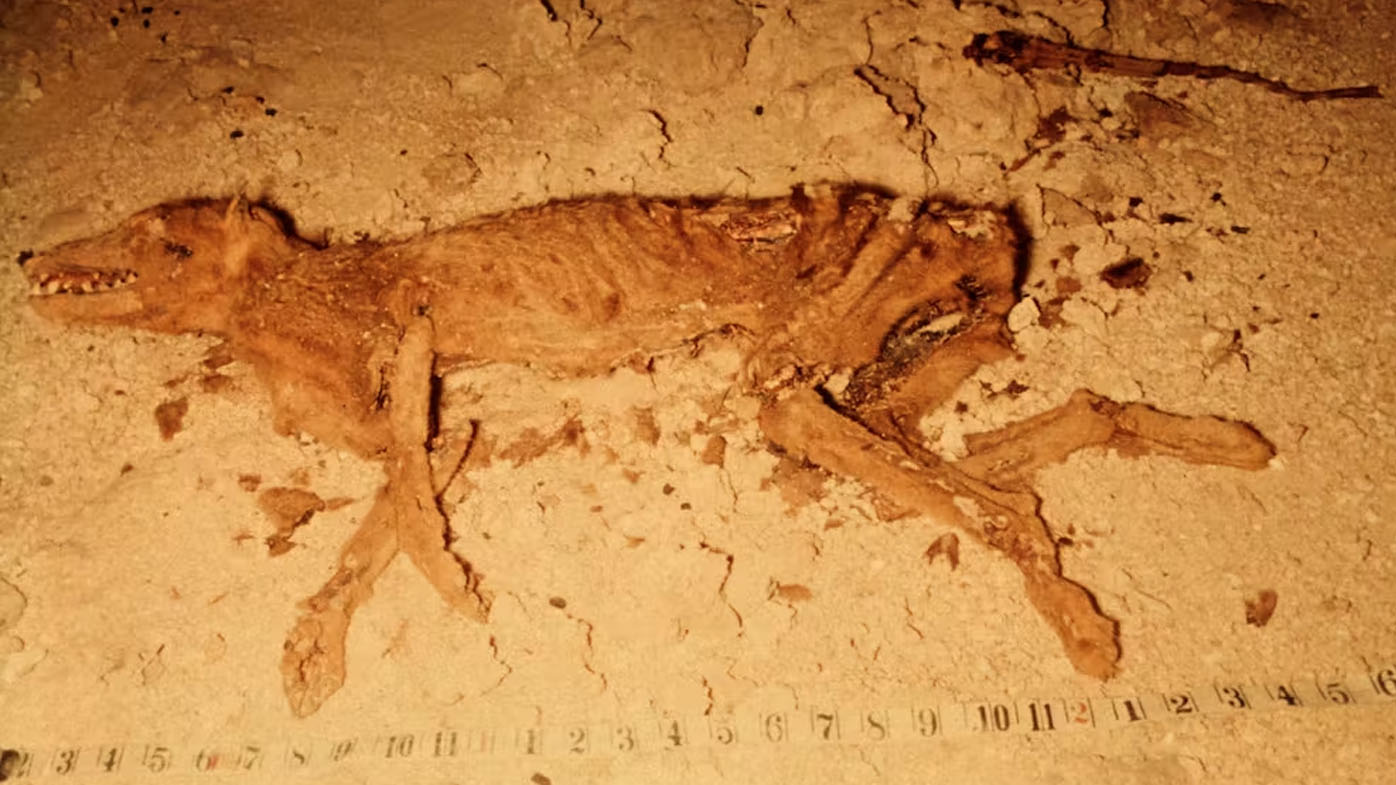
Mummified thylacine (Tasmanian tiger) remains and complete thylacoleo (marsupial lion) skeletons from thousands of years ago capture striking snapshots of changing ecosystems.
Older still are gentle linear ridges that cross the Nullarbor Plain. Recently, we showed these ridges are relics of a long-vanished landscape. Ancient sand dunes controlled the gentle dissolution of the underlying limestone to leave a subtle imprint of windblown patterns from millions of years ago.
READ MORE: Why Australia needs to prepare for nuclear attack
The bullseye
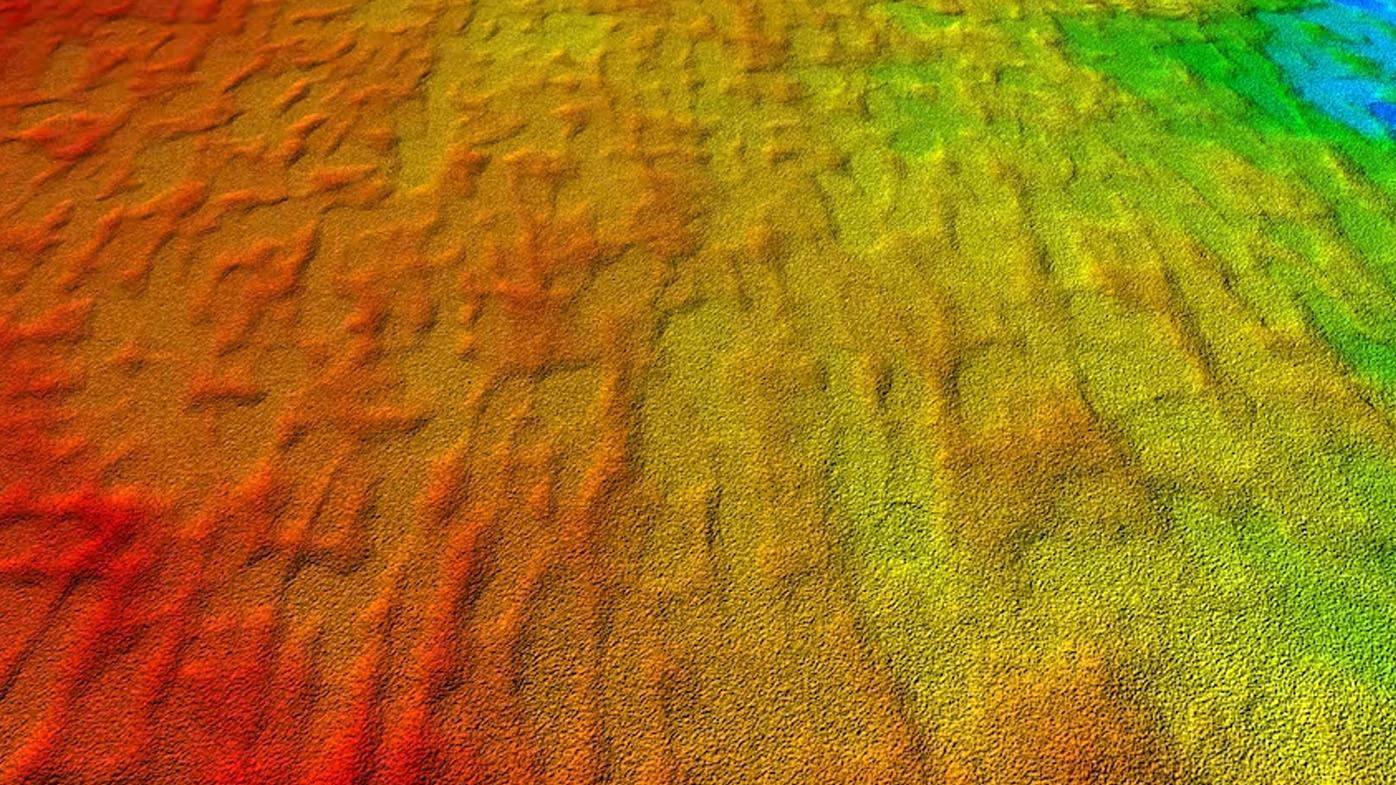
For our most recent work, we used landscape data from the TanDEM-X Digital Elevation Model produced by the German Aerospace Centre, which has a resolution of around 12 metres.
Studying these images of the Nullarbor revealed a previously unnoticed "bullseye" feature: a ring-shaped hill with a central dome, just over a kilometre wide and only a few metres high.
READ MORE: 'Eureka' discovery in remote jungle cave 'changes history of human medicine'
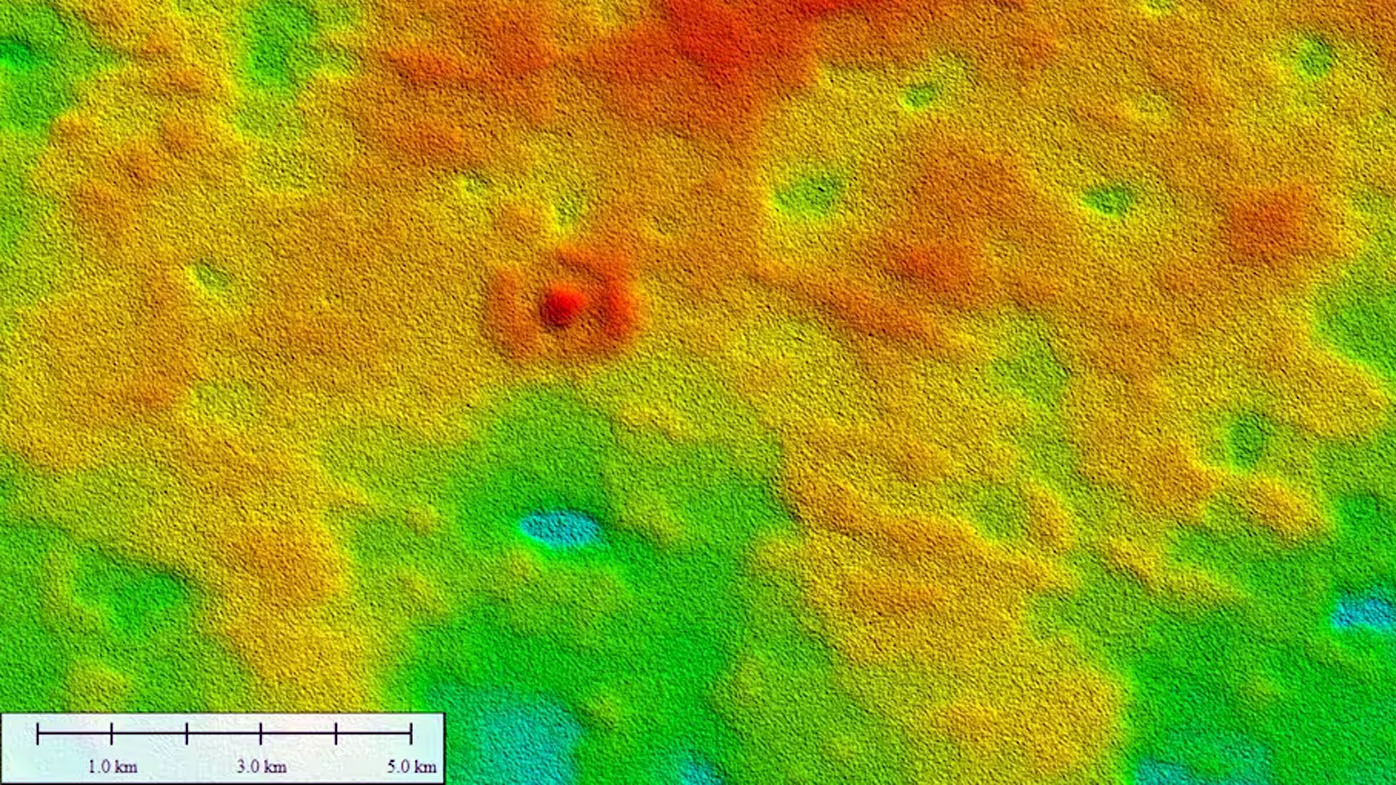
Initially, we thought we had found the first meteorite impact crater to be discovered on the Nullarbor Plain. The area is famous for meteorites that can help us understand the history of our solar system, but to date no definitive craters caused by meteorites have been found.
However, when we took a closer look at the bullseye we saw none of the chemical or high-pressure indicators of an impact.
We uncovered the real explanation for the bullseye after cutting and polishing samples of rock thin enough to let light shine through, and inspecting them under a microscope. Unlike the limestone seen at hundreds of other sites across the plain, here we saw evidence for tiny microbial organisms holding the sediment together.
Supported by similar "doughnut" structures formed by algae on the Great Barrier Reef, we interpreted the bullseye as an ancient isolated "reef". This biogenic mound formed on the seabed long ago but degraded so slowly after the land was lifted above the waves that it is still recognisable roughly 14 million years later.
How understanding the past can help the future
Our findings add to increasing recognition of the region as an exceptional archive of environmental change that we must better understand and protect.
The emergence of the Nullarbor Plain has been an important driver of the evolution of plants and animals. Ancient fossils and even DNA preserved due to the stable conditions will help us more accurately reconstruct its vanished ecosystems.
More complete understanding of how landscapes and ecosystems were transformed in the past will, in turn, help us conserve the animals, plants and environments we have today, and minimise the negative impacts of future anthropogenic climatic change.
This article was originally published on The Conversation and is republished here with permission.
'The silence and images will speak loudly': Overton expecting a day like no other ahead of Queen's funeral
London: When 9News anchor Peter Overton arrived in London and headed to his broadcast position at St James' Palace, he was struck by one thing.
"What hit me was the silence," he told 9news.com.au.
"London is an intense, busy global city. But there seems to be a reverence right now. The only noises you hear are the sirens of the emergency services doing their job. Everything else is silent."
FULL COVERAGE: The death of Queen Elizabeth II
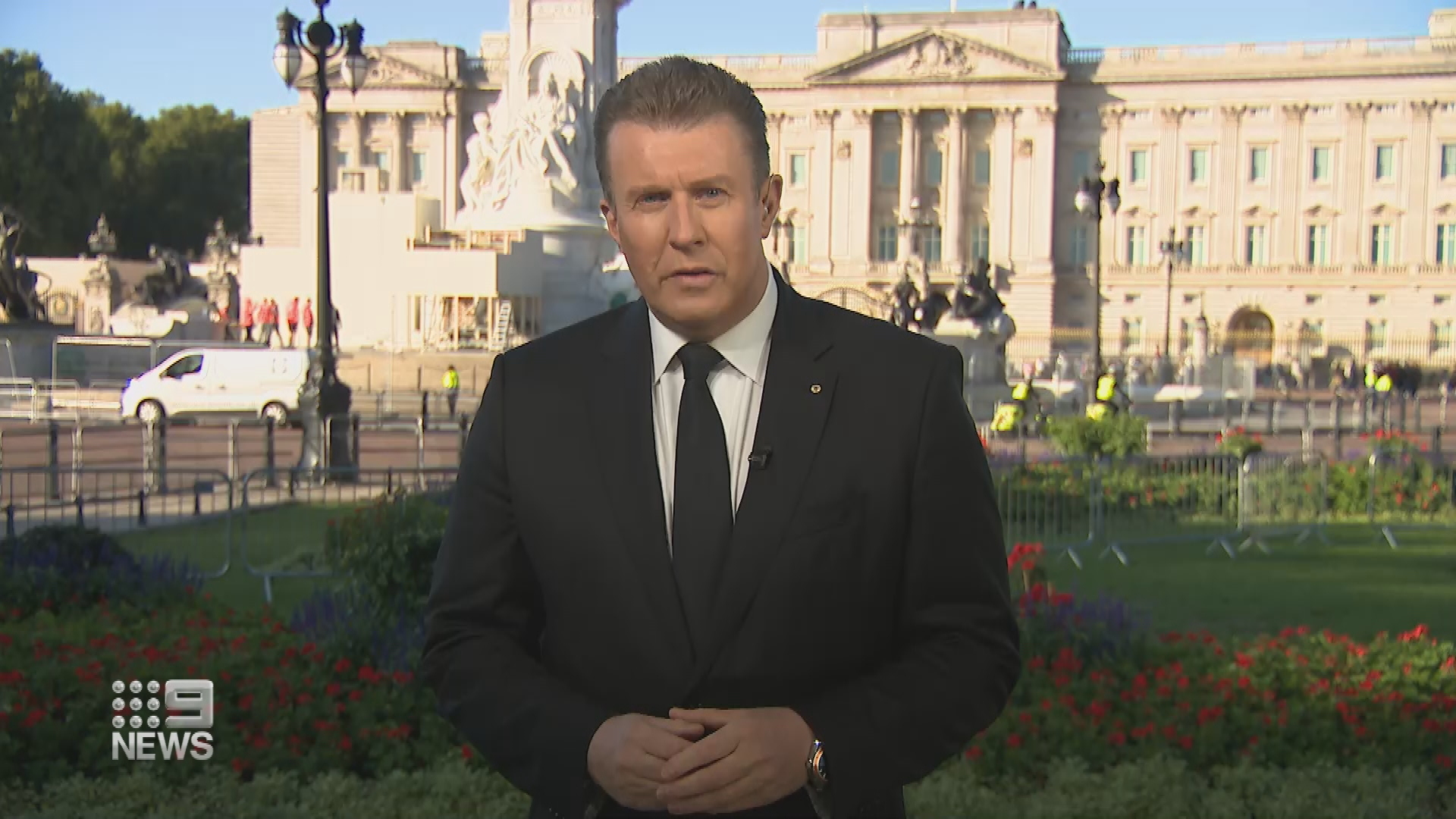
Overton, who presents the 9News Sydney 6pm bulletin, is in the UK along with colleagues Tracy Grimshaw, Karl Stefanovic and Allison Langdon for Nine's coverage of the funeral of Queen Elizabeth II on Monday.
"As a journalist, you come in and you're in the moment," he said.
"You have a job to do. Sometimes, you need to step back and say, you know, we're part of history here. We are witnessing history.
"I think that people are still processing that she's gone.
"The woman that we all thought was bulletproof, that would never die, is gone.
"And I think that's striking people now and that's why we're seeing 12-hour queues for people to pay respects to Her Majesty.
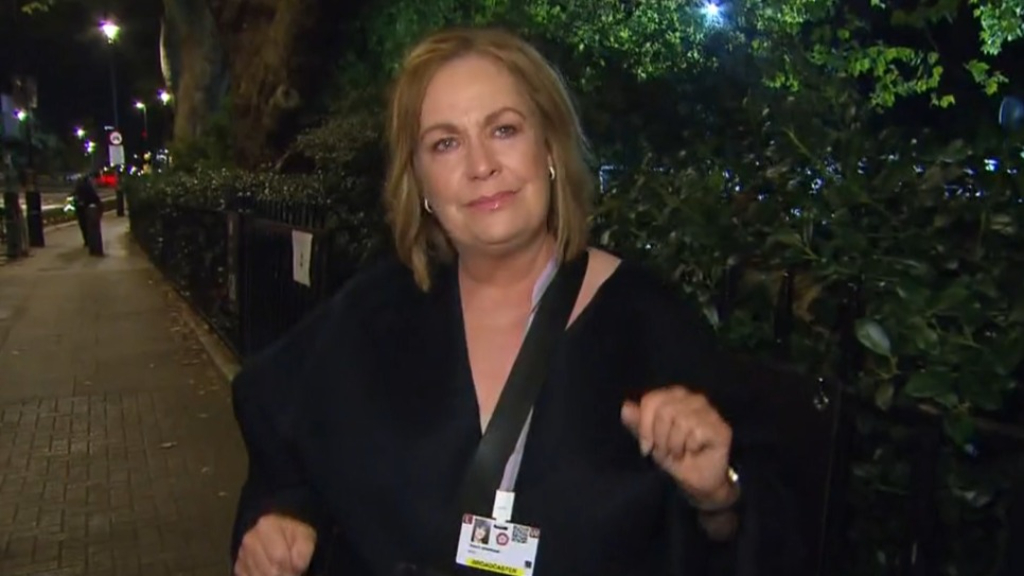
"Just look at Tracy Grimshaw's reaction when she went to Westminster Hall and saw the Queen lying in state.
"I mean, Tracy has been around a long time. She's seen some stuff.
"Trace was clearly deeply moved. How could you not be deeply moved when you stop and think about who is lying there?
"It's not only the Queen. It's a mother, a grandmother and a great-grandmother. And I think she's just remarkable.
Nine's Brett McLeod on covering Queen's death: 'I could feel a catch in my voice'
"I look at Charles and I look at Edward. I look at Andrew and I look at Anne.
"I haven't called them by their official titles because to me, they're kids.
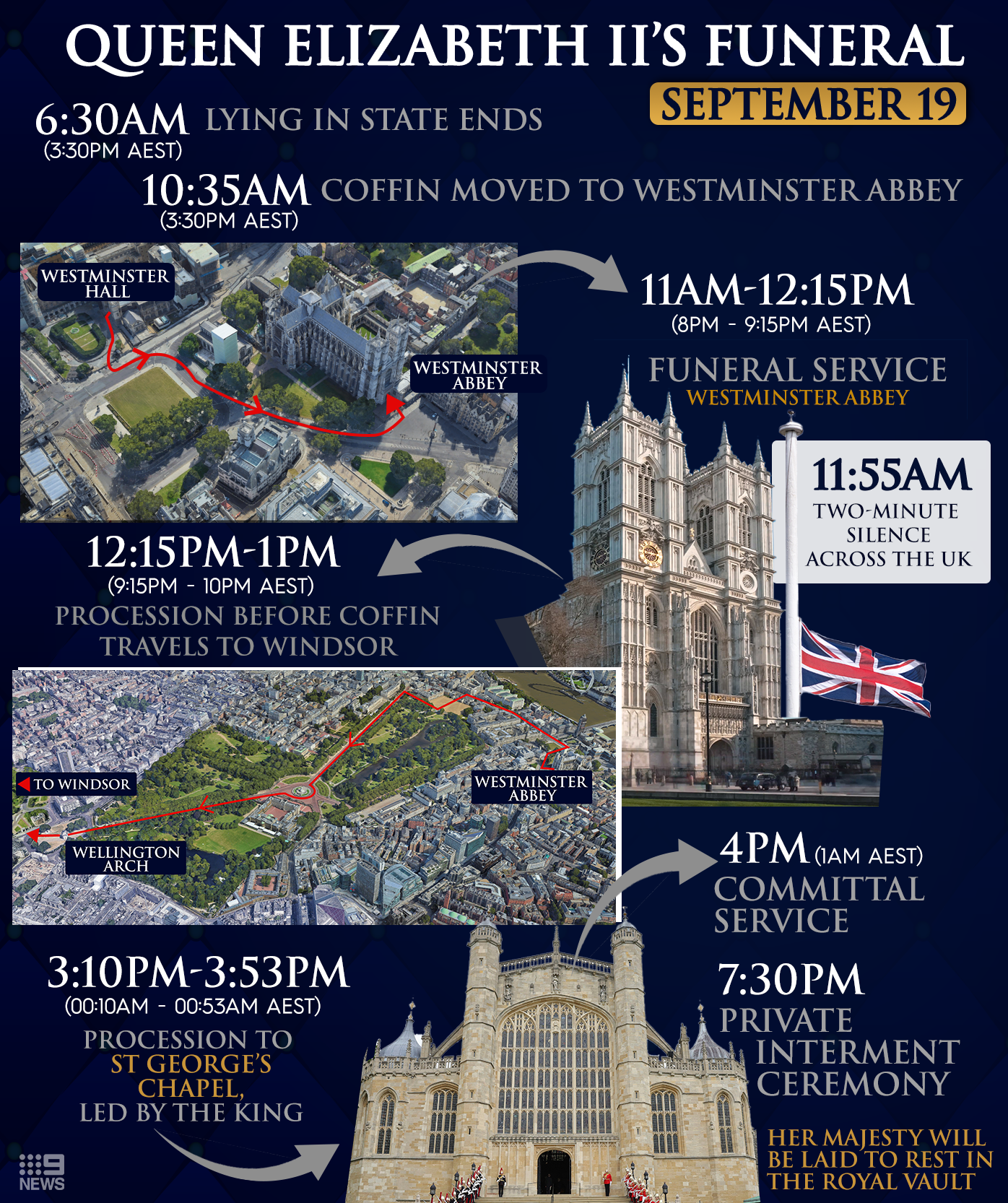
"People who lost their dad and now they've lost their mum. And they are on public display the whole time. That's what this all boils down to."
Ahead of tomorrow's funeral, the father-of-two is all too aware of the responsibility and importance of the event.
"I think it is an honour to be part of the coverage, but it's daunting as well," Overton said.
"When it comes to history like this, I think less is more in this.
"I really do. I think silence and the images will speak loudly. They will carry it.
"Sometimes you need to let it breathe, so viewers can respond emotionally to what we're presenting.
"I think we will all need to sit there and let this momentous occasion, this significant event, sink in."
Nine's rolling coverage begins from Buckingham Palace at 5am with Today hosted by Karl Stefanovic and Allison Langdon, followed by Today Extra hosted by David Campbell and Sylvia Jeffreys at 9.00am.
From midday, Georgie Gardner and David Campbell will mark the end of our longest reigning monarch with three hours of coverage honouring The Queen's amazing life.
At 3pm Tracy Grimshaw, Peter Overton, Karl Stefanovic and Allison Langdon will lead Nine's coverage from Westminster Abbey, Buckingham Palace and Windsor Castle.
Special state-based editions of 9News will be broadcast from 6pm (5.30pm Adelaide, 4pm Perth), before we return to England at 7pm and roll right through the evening, featuring coverage from the BBC headed by the world's pre-eminent royal expert Huw Edwards live and commercial-free.
Wellington mayoral race poll: Labour Rongotai MP Paul Eagle has narrow lead
A new political poll shows Labour Rongotai MP Paul Eagle has a narrow lead in Wellington’s mayoral race. The Kantar Public poll was commissioned by current affairs programme Q+A and surveyed 500 eligible voters between August 31…
Queen Elizabeth death: King Charles NZ visit likely; PM Jacinda Ardern meeting 'warm'
Prime Minister Jacinda Ardern believes it is likely King Charles III will travel to Commonwealth countries, including New Zealand, after his comments during her first meeting with Charles as King.Ardern met with King Charles today…
Auckland traffic: Long delays after Harbour Bridge crash, motorists warned
Auckland motorists are being warned of long delays after a serious crash on the Harbour Bridge early this morning.Traffic congestion continues to build and as of about 11am, is causing northbound delays back to the Gillies Ave on-ramp…