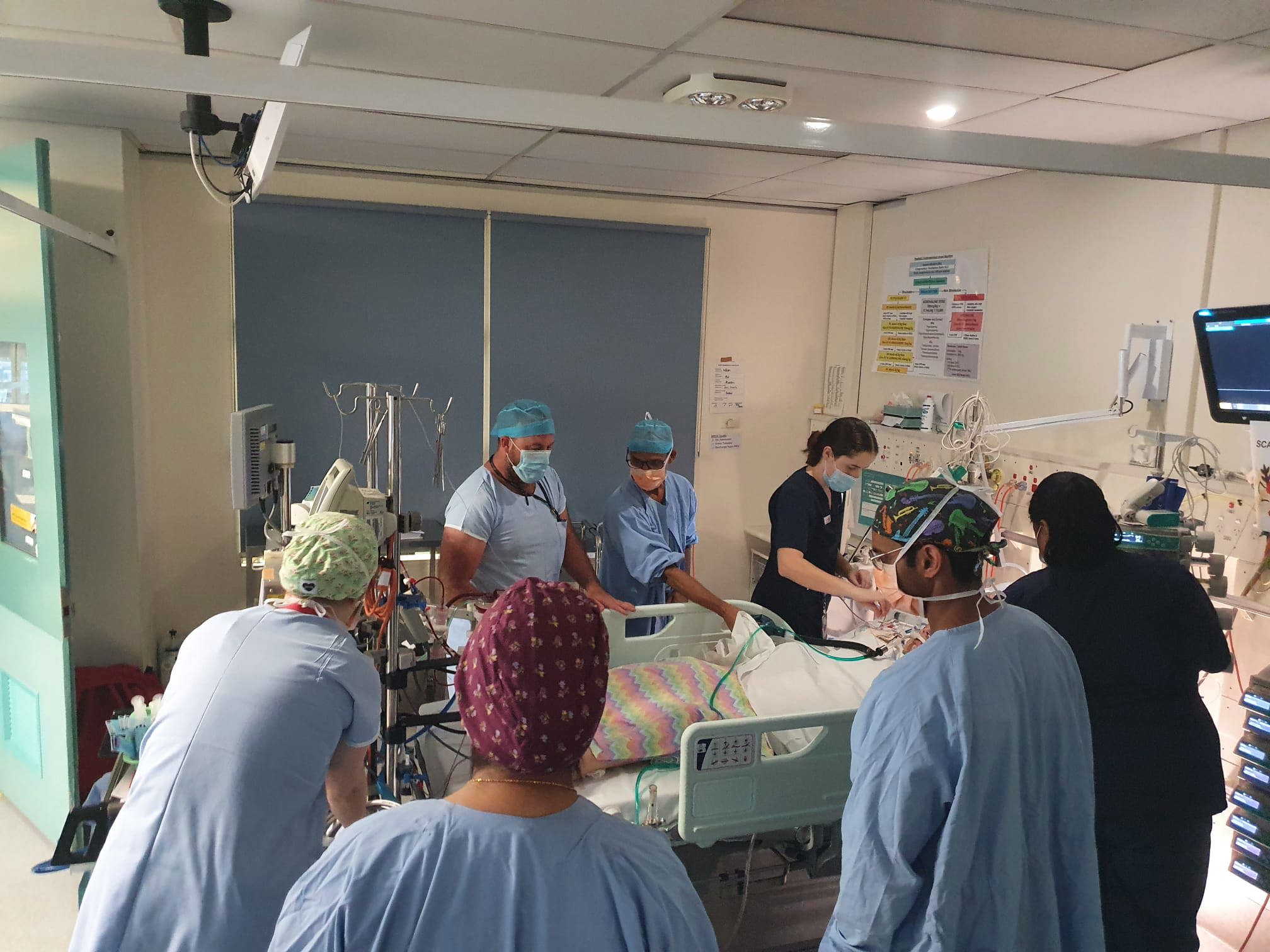
Whānau worry patients without visitors may go days without a proper wash.
Tag Archives: oceania
AI dominates as Australia’s fastest-growing jobs revealed
Jobs in artificial intelligence (AI) and technology are the fastest-growing in Australia, a new study claims.
The role of AI engineer has experienced the biggest growth in the last 12 months, with other tech-based roles booming in growth, research by LinkedIn said.
The study examined millions of jobs started by LinkedIn members from January 1, 2023 to July 31, 2025 to calculate a growth rate for each job title, and ranked the 15 jobs with the greatest growth based on the criteria.
READ MORE: 'Appalling': Trump's own party members decry his Greenland move
AI engineer, a role described as designing and building AI systems to perform several tasks, came out on top ahead of chief risk officer, which helps identify and assess risks to a company, including cybersecurity threats.
AI featured prominently in the list, with director of artificial intelligence – overseeing the development and use of AI strategies within a company – was fourth on the list.
"AI is no longer a specialist skill, it's becoming part of everyday work and leadership," LinkedIn's Brendan Wong claimed.
"Whether you're in tech, business or creative industries, building AI literacy and staying open to new skills will be key to future-proofing your career."
READ MORE: Family receives $4.8 million after woman declared dead then found alive in body bag
The study reveals more people are looking to start their own small businesses, with the role of founder appearing in seventh on the list after a 58 per cent surge, according to the study's data.
Fastest growing jobs
|
1 |
AI Engineer |
AI engineers design and build systems that use artificial intelligence to perform tasks such as analysing data, recognising patterns and making predictions. There is a major surge in demand for AI engineers in Australia, as generative AI adoption accelerates across industries. |
|
2 |
Chief Risk Officer |
Chief risk officers identify, assess and manage potential risks that could affect an organisation's operations, finances or reputation. As Australian firms navigate increasing regulatory scrutiny, cybersecurity threats and operational risks, the Chief Risk Officer role is becoming more strategic and central to C-suite decision-making. |
|
3 |
Mechanical Engineer |
Mechanical engineers design, develop and test mechanical systems and devices to ensure they function safely and efficiently. Mechanical engineers are increasingly needed to support Australia's infrastructure and energy transition. |
|
4 |
Director of Artificial Intelligence |
Directors of artificial intelligence oversee the development and implementation of AI strategies within an organisation. More C-suite executives in Australia are upskilling in AI, reflecting a push for a senior leader to guide AI strategy, governance and transformation. |
|
5 |
Organisational Development Manager |
Organisational development managers create and implement strategies to improve workplace structures, processes and employee performance. With businesses rapidly transforming to adapt to AI, there's growing demand for people who can design and implement change-management strategies. |
|
6 |
Legal Director |
Legal directors manage legal matters for an organisation, including compliance, contracts and advising on regulatory issues. In Australia's increasingly complex regulatory environment — driven by technology (AI), ESG and private-capital investment — Legal Directors are in demand to steer compliance, contracts and high-value transactions. |
|
7 |
Founder |
Founders establish and lead organisations by defining their vision, securing resources and guiding overall operations. Australia's startup ecosystem is growing fast across a variety of sectors including health tech, climate solutions and AI, and there's strong momentum for founders to launch startups that build on generative AI and data tools. |
|
8 |
Media Director |
Media directors plan and oversee media campaigns, ensuring content is delivered effectively across channels to reach target audiences. As organisations invest more in digital transformation and AI-driven content, there's a rising need for Media Directors who can lead multi-channel media strategy and content operations that leverage new technologies. |
|
9 |
Regulatory Affairs Consultant |
Regulatory affairs consultants advise organisations on compliance with laws and regulations, preparing documentation and liaising with authorities as needed. With the rapid uptake of AI and other transformative technologies, companies increasingly need Regulatory Affairs Consultants to help them navigate evolving legal landscapes, engage with regulators and maintain compliance. |
|
10 |
Power System Engineer |
Power system engineers design and maintain electrical power systems to ensure reliable generation, transmission and distribution of electricity. Australia's energy transition — especially growth in renewables and battery storage — is driving demand for power system engineers to design, maintain and optimise generation, transmission and distribution systems |
DOWNLOAD THE 9NEWS APP: Stay across all the latest in breaking news, sport, politics and the weather via our news app and get notifications sent straight to your smartphone. Available on the Apple App Store and Google Play.
Aussies among tourists trapped on remote desert island
The federal government is helping Australian tourists stranded on a remote desert island in Yemen.
They are among scores of foreign travellers who visited the island of Socotra in the Indian Ocean before being caught up in rising tensions between regional powers.
"The Department of Foreign Affairs and Trade (DFAT) is providing consular assistance to a small number of Australians currently in Yemen," a DFAT spokesperson said today.
READ MORE: UK, France considers sending troops to Ukraine
"Owing to our privacy obligations we are unable to provide further comment."
Travel plans for about 400 international tourists became disrupted when Yemeni authorities imposed a state of emergency on Socotra leading to the closure of ports of entry, including the island's airport, reports say.
The island is a UNESCO World Heritage site and home to the rare Dragon Blood tree. It has become a magnet for adventure tourists and social media influencers attracted by its stunning cliffs, rare fauna and pristine white sand beaches.
Yemen has been mired for more than a decade in a civil war that involves a complex interplay of sectarian grievances and the involvement of regional powers.
The Iran-aligned Houthis control the most populous regions of the country, including the capital Sanaa. Meanwhile, a loose regional coalition of powers – including Saudi Arabia and the UAE – has backed the internationally recognised government in the south.
Its distance from the mainland has shielded Socotra from the worst of Yemen's long-running conflict. But regional tensions that last week culminated in Saudi strikes on a UAE-linked shipment in Yemen have now had an impact.
Flights are expected to restart this week, but it is still unclear when.
DFAT advises Australians against travelling to Socotra due to ongoing armed conflict and a very high threat of kidnapping and terrorism. There are also military operations against Houthi targets in the Red Sea.
Australia, like many other Western nations, does not have an embassy or consulate in Yemen.
Officials at the Australian embassy in Riyadh, Saudi Arabia, are unable to provide emergency help to citizens in Yemen.
– With AP, CNN
Family receives $4.8 million after woman declared dead then found alive in body bag
A town in the US has agreed to a $US3.25 million ($4.82 million) settlement with the family of a young woman who was declared dead at home but then gasped for air and opened her eyes when her body bag was unzipped at a funeral home.
Paramedics were accused of gross negligence in how they responded to Timesha Beauchamp after a 911 call in the Detroit suburb of Southfield in 2020.
The 20-year-old, who had cerebral palsy, was eventually rushed to a hospital and died two months later.
READ MORE: 'Appalling': Trump's own party members decry his Greenland move
READ MORE: The truth behind Trump's demand for Greenland
“We recognise that no resolution can undo the profound tragedy that occurred on August 23, 2020, or ease the pain experienced by Ms Beauchamp’s family," Southfield said in a statement.
“This case involved extraordinarily difficult circumstances that arose in the complex world of a global pandemic.”
Beauchamp was struggling to breathe when her family called 911.
A medical crew tried to resuscitate her and also consulted a doctor, who declared her dead over the phone without going to the home.
Later that day, a funeral home opened the body bag and found Beauchamp gasping for air.
She was swiftly taken to a hospital but never recovered.
READ MORE: UK, France considers sending troops to Ukraine
“She was put in a situation she never should have been in," Steven Hurbis, an attorney for Beauchamp’s family, said on Tuesday (Wednesday AEST).
He added that medical professionals said Beauchamp would have survived if she was taken immediately to a hospital from her home.
The City of Southfield fought the lawsuit and persuaded a judge to dismiss it based on governmental immunity.
The Michigan Court of Appeals, however, overturned that decision in 2024.
The Southfield fire chief had said Beauchamp's situation might have been a case of “Lazarus syndrome,” a reference to people who come back to life without assistance after attempts to resuscitate have failed.
DOWNLOAD THE 9NEWS APP: Stay across all the latest in breaking news, sport, politics and the weather via our news app and get notifications sent straight to your smartphone. Available on the Apple App Store and Google Play.
Bondi hero touches down in US for medical treatment
Bondi hero Ahmed Al Ahmed has touched down in New York City after flying to the United States for medical treatment.
The 43-year-old, who was shot multiple times during the December 14 Bondi massacre, was flanked by FBI personnel as he arrived in Los Angeles for the first leg of his journey.
Al Ahmed described his visit to the US as a "long journey, but a necessary one" as he seeks specialist treatment for his injuries.
READ MORE: 'Doesn't feel fair': Australian-British citizens caught out by new passport rule
He has shared footage and photos of his journey on his newly-created Instagram, which now has over 5000 followers.
"On my way to start my treatment journey in the United States. I kindly ask everyone to keep me in their prayers," he said in a post.
"Thank you for your love and support."
Ahmed's arrival in the US comes just days after he and other heroes and victims were honoured during the Ashes Test at the Sydney Cricket Ground (SCG) over the weekend.
The tobacco shop owner was recognised for his bravery alongside first responders, including intensive care paramedics, NSW police officers, hospital and SES staff, lifeguards and lifesavers.
READ MORE: Aussie mum and dad both diagnosed with brain cancer months apart
READ MORE: Trump offered to get 'MAGA Granny' off the hook. She refused
He was seen with his arm in a sling after suffering five gunshot wounds during the terror attack.
Ahmed has already undergone three rounds of surgery for his injuries.
The father-of-three was among the first heroes identified following the massacre, which killed 15 innocent people during a Chanukah by the Sea celebration at Sydney's famous Bondi Beach.
READ MORE: Macca's fights back after council blocks new 24-hour joint on trendy street
He was seen wrestling the gun from one of the shooters, getting shot in the process.
"My target was just to take the gun from him and to stop him from killing a human being, life, and not killing innocent people," he told CBS in an exclusive interview.
Ahmed recognised that his actions saved countless lives, but said, "I feel sorry still for the lost".
In his hospital bed, he was awarded a cheque of $2.5 million after money was raised on GoFundMe to support his recovery.
Sign up here to receive our daily newsletters and breaking news alerts, sent straight to your inbox.
The truth behind Trump’s demand for Greenland
When US forces struck the Venezuelan capital and ousted the country's president Nicolás Maduro, it turned one of President Donald Trump's rhetorical threats into reality.
In the days since, his frequent musings about other items on his foreign policy wishlist have rung with renewed force, especially his repeated desire for the US to take over Greenland – the vast autonomous Arctic territory ruled by Denmark.
In the wake of such a brazen display of US military power in Venezuela, this rhetoric has taken on a different character, straining Washington's relationship with its NATO ally.
READ MORE: UK, France considers sending troops to Ukraine
Danish Prime Minister Mette Frederiksen reiterated that she had already "made it very clear where the Kingdom of Denmark stands, and that Greenland has repeatedly said that it does not want to be part of the United States."
She even warned that it could lead to the demise of the NATO alliance.
So why might Trump keep turning his attention to this remote, sparsely populated island – and why is it causing tensions with Europe?
What is Greenland like?
Greenland, a resource-rich island of 2.16 million square kilometres, is a former Danish colony and now an autonomous territory of Denmark, situated in the Arctic.
It's the world's least densely populated country and is so remote that its 56,000 residents travel by boat, helicopter and plane between its towns, which are predominantly scattered along the island's western coast.
Nuuk, the territory's capital city, is emblematic of those towns, featuring brightly coloured houses crowded together between a jagged coastline and inland mountains.
Outside the towns, Greenland is mostly wilderness with 81 per cent of its land under ice. Nearly 90 per cent of its population is of Inuit origin and the territory's economy has long revolved around fishing.
READ MORE: Capital city to swelter in record temperatures as heatwave takes hold
Why is it so important strategically?
Greenland occupies a strategic geopolitical position, sitting between the US and Europe and astride the so-called GIUK gap – a maritime passage between Greenland, Iceland, and the UK that links the Arctic to the Atlantic Ocean.
Its rich deposits of natural resources, including oil, gas and rare earth minerals, make it even more strategically important, especially as China has leveraged its domination of the rare earth industry to exert pressure on the US.
These rare earth minerals are increasingly crucial to the global economy since they are required to manufacture everything from electric cars and wind turbines to military equipment.
READ MORE: 'Doesn't feel fair': Australian-British citizens caught out by new passport rule
Greenland's trove of minerals may become more accessible as the climate crisis melts Arctic ice, a phenomenon which also makes northern shipping routes navigable for more time throughout the year, potentially reorienting trade and making the region even more important, despite Trump calling the climate crisis "the greatest con job."
Trump has downplayed the significance of Greenland's natural resources, telling reporters last month: "We need Greenland for national security, not for minerals."
But his former national security adviser Mike Waltz suggested in January 2024 that Trump's focus was on natural resources, telling Fox News that the administration's focus on Greenland was "about critical minerals" and "natural resources."
What does Venezuela have to do with it?
The day after US forces snatched Maduro from his home, Trump repeated that the US needs Greenland "from the standpoint of national security," before White House deputy chief of staff for policy Stephen Miller reiterated those claims on Monday, further sharpening the spotlight on the Arctic territory.
"We need Greenland…it's so strategic right now. Greenland is covered with Russian and Chinese ships all over the place," Trump told reporters aboard Air Force One, despite at first saying he didn't want to talk about it.
"We need Greenland from the standpoint of national security, and Denmark is not going to be able to do it."
Doubling down on Tuesday, the White House said it is "discussing a range of options" to acquire Greenland and that using the US military is not off the table.
What has Trump said before?
Trump inquired about the possibility of buying Greenland during his first term and, despite being told by the island that "Greenland is not for sale," he revived those calls in December 2024, saying in a social media post: "For purposes of National Security and Freedom throughout the World, the United States of America feels that the ownership and control of Greenland is an absolute necessity."
READ MORE: Trump's claims of running Venezuela leave questions despite congressional briefing
He claimed that the US needs Greenland for "economic security," before Vice President JD Vance travelled to the island in March 2025 where he said it was "the policy of the United States" to see changes to the island's Danish leadership, but acknowledged that Greenlanders should decide their future.
Polling in Greenland shows clear opposition to becoming part of the US, with 85 per cent of Greenlanders against American rule, Reuters reported.
What does this mean for NATO?
If the US uses military action to seize Greenland – something Trump has pointedly refused to rule out – it could fracture the NATO alliance.
Frederiksen said, "if the US chooses to attack another NATO country militarily, everything stops, including NATO and thus the security that has been provided since the end of World War II."
On Tuesday, leaders from major European powers expressed support for Denmark and Greenland, adding that Arctic security must be upheld collectively with NATO allies, including the US.
READ MORE: Swiss bar hit by deadly fire had not been inspected in five years
"Greenland belongs to its people. It is for Denmark and Greenland, and them only, to decide on matters concerning Denmark and Greenland," leaders of France, Germany, Italy, Poland, Spain, Britain and Denmark said in a joint statement.
"NATO has made clear that the Arctic region is a priority and European Allies are stepping up."
What do Greenlanders think?
Trump's frequent posturing about Greenland strikes right at the heart of the territory's politics, which has long been shaped by Denmark's colonial legacy and a push for independence.
Greenland was incorporated into Denmark in 1953, as a tide of decolonisation swept the globe following World War II. In 1979 it was granted home rule; in 2009 it achieved self-government but its foreign, security, defence and monetary policy are all still controlled by Denmark.
During recent election campaigns, Greenland's politicians have promised to take steps towards independence but have not offered a concrete timeline to do so. While not all Greenlanders want independence from Denmark, few want to trade Danish for US leadership.
Greenland's Prime Minister Jens-Frederik Nielsen called the US's rhetoric "completely unacceptable."
READ MORE: Carer charged over fatal house fire
"When the President of the United States speaks of 'needing Greenland' and links us to Venezuela and military intervention, it is not just wrong. It is disrespectful," he said in a statement.
"No more fantasies of annexation," Nielsen added. "We are open to dialogue. We are open to discussions. But they must take place through the proper channels and in respect of international law … Greenland is our home and our territory. And it will remain so."
According to Kuno Fencker, a member of parliament for the more pro-US Naleraq party, some of Trump's comments have been "received quite well."
"If he says Greenland has the right to self-determination or they could join the United States, it's a big offer from the United States president," Fencker told CNN.
"But if journalists are putting words in his mouth about annexing or taking Greenland military, that's not been taken well," he added.
DOWNLOAD THE 9NEWS APP: Stay across all the latest in breaking news, sport, politics and the weather via our news app and get notifications sent straight to your smartphone. Available on the Apple App Store and Google Play.
‘Doesn’t feel fair’: Australian-British citizens caught out by new passport rule
British-Australian man Danny Flint has to fork out $600 if his family wants to travel back to the United Kingdom again.
The dual citizen, who lives in Brisbane, has been caught off guard by a small but significant change to the entry rules for travellers visiting England, Scotland, Wales or Northern Ireland.
From February 25 this year, the UK's Electronic Travel Authorisation (ETA) scheme will be fully enforced following a grace period.
READ MORE: Trump offered to get 'MAGA Granny' off the hook. She refused
READ MORE: Macca's fights back after council blocks new 24-hour joint on trendy street
An ETA costs just £16 (approx. $A32) and can be used by visitors from 85 visa-exempt countries, including Australia, however dual citizens with Australian and British or Irish citizenship are exempt from needing one.
But there's a catch – these travellers can't use their Australian passport to fly to the UK and won't be let on their flight if their British one has expired.
"I have an elderly parent still in the UK, so [I] do not want any barriers to quick travel," Flint told nine.com.au.
"It doesn't feel fair, and I'm not sure why it has been introduced – definitely another expense, and hassle. Why could an Australian citizen travel on the Australian passport, but a dual citizen couldn't?"
Flint's own British passport has expired, as he had been successfully travelling on his valid Australian passport.
Now, he needs to pay about $600 to renew his and his family's British passports.
It costs about $189 to renew or replace each passport, plus postage fees.
It can also take about 10 weeks for them to arrive in Australia.
The process is so cumbersome that Flint has even considered rescinding his UK citizenship.
Fellow Queenslander Wendy Hilsum was born in the UK and has been using her Australian passport to travel for years too.
"I prefer to just have the one passport," Hilsum said.
"I haven't applied for many years. Australia's passport is the most expensive in the world and it states on there that I am an English-born citizen.
"Not sure why they need that extra money from us."
Hilsum also has elderly parents and doesn't want to be refused travel when she or her sister tries to visit them back home.
"I don't intend to live back in the UK, however my parents are in their 80s so I'd need to be able to travel with ease," she added.
Do you have a story? Contact reporter April Glover at Google Play.
Trump’s claims of running Venezuela leave questions despite congressional briefing
Against a backdrop of broad but vague assertions by US President Donald Trump that the United States is going to "run" Venezuela after the ouster of Nicolás Maduro, a briefing by Secretary of State Marco Rubio and other top officials left questions among lawmakers about the administration's next steps in the South American country.
Seemingly contradictory statements from Trump and Rubio have suggested at once that the US now controls the levers of Venezuelan power or that the US has no intention of assuming day-to-day governance and will allow Maduro's subordinates to remain in leadership positions for now.
House Speaker Mike Johnson told reporters after Rubio's briefing late on Monday that he does not expect the US to deploy troops there.
READ MORE: Swiss bar hit by deadly fire had not been inspected in five years
The lack of clarity has wrought mounting concerns from lawmakers, Democrats especially, that Trump is embarking on a new era of US expansionism without consultation of Congress or a clear vision for running Venezuela.
The president, in remarks that neared 90 minutes, told House Republicans on Tuesday that the military operation in Venezuela was an "amazing military feat" and "brilliant tactically," while also joking that Maduro, before he was deposed, had been imitating Trump's style of dancing. But he offered few new details in his broad political remarks, nor any updates on the US troops who were injured.
He also criticised Democrats for not praising him for the operation and said they should tell him he did a great job.
"I would say that if they did a good job, their philosophies are so different," Trump said.
"But if they did a good job, I'd be happy for the country."
READ MORE: Danish PM says US takeover of Greenland would be the end of NATO
The uncertainty on definitive next steps in Venezuela contrasts with the years of discussions and planning that went into US military interventions that deposed other autocratic leaders, notably in Iraq in 2003, which still did not often lead to the hoped-for outcomes.
'Disagreement about how to proceed'
The discrepancy between what Trump and Rubio have said publicly has not sat well with some former diplomats.
"It strikes me that we have no idea whatsoever as to what's next," said Dan Fried, a retired career diplomat, former assistant secretary of state and sanctions coordinator who served under both Democratic and Republican administrations.
"For good operational reasons, there were very few people who knew about the raid, but Trump's remarks about running the country and Rubio's uncomfortable walk back suggests that even within that small group of people, there is disagreement about how to proceed," said Fried who is now with the Atlantic Council think tank.
Supporters of the operation, meanwhile, believe there is little confusion over the US goal.
"The president speaks in big headlines and euphemisms," said Rich Goldberg, a sanctions proponent who worked in the National Energy Dominance Council at the White House until last year and is now a senior adviser to the Foundation for Defence of Democracies, a hawkish think tank.
Goldberg does not see Rubio becoming "the superintendent of schools" but "effectively, the US will be calling the shots".
"There are people at the top who can make what we want happen or not, and we right now control their purse strings and their lives," he said.
"The president thinks it's enough and the secretary thinks it's enough, and if it's not enough, we'll know very soon and we'll deal with it."
If planning for the US "to run" Venezuela existed prior to Maduro's arrest and extradition to face federal drug charges, it was confined to a small group of Trump political allies, according to current US officials, who note that Trump relies on a very small circle of advisers and has tossed aside much of the traditional decision-making apparatus.
These officials, who spoke on condition of anonymity to discuss their understanding of internal deliberations, said they were not aware of any preparations for either a military occupation or an interim civilian governing authority, which has been a priority for previous administrations when they contemplated going to war to oust a specific leader or government. The White House and the State Department's press office did not return messages seeking comment.
Long discussion among agencies in previous interventions
Previous military actions that deposed autocratic leaders, notably in Panama in 1989 and Iraq in 2003, were preceded by months, if not years, of interagency discussion and debate over how best to deal with power vacuums caused by the ousters of their leaders. The State Department, White House National Security Council, the Pentagon and the intelligence community all participated in that planning.
In Panama, the George H.W. Bush administration had nearly a full year of preparations to launch the invasion that ousted Panama's leader Manuel Noriega. Panama, however, is exponentially smaller than Venezuela, it had long experience as a de facto American territory, and the US occupation was never intended to retake territory or natural resources.
By contrast, Venezuela is vastly larger in size and population and has a decades-long history of animosity toward the United States.
"Panama was not successful because it was supported internationally because it wasn't," Fried said.
"It was a success because it led to a quick, smooth transfer to a democratic government. That would be a success here, but on the first day out, we trashed someone who had those credentials, and that strikes me as daft."
He was referring to Trump's apparent dismissal of opposition leader Maria Corina Machado, whose party is widely believed to have won elections in 2024, results that Maduro refused to accept.
Trump said on Saturday that Machado "doesn't have the support within or the respect within the country" to be a credible leader and suggested he would be OK with Maduro's No. 2, Delcy Rodríguez, remaining in power as long as she works with the US.
Hoped-for outcomes didn't happen in Iraq and Afghanistan
Meanwhile, best-case scenarios like those predicted by the George W. Bush administration for a post-Saddam Hussein Iraq that it would be a beacon of democracy in the Middle East and hopes for a democratic and stable Afghanistan following the ouster of the Taliban died painfully slow deaths at the tremendous expense of American money and lives after initial euphoria over military victories.
"Venezuela looks nothing like Libya, it looks nothing like Iraq, it looks nothing like Afghanistan. It looks nothing like the Middle East," Rubio said this weekend of Venezuela and its neighbours.
"These are Western countries with long traditions at a people-to-people and cultural level, and ties to the United States, so it's nothing like that."
The lack of clarity on Venezuela has been even more pronounced because Trump campaigned on a platform of extricating the US from foreign wars and entanglements, a position backed by his "Make America Great Again" supporters, many of whom are seeking explanations about what the president has in mind for Venezuela.
"Wake up MAGA," Republican Rep. Thomas Massie of Kentucky, who has bucked much of his party's lockstep agreement with Trump, posted on X after the operation.
"VENEZUELA is not about drugs; it's about OIL and REGIME CHANGE. This is not what we voted for."
Sen. Rand Paul, also a Kentucky Republican, who often criticises military interventions, said "time will tell if regime change in Venezuela is successful without significant monetary or human cost".
"Easy enough to argue such policy when the action is short, swift and effective but glaringly less so when that unitary power drains of us trillions of dollars and thousands of lives, such as occurred in Afghanistan, Iraq, and Vietnam," he wrote on social media.
In addition to the Venezuela operation, Trump is preparing to take the helm of an as-yet unformed Board of Peace to run post-war Gaza, involving the United States in yet another Mideast engagement for possibly decades to come.
And yet, as both the Iraq and Afghanistan experiences ultimately proved, no amount of planning guarantees success.
DOWNLOAD THE 9NEWS APP: Stay across all the latest in breaking news, sport, politics and the weather via our news app and get notifications sent straight to your smartphone. Available on the Apple App Store and Google Play.
Aussie mum and dad both diagnosed with brain cancer months apart
It's a fight a Perth mother and father didn't see coming.
Katie and Greg Britton are facing a heartbreaking journey after both were diagnosed with brain cancer months apart.
"They're in no way related and unfortunately it's just very bad luck," Mrs Britton told 9News.
READ MORE: Human remains wash up on Western Australian beach
While their tumours aren't linked, they're taking the battle on side-by-side.
The Perth father first noticed a numbing in his toe, followed by losing all feeling to his side.
An MRI found a 4.5-centimetre tumour.
"It was right in my brain stem and it was just affecting everything – my breathing, heart, everything, just slowly shutting me down," Mr Britton told 9News.
The tumour was removed 12 months later but he's not in the clear just yet.
"It probably will grow back at some stage, so yeah it's just about staying as fit as I can and healthy," he said.
Mrs Britton started having her own signs and symptoms, including headaches and pain in her ear and cheek.
"I went into Joondalup Hospital and they diagnosed me very very quickly and I was in for surgery the next day," she said.
She underwent surgery four months to the day after her husband on her own four-centimetre tumour.
Mrs Britton has just finished her first six-week round of chemotherapy and radiation but said the hardest part for the couple was telling their two teenage children.
"I was heartbroken for them, because watching how much they all struggled the first time around, to then put them through that again was a very difficult time," she said.
The couple are not alone. According to Cancer Australia, there's a one in 156 chance of being diagnosed with brain cancer by the age of 85.
In 2023 brain cancer was the ninth most common cause of cancer death in Australia.
It's estimated to remain that way this year.
The Brittons are sharing their story to warn others about the importance of early detection.
They also have nothing but praise for medical researchers and foundations like Cure Brain Cancer, with funds raised opening the door to more medical opportunities.
"Not only does it make my experience of being managed for cancer so much better, but it also means my chances of living longer are so much better," Mrs Britton said.
Police return to remote property where four-year-old Gus disappeared
Police have returned to the remote South Australian property where four-year-old Gus Lamont disappeared and have spoken to his family.
The boy was last seen playing on a mound of dirt about 5pm on September 27 at the Oak Park Station homestead, about 43 kilometres south of Yunta.
Intensive searches have failed to locate Gus and the latest was suspended late last year.
READ MORE: Eerie images of graffiti believed to be linked to cold case disappearance and suspected murder
Today, police confirmed they travelled last week to the property and spoke with the heartbroken family.
"We've taken statements with the family, we've had to go through those statements with the family, and that's just part of the normal investigational process that we go through," Detective Superintendent Darren Fielke said.
"We continue to engage with them.
"They went through a pretty horrid Christmas without Gus, and we check-in with the family regularly."
Lamont was last seen by his grandmother.
About 30 minutes later, he had vanished and a full-scale search was soon launched.
READ MORE: Three states to sizzle under worst heatwave since Black Summer bushfires
Crews comprised of police, emergency services, the defence force and volunteers have combed through the property, mine shafts and bodies of water in what is one of the largest searches for a missing person in South Australia.
They have failed to locate any trace of Gus.
The four-year-old with blond curly hair has been described as a shy but adventurous child.
His family have said in a statement they are "devastated" and "deeply distressed" by his disappearance.
DOWNLOAD THE 9NEWS APP: Stay across all the latest in breaking news, sport, politics and the weather via our news app and get notifications sent straight to your smartphone. Available on the Apple App Store and Google Play.