Category Archives: headline

'Mayhem and chaos': Afghans who made it out, and those who didn't

When the Taliban recaptured Afghanistan, tens of thousands of civilians decided to flee their homes.

Translators, military contractors, public officials, journalists, human rights activists, employees of foreign NGOs and many others suddenly found themselves at risk. Many had direct links to the United States and its allies and feared the militant group would seek their revenge against them after the US withdrawal.

Others were afraid the freedoms they got used to in the past two decades would quickly disappear under Taliban rule. Many felt the safety of their families was in jeopardy.

More than 120,000 people have been evacuated from Afghanistan since late July, according to the White House. Now that the US and its allies have ended their airlift missions, it has become clear that many vulnerable Afghans were left behind.

Some didn't make it to the airport on time. Others never had an opportunity to leave. Some simply chose to stay and fight for their rights. Here are stories of some of those who escaped — and those who didn't make it.

READ MORE: US dropped 'Ninja bomb' to kill terrorists in Afghanistan
I walked through a drainage canal to get to the airport

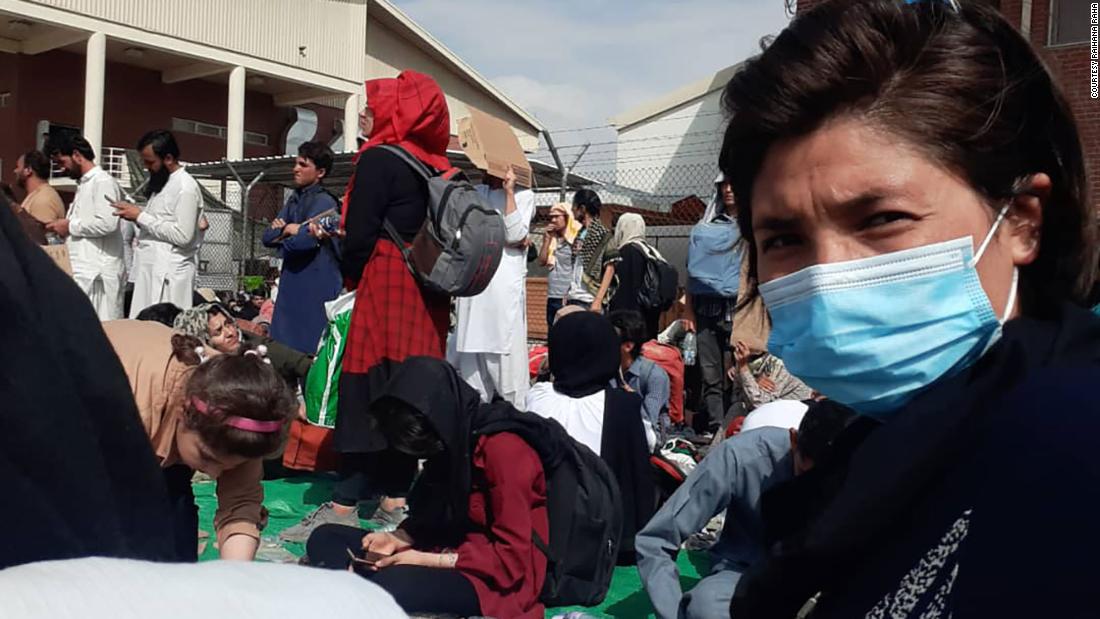
Raihana Raha got into the Kabul airport with the assistance of French soldiers after walking through a drainage canal, knee deep in wastewater.

Days later, in the safety of a hotel in Paris, she was still worried people could smell it on her.

Ms Raha, a 25-year-old women's rights activist, fled Afghanistan shortly after the Taliban captured Kabul. She didn't sleep at home, hiding instead at a friend's house. 

Once she received her visa she headed to the airport along with a group of other women in a similar situation.

She still finds it difficult to describe what she was thinking during the three treacherous days she spent waiting outside the Hamid Karzai International Airport. 

"All that I could do was just, you know, [be] strong and do what I could do … it was all about chances. It was about trying to find a chance," she said.

When Ms Raha got inside the airport, it struck her how quiet it became.

"The people, when they get to the airport, they were silent, most of them were silent, it seemed like they were thinking about what's happened to them, what happened to their country, what's happening to their lives, you know, because most of them, they were the people who were working, the people who had a lot of plans to make their dreams [come true]," she told CNN.

It finally hit her on the plane. She was leaving her country.

"A lot of people were sitting on the floor, most of the people there were crying and I could feel why they were crying, because they were thinking about how they are leaving their country and for what, and why they're leaving," she said.

Ms Raha herself isn't a big crier, she said. At least, not normally. "It's not easy for me to cry, sometimes in the past, when I was trying to cry, I couldn't, I don't know why, I just couldn't, but on that day, I couldn't stop myself," she said. 

"Of course I cried."

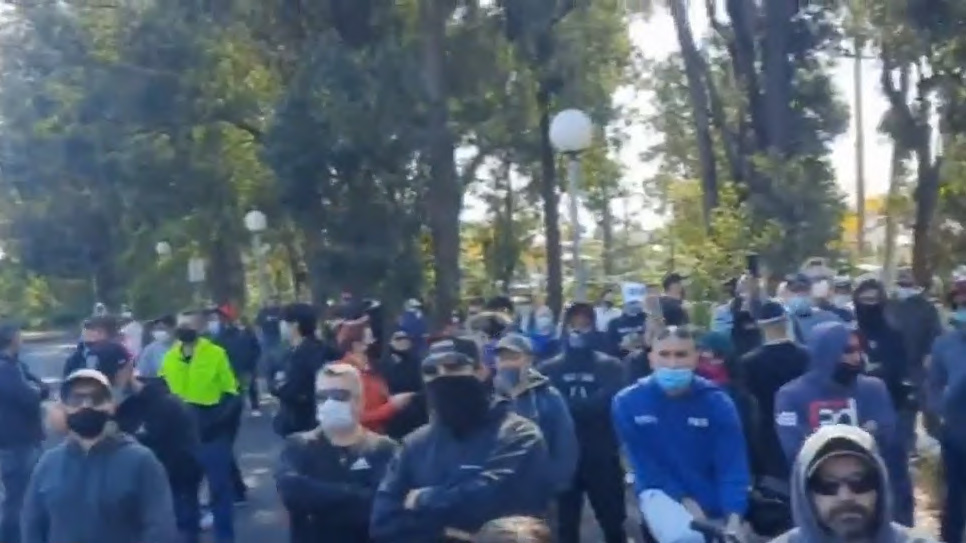
READ MORE: Police hurt, more than 100 arrested and 430 fined at anti-lockdown protests
I told my son the gunfire was a celebration

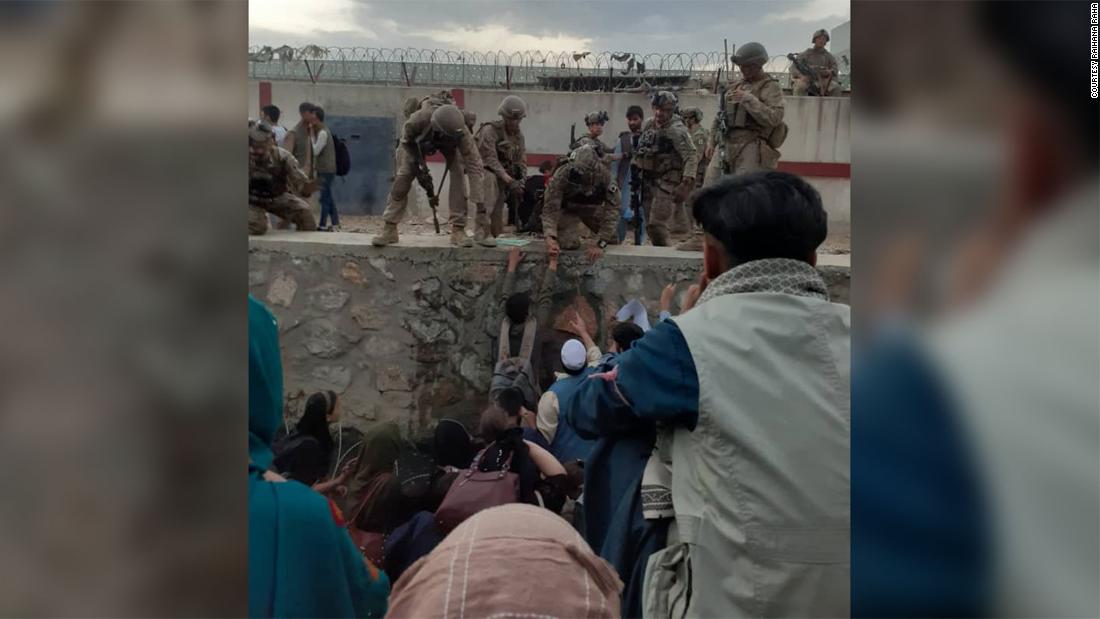
Rafiullah Stanikzai and his family also spent three days and three nights hiding outside the airport, covering their faces whenever Taliban fighters passed by. At one point, the fighters kicked and threatened him, ordering him to leave.

His four-year-old son Mohammad was crying, terrified of the near-constant shooting. To soothe him, Mr Stanikzai told Mohammad the gunfire was just a celebration.

Mr Stanikzai, a 33-year-old former translator, had previously worked for the Czech unit of the NATO-led security mission in Afghanistan. He said that, until a few weeks ago, he and his family had a good life in Afghanistan. His wife, Maryam, was lecturing at a university, and he had a good job.

He said he was finally escorted through the Taliban checkpoint at the airport by Czech soldiers who later led him towards a plane he believed he'd be boarding. 

"And then suddenly, [they] left us exactly in front of the airplane, saying that the plane is full and didn't give information about any other plane," he said.

The plane took off, with Mr Stanikzai and his family left on the tarmac. 

The Czech Republic's Foreign and Defence ministries told CNN that Mr Stanikzai was not eligible for evacuation because he was excluded from the government's resettlement program for Afghan contractors in 2013 — something Mr Stanikzai said the Czechs never told him, pointing to recommendation letters and other documents the Czech army provided him with.

The family spent another cold night queuing for a place on a US flight out of Kabul, waiting patiently to get through US passport clearance and a security screening. 

Eventually, they were taken to Qatar, spending a few days there before being sent to Germany and later onto the US.

READ MORE: Camera discovery reveals last images of Australian mountain climber before he died
I was running towards the airport

Peymana Assad recalls seeing hundreds of people surrounding the military convoy that was taking her to safety.

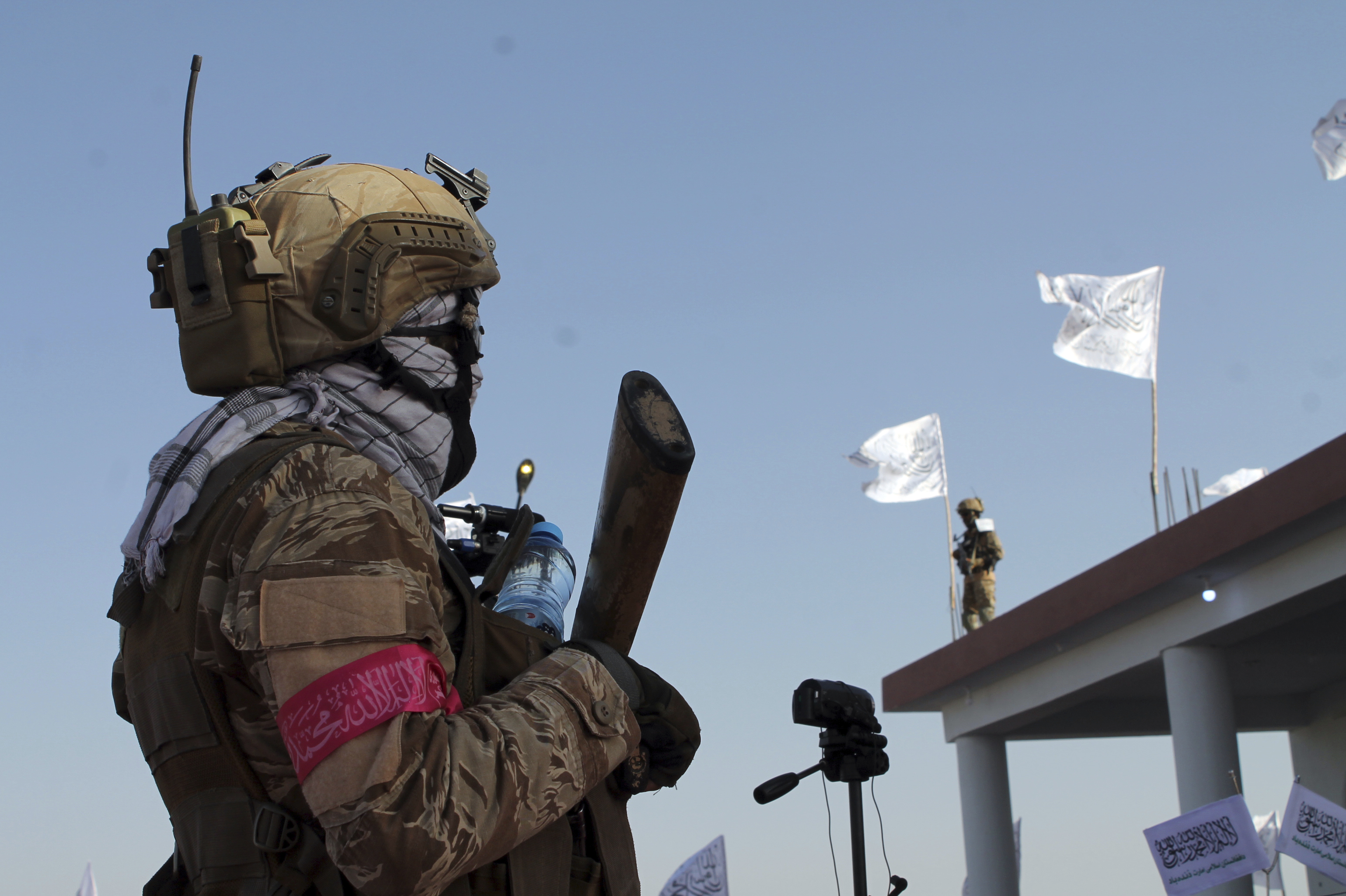
"Children, women, little kids, little girls just standing on both sides … you had three British soldiers on one side, three British soldiers on the other side, just pointing guns at these people to stop them from creating a stampede and running at the gate once the gates opened to let the convoys in," she told CNN.

Ms Assad, who was visiting her Afghan family from the UK, said the neighbours came knocking after learning the Taliban were taking over Kabul. They told her she needed to leave immediately. 

The roads were already completely blocked with people desperately trying to escape and if the Taliban came and took over the district, she would be unable to leave.
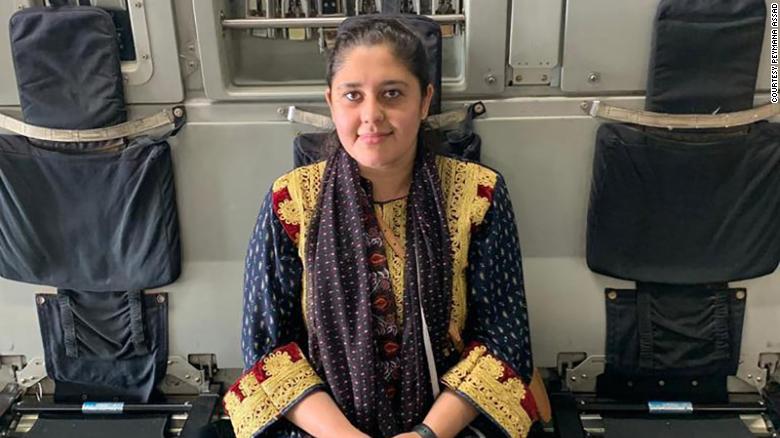
"So that's when I grabbed my hand luggage. I got out on foot, on the back streets onto the main dual carriageway towards the airport, towards Kabul airport, and started walking and running," she said.

There were hundreds of people around, all running towards the airport. 

"It was just mayhem and chaos and panic and the complete fear," Ms Assad said, remembering one particularly terrifying moment.

"One of the shopkeepers pointed at me and he said, 'If the Taliban catch you, they're going to kill you.'"

Ms Assad realised that she stood out in her fancy Afghan dress and Nike sneakers. 

"I looked so different to everyone else. I looked completely foreign … and that just put more fear in my heart and I just started walking faster," Ms Assad said.

Hours later, in the safety of the airport and about to board the government flight, Ms Assad glanced at a television set in the waiting area. 

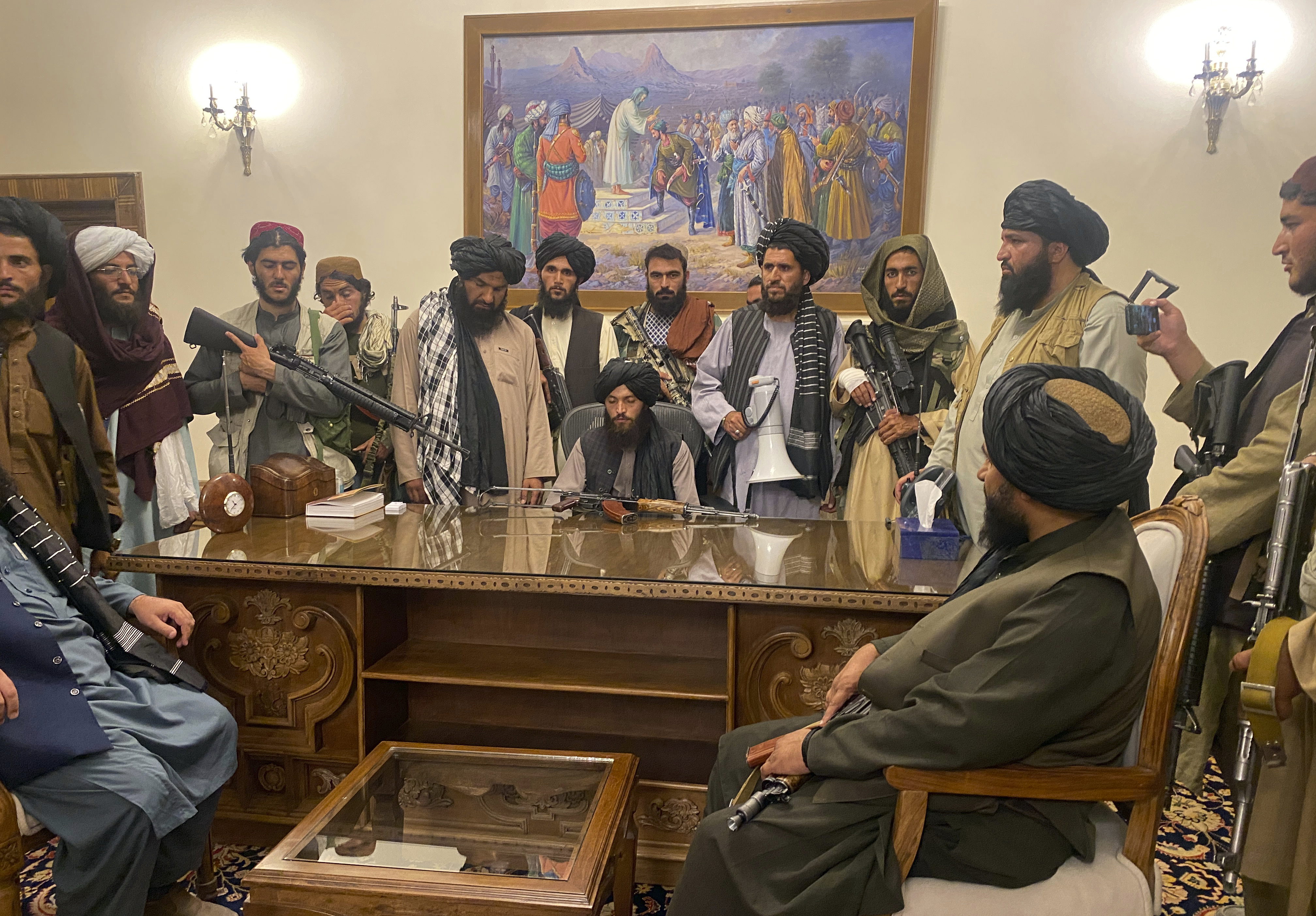
"The Taliban were in the presidential palace … the Taliban had taken control of Kabul," she said.

READ MORE: Baby Afghan girl born mid-evacuation flight headed for UK
It's as much my country as it's theirs

Unlike many others in her position, Pashtana Durrani, the founder and executive director of Learn, a nonprofit organisation focused on education and women's rights, never really considered leaving Afghanistan, despite the risks she might face.

"There are a lot of people depending (on) me … 7000 girls still need lessons and if I am not there, they won't get it, so for me it's very important to fight for their rights … not every person can leave, not every person has a privilege to leave," she told CNN.

The 23-year-old said she was in hiding in Afghanistan, focused on enrolling as many children into digital learning programs as possible, before "things get worse" under the Taliban.

"My family forced me into hiding, a lot of people are concerned about my safety … I personally am not afraid of them. It's as much my country as it's theirs," she said.

Ms Durrani said she worries about the safety and the future of the women and girls. She questions the Taliban's commitment to protect their rights.

"We are told that we have to stay home until the Taliban fighters accept women in public spaces … but what if they never get comfortable with women, what then, what is the deadline?" she said.

Ms Durrani, a young, educated Afghan woman, said she feels it's her responsibility to stay and challenge the Taliban.

"Right now we fight back," she said.

"We ask for our rights. It's important. If we don't speak now — we are the educated generation, the next generation won't even be educated … that's not supposed to be happening, not on my watch."

READ MORE: How Australia's 80 per cent vaccine target matches up to the rest of the world

https://twitter.com/LEARNAfg/status/1428285566077095943

I haven't been to work since they took over

Meanwhile, in the western city of Herat, a young journalist in her 30s says her life and work have been on hold since the Taliban takeover.

"The atmosphere is tragic and full of pain and suffering," she told CNN.

"Before the arrival of the Taliban, I would go to work, but since then, it has been a dark day, a dark day for Afghans and Afghan journalists when Herat fell."

The journalist said she had not been to work since the Taliban took over Herat.

"Our local newspaper is on a break and we are not printing anything," she said.

"[The] Taliban has asked women to stay home. Same with schools. Schools are operating but not in the same quality as before. The future is unclear."

The arrival of the Taliban, she said, had changed everything. 

"I am thinking of my future every second of the day," she said.

"I have two kids, what will happen to their future? Will they be safe? Will they be alive? 

"Will the Taliban start killings and executions like before? Will they put women in cages?"
Police Investigating Circumstances Surrounding Man’S Death

The Police are investigating the circumstances surrounding the death of 39-year-old Wilson Dore of Bath Village. Dore’s body was found partially clothed in Bath Village at about 7:30 p.m. on August 29, 2021. The District Medical Officer arrived at the scene and pronounced him dead. An autopsy has been scheduled to determine the exact cause of death.

Persons with information about this incident are urged to contact the Charlestown Police Station by dialling 469-5391, the nearest Police Station or the Crime Hotline at 707. Investigations into the matter are ongoing.

The post Police Investigating Circumstances Surrounding Man’S Death appeared first on The St Kitts Nevis Observer.

Depressed Econmies: T&T, Barbados Given IMF Cash Lifelines

The Trinidad and Tobago government will hold a three day retreat in Tobago this week, amid concerns that there is need for a serious re-examination of the existing socio economic policies occasioned by the coronavirus (COVID019) pandemic.

Prime Minister Dr. Keith Rowley, speaking on a television program on Tuesday, said also that the recent decision by the International Monetary Fund (IMF) to allocate an estimated US $644 million to Trinidad and Tobago from the largest allocation of Special Drawing Rights (SDRs) in its history, will also be an agenda item at the retreat.

Minister “This pandemic has affected us three times as bad …and it is so widespread and all pervasive in that the global financial crisis basically was dealing with people who had money and was losing money and those who did not have, have nothing to lose,” he told the “Brighter Morning with Bhoe” program hosted by former government minister Dr. Bhoe Tewarie.

“But this pandemic affects every body…in the world and it has a much larger damaging impact on the world’s economies and that is why the IMF has come in. I mean why you read, like here in the CARICOM (Caribbean Community) some countries are pointing to a huge percentage of loss in GDP (gross domestic product), here in Trinidad and Tobago we are still trying to assess  the extent of the loss of our GDP simply by being in this pandemic situation.

“If you look at what is happening in the big economies in the world, how much hundreds of billions are loss simply because having to respond to the pandemic, here in Trinidad and Tobago when we stayed home for a month …earning nothing, shutting down everything, you could imagine the effect that is having

Crisis Many Times More Devastating

Rowley told his audience that the Washington-based financial institution has recognized that this is a crisis that is many times more devastating than the global financial crisis that was experienced in 2009.

“We are very happy for their response and our share of that support is going to be utilized much to our benefit,” Rowley said, adding that from time to time when “one speaks of the IMF, they speak of the old guard they know, but on this occasion I hope you understand being a member of the IMF has its great benefit.

IMF managing director, Kristalina Georgieva, said that the US$650 billion SDR allocation is a significant shot in the arm for the world and, if used wisely, a unique opportunity to combat this unprecedented crisis.

“SDRs are being distributed to countries in proportion to their quota shares in the IMF. This means about US$275 billion is going to emerging and developing countries, of which low-income countries will receive about US$21 billion, equivalent to as much as six per cent of gross domestic product (GDP) in some cases,” she said.

“Countries can use the space provided by the SDR allocation to support their economies and step up their fight against the crisis,” she added.

Funds will strengthen  Trinidad and Tobago Position

Rowley said that Trinidad and Tobago would use its allocation  “mainly to strengthen our position going forward encouraging export marketing, ensuring that we can fund the recovery that has to be done in a variety of ways and it is going to prevent us from having to borrow as much as we would have had to borrow from other sources if we were without this kind of support.

Asked whether the new funding would also be used to assist in both import or export substitution for local businesses, Rowley replied “absolutely.

“What we will be using it for is to ensure that what we wanted to and would have been funded by the scare resources or the expensive we will have to find. We are going to have to support those who are engaged in that activity (export marketing) and it will be whatever that is to help us get into the market place and to earn from that market”.

He said the funds would also help to provide a number of businesses that would have used up their resources to sustain them during the pandemic and allow for their re-entry into the market “strong and productive.

“We have to come up with modules of expenditure, very carefully administered to allow this funding to be had without it being a largess or a gift which does not solve the problem and we already doing that and I could tell you the Cabinet meets in retreat next week in Tobago for three days and this is the kind of thing we will be focusing on.

“There will be certain shifts that we will have to make,” Rowley said, noting that much of government’s revenue is spent on subsidies.

“I know once you mention that people begin to see oh hardship because without these subsidies you are going to have hardship…but if we don’t address these things we end up requiring more and more of that kind of support which is unproductive,” Rowley said, noting that Trinidad and Tobago had spent an estimated TT$30 billion (one TT dollar=US$0.16 cents) on subsidizing fuel in recent years.

“If one is to be honest and ask ourselves look at where we are now. Suppose we had not done that and we had used most of that money either in savings or in doing other productive things, wont we have been better off because we subsidize fuel for everybody in the country.

Subsidies and Disruptions

‘You buy a million dollar car and the state is subsidizing your fuel. Is that a good idea? And we have to address these things frontally and fairly and honestly and this pandemic is pushing us in that direction if we were not going there before because there is no other way out.

“We have to do things differently  and there might be some disruption before, but we hoping as we do them we will minimize those disruptions, the inconvenience and the hurt and build a new platform that gives our children a more confident future,” Rowley told the television program.

CMC

============================================

Barbados Economy “Remains Severely Depressed.”

Bert-Van-Selm

A delegation from the International Monetary Fund (IMF) Friday ended a visit to the island, indicating that the Barbados economy “remains severely depressed” as a result of the ongoing global coronavirus (COVID019) pandemic.

The IMF delegation, headed by Bert van Selm had conducted a staff visit via videoconferencing between August 24-27 at the invitation of the Barbados government of Prime Minister Mia Motley.

According to a statement issued here, while tourism is expected to recover gradually in the second half of 2021 and the first half of 2022, risks to the outlook remain.

But the IMF official said that despite this very challenging environment, Barbados continues to make good progress in implementing its ambitious and comprehensive economic reform program, while expanding critical investments in social protection.

It said indicative targets under the IMF’s Extended Fund Facility (EFF)-supported program for end-June 2021 were met, and since then international reserves have been further boosted by the recent global  special drawing rights (SDR) allocation.

The head of the IMF delegation said that the tourism activity has picked up in recent months but remains at a fraction of normal levels.

“The economy is estimated to have grown 5.5 per cent in the second quarter of 2021 relative to the second quarter of 2020,” he said, noting that Hurricane Elsa, a category one storm struck Barbados in July and caused significant damage to the island’s housing.

“Economic growth for the second half of 2021 and the first half of 2022 is premised on a gradual recovery of tourism,” the IMF official added.

He said in this very challenging environment, Barbados continues to make good progress in implementing its ambitious and comprehensive economic reform program, while expanding critical investments in social protection.

“Indicative targets for end-June under the EFF were met. The global SDR allocation that became effective on August 23, 2021, including an allocation of about US$129 million to Barbados, has further boosted international reserves, to more than US$1.4 billion.

“”Structural reforms are ongoing, and structural benchmarks under the EFF were met. The government developed plans to recapitalize the Central Bank of Barbados and address medium and long-term challenges for the National Insurance Scheme (NIS) stemming from the debt restructuring and the COVID pandemic, and recapitalization of the NIS has started.”

He said that a medium-term fiscal framework was tabled in Parliament to enhance transparency and accountability in fiscal policy, while retaining sufficient flexibility to respond to the pandemic and other economic shocks.

The IMF official said that the delegation is looking forward to conducting discussions for the sixth review under the EFF in November.

Barbados entered into a four-year US$290 million EFF arrangement with the IMF in October 2018 and following a virtual mission between May 3-7, the Washington-based financial institution said then that the island would receive US$24 million.

CMC/

The post Depressed Econmies: T&T, Barbados Given IMF Cash Lifelines appeared first on The St Kitts Nevis Observer.

Jamaica Resupplied with Oxygen as COVID Cases Surge

CNW- Sick Jamaicans can breathe again. Health Minister Dr. Christopher Tufton Monday confirmed that a shipment of oxygen has arrived on the island and that distribution has already started.

“Bulk oxygen has arrived with distribution starting this morning at 4.45 am (local time),” Tufton said in a message on his Twitter page.

He said he was thanking the Kingston Wharves for sending a special crew of operators from as early as 1.00 am (local time) to unload the ship, adding “thanks to the public health team, customs and IGL for this collaborative effort”.

On Sunday, the government confirmed reports of a shortage of medical oxygen across the island with the Ministry of Health and Wellness noting in a statement that the authorities were working to ease the crisis.

Jamaica Chris Tufton
Chris Tufton, Minister of Heaare

‘With lives at stake given the high number of hospitalizations associated with COVID-19, the Ministry of Health & Wellness is pursuing all efforts to support public health facilities that are low or otherwise now out of oxygen.”

According to the Ministry, all hospitals were low in supply and those that were out and had to be supplemented. It said that the Ministry is now in dialogue with oxygen suppliers IGL Limited, who are seeking to have stores increased on Monday and into Tuesday.

“All hospitals – through the regional technical directors at the regional health authorities (RHAs) and senior medical officers – have, in the interim, been instructed on oxygen conservation while the island awaits the restoration of supplies.”

In his tweet message on Monday, Tufton urged Jamaicans to get vaccinated as the country continues to struggle with a third wave of COVID-19 infections.

On Sunday, the authorities reported that the island recorded 929 new COVID-19 infections and confirmed 21 deaths.

The new cases moved the total number of infections to 66,663 since the first case was recorded last year while the death toll climbed to 1,504.

CMC/

The post Jamaica Resupplied with Oxygen as COVID Cases Surge appeared first on The St Kitts Nevis Observer.

World View: Last Yanks Leave Afghanistan, Ida’s Aftermath, Venice Film Festival Opens, More

Aug 31, 2021

Alternate text

The Associated Press

The Rundown

I'm an image

WASHINGTON (AP) — The United States has completed its withdrawal from Afghanistan, ending America’s longest war and closing a chapter in military history likely to be remembered for colossal failures, unfulfilled promises and a frantic final exit…Read More

I'm an image

NEW ORLEANS (AP) — Louisiana communities battered by Hurricane Ida faced a new danger as they began the massive task of clearing debris and repairing damage from the storm: the possibility of weeks without power in the stifling, late-summer heat….Read More

I'm an image

WASHINGTON (AP) — With the final stream of U.S. cargo planes soaring over the peaks of the Hindu Kush, President Joe Biden fulfilled a campaign promise to end America’s longest war, one it could not win. …Read More

I'm an image

KABUL, Afghanistan (AP) — The Taliban triumphantly marched into Kabul’s international airport on Tuesday, hours after the final U.S. troop withdrawal that ended America’s longest war. Standing on the tarmac, Taliban leaders pledged to secure the …Read More

I'm an image

ROME (AP) — Visitors to Venice could be forgiven for not realizing that beyond the majesty of St. Mark’s Square and the romance of gondola rides lies a city that helped provide a baseline of what the world knows today about containing pandemics. …Read More

OTHER TOP STORIES

SOUTH LAKE TAHOE, Calif. (AP) — A ferocious wildfire swept toward Lake Tahoe on Tuesday just hours after roads were clogged with fleeing cars when the entire Californ…Read More

NEW YORK (AP) — An 80-pound cougar was removed from a New York City apartment where she was being kept illegally as a pet, animal welfare officials said Monday. The o…Read More

WASHINGTON (AP) — Despite a few high-profile conservation success stories – like the dramatic comeback of bald eagle populations in North America – birds of prey are …Read More

SEOUL, South Korea (AP) — North Korea appears to have restarted the operation of its main nuclear reactor used to produce weapons fuels, the U.N. atomic agency said, …Read More

The post World View: Last Yanks Leave Afghanistan, Ida’s Aftermath, Venice Film Festival Opens, More appeared first on The St Kitts Nevis Observer.

Goats brought in to prevent bushfires in NSW Central West

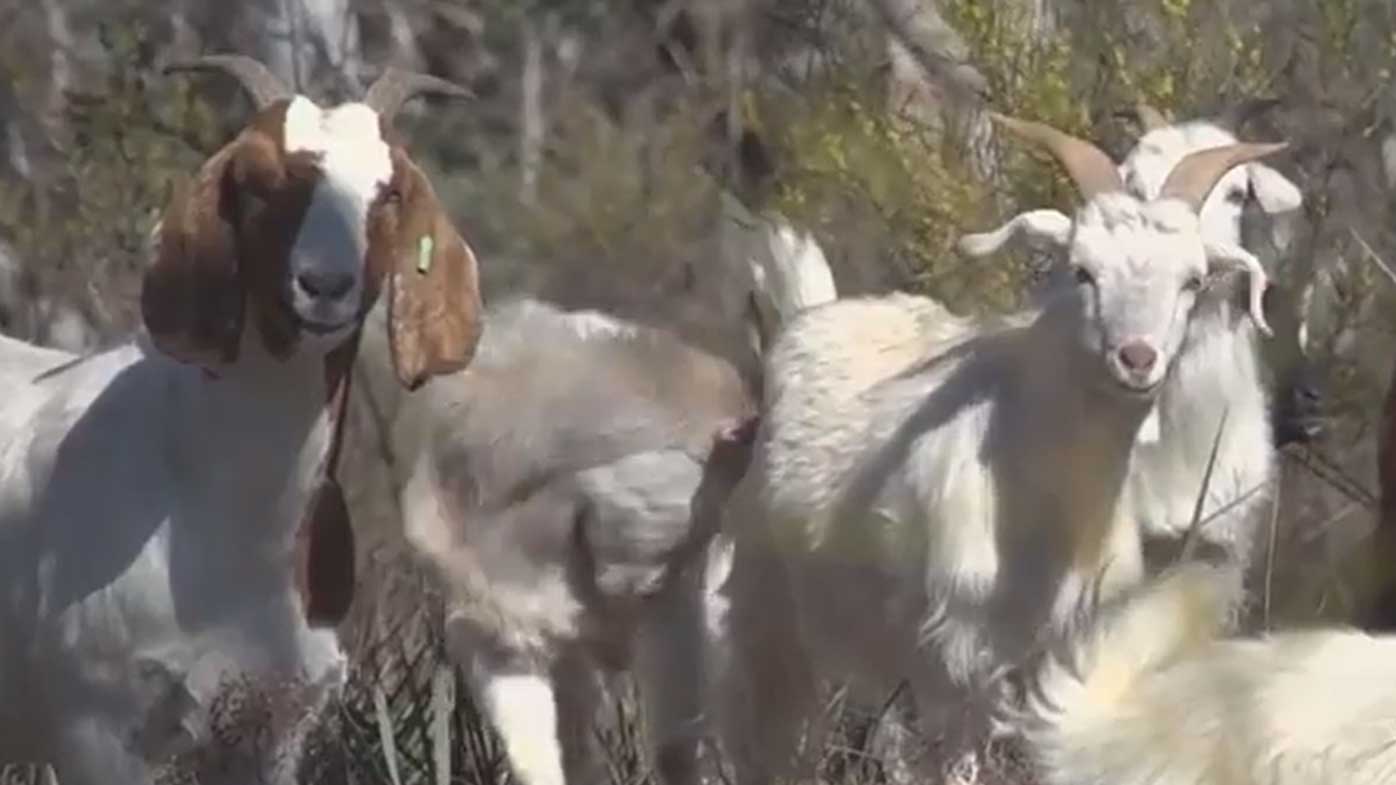
Goats spend almost all their waking hours eating, nibbling away non-stop at grass and shrubs.

All that chewing and chomping is now being put to good use by the Rural Fire Service in NSW's Central West – hungry goats helping reduce the risk of bushfires.

A herd of bucks and billies have been picked to protect Clandulla village near Mudgee – which has been identified as an extreme bushfire risk this summer.

READ MORE: Man attacked by a goat in NSW Blue Mountains

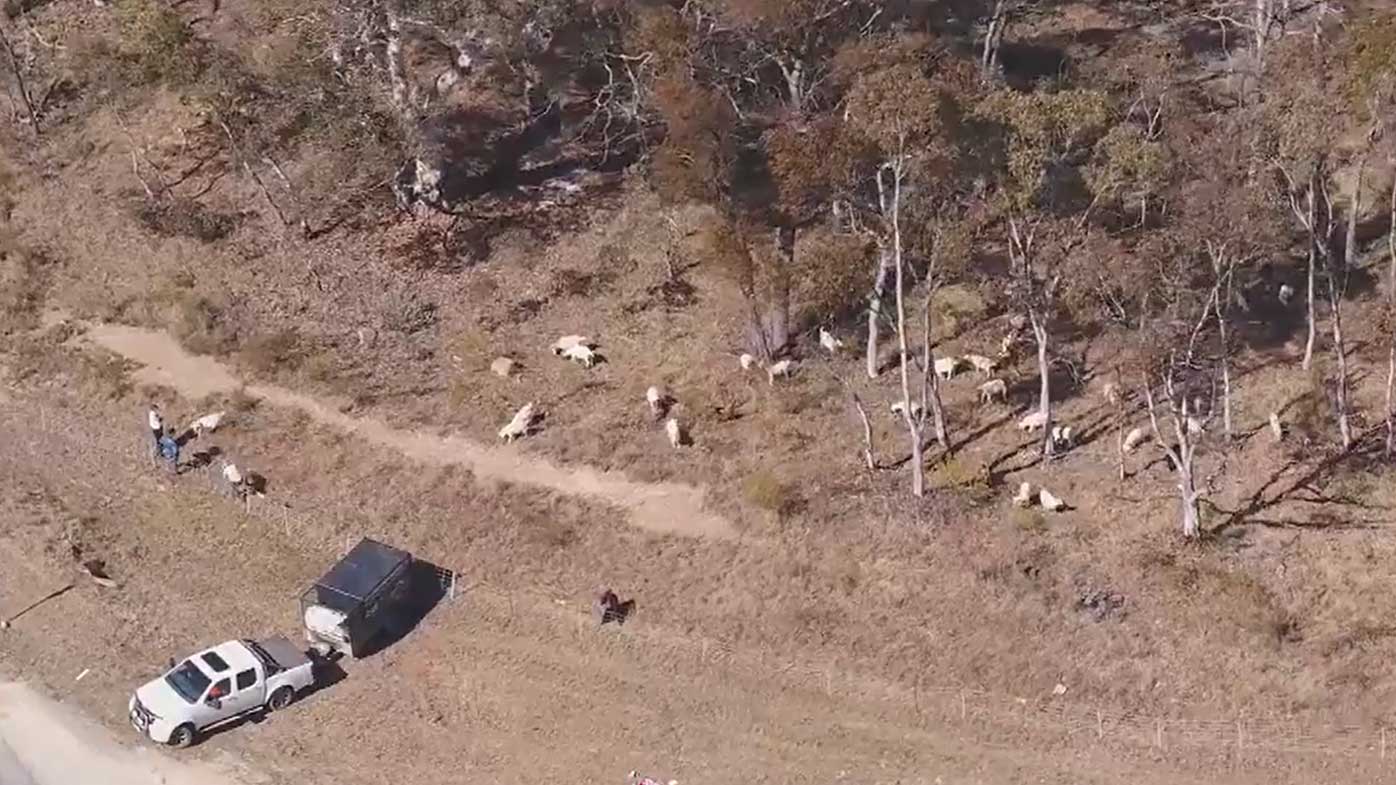
Goats are being used instead of backburning in the NSW Central West.

The goats are on loan from two local farmers.

They'll be grazing in Clandulla for the next two months, eating their way through any foliage that could start a fire.

"Goats will eat up shrubs, small tree saplings and eat woody weeds some of your other animals won't," farmer Michael Blewitt said.

And while employing goats to fight fires is an Australian-first, it has already been done in the USA, Portugal and Spain.

The goats grazing near Mudgee.

These goats are expected to clear more than two hectares over the next three weeks, creating a buffer zone to the village of 200 people.

While backburning is reliant on certain weather conditions, goats are happy to clear away grass, shrubs and bushes no matter the weather.

READ MORE: Goat rescued from roof of Sydney home

Third Quake in August Shakes Trinidad

Shortly after midday on Monday, for the second consecutive week, parts of Trinidad were jolted by a light magnitude 4.6 earthquake west of the country.

The University of the West Indies Seismic Research Centre recorded this quake at 86 kilometres depth.

The Centre also notes that this earthquake has been reviewed by an analyst.

This earthquake was reportedly widely felt across Northern and Central Trinidad.

Earthquakes in this area are typical for Trinidad and Tobago. This is the third felt earthquake this month, with the last two occurring on August 23rd at a magnitude 4.0 and the other, a magnitude 4.4, on August 12th.

Generally, across the Eastern Caribbean, a seismically active area, earthquakes of this magnitude, up to M8.0 and greater, are possible. Seismologists have repeated this statement at the University of the West Indies Seismic Research Centre for decades.

Each year, over 2,200 seismic events are recorded in the Eastern Caribbean. On average, the Eastern Caribbean has seen a pattern of major (M7.0-M7.9) quakes every 20 to 30 years. That pattern has stayed true. The last major earthquake occurred north of Martinique in 2007.

Three years ago, on August 21st and August 22nd, 2018, Trinidad and Tobago was struck by two large earthquakes registering a magnitude 6.9 and 5.9, respectively, the largest quakes to strike near T&T in recent history.

Reporter: Kalain Hosein

The post Third Quake in August Shakes Trinidad appeared first on The St Kitts Nevis Observer.

Haiti’s Food Crisis Became Deeper After Devastating Quake

NAN KONSEY, Haiti, Aug 30 (Reuters) – In a tent encampment in the mountains of southern Haiti, where hundreds of villagers sought shelter after a powerful earthquake flattened their homes this month, a single charred cob of corn was the only food in sight.

“I’m hungry and my baby is hungry,” said Sofonie Samedy, gesturing to her pregnant stomach.

Samedy had eaten only intermittently since the 7.2-magnitude earthquake on Aug. 14 destroyed much of Nan Konsey, a remote farming village not far from the epicenter. Across Haiti, the quake killed more than 2,000 people and left tens of thousands homeless.

In Nan Konsey, the earth’s convulsions tore open the village’s cement cisterns used to store drinking water and triggered landslides that interred residents’ modest subsistence farms.

Since then, Samedy and the rest of the community have camped alongside the main highway, about a 40-minute walk from their village, hoping to flag down the rare passing truck to ask for food and water.

“I’m praying I can still give birth to a healthy baby, but of course I’m a little afraid,” she said.

Haiti, the poorest country in the Americas, has long had one of the world’s highest levels of food insecurity. Last year, Haiti ranked 104 out of the 107 countries on the Global Hunger Index. By September, the United Nations said 4 million Haitians – 42% of the population – faced acute food insecurity.

This month’s earthquake has exacerbated the crisis: destroying crops and livestock, leveling markets, contaminating waterways used as sources of drinking water, and damaging bridges and roads crucial to reaching villages like Nan Konsey.

The number of people in urgent need of food assistance in the three departments hardest-hit by the earthquake – Sud, Grand’Anse and Nippes – has increased by one-third since the quake, from 138,000 to 215,000, according to the World Food Programme (WFP).

“The earthquake rattled people who were already struggling to feed their families,” Lola Castro, WFP’s regional director for Latin America and the Caribbean, said in a statement.

“The compound effects of multiple crises are devastating communities in the south faced with some of the highest levels of food insecurity in the country.”

‘IN THE HANDS OF GOD’

Just off the highway leading to Nan Konsey, a few dozen men gathered at a goat market, where they sold off their remaining livestock to secure cash to feed their children or to pay for family members’ funerals.

Before the quake, farmer Michel Pierre had tended 15 goats and cultivated yams, potatoes, corn, and banana trees. He arrived at the market with the only two animals that survived the earthquake.

With his crops also buried beneath landslides, he hoped to earn about $100 from the sale to feed himself, his wife and his children.

When that money runs dry, he said, he isn’t sure what he will do. He is still in debt from when Hurricane Matthew ravaged Haiti in 2016.

“Day by day, it’s getting harder to be a farmer,” he said. “I am in the hands of God.”

Haiti was largely food self-sufficient until the 1980s, when at the encouragement of the United States it started loosening restrictions on crop imports and lowered tariffs. A subsequent flood of surplus U.S. crops put droves of Haitian farmers out of business and contributed to investment in the sector tailing off.

In recent years, climate change has made Hispaniola – the island Haiti shares with the Dominican Republic – increasingly vulnerable to extreme droughts and hurricanes. Spiraling food costs, economic decline and political instability have worsened the shortages.

For Gethro Polyte, a teacher and farmer living north of the town of Camp-Perrin, the earthquake decimated his two main sources of income: leveling the school where he taught fourth grade, and submerging his crops and livestock in an avalanche of earth.

Before the disaster, he and his family had been able to pull together two meals a day and draw water from underground springs, he said. But since then, his food supplies have dwindled down to a few yams and bananas, and the water has been contaminated with silt.

Polyte doubted the school would be rebuilt for classes to start in September and for him to receive a paycheck, given the chaos following the assassination of President Jovenel Moise in July. And with bank loans still to pay off, he doubted he’d be able to secure money to invest in rebuilding his farm.

“We are living now by eating a little something just to kill the hunger,” he said. “And, of course, things will only grow worse in the coming days.”

Reporting by Laura Gottesdiener in Haiti, additional reporting by Ricardo Arduengo and Herbert Villarraga in Haiti Editing by Daniel Flynn and Rosalba O’Brien

The post Haiti’s Food Crisis Became Deeper After Devastating Quake appeared first on The St Kitts Nevis Observer.

Mexico Condemns Violent Actions by Its Migration Agents Caught on Video

MEXICO CITY, Aug 30 (Reuters) – Mexico’s National Migration Institute (INM) condemned the actions of agents caught on video over the weekend throwing a migrant to the ground and kicking him in the face with the help of National Guard troops.

The government deployed hundreds of security forces to head off a caravan of migrants and asylum seekers who left the southern city of Tapachula on Saturday for Mexico City, where they hoped to seek expedited asylum proceedings.

Videos posted to social media showed confrontations along a highway in the state of Chiapas between members of Mexico’s militarized National Guard and the migrants, many of whom were accompanied by young children or carrying babies.

One of the videos shows an INM agent, with the help of National Guards wearing riot gear, grabbing one of the migrants and knocking him to the ground, as another agent kicks him in the face.

In a statement, INM announced the two agents had been “suspended” due to what it described as their inappropriate conduct on Saturday.

“No conduct outside human rights protocols and policies will be tolerated,” the statement said, adding that additional punishment will be determined by an internal inspector.

Another video showed members of the National Guard using their shields to beat a migrant carrying a minor.

Neither the INM or National Guard made any mention of the videos. It was unclear who had recorded the videos.

Amnesty International’s Mexico office called on Twitter for Mexico “to act with a humanitarian approach in the face of the arrival of Central American and Haitian migrants fleeing the violence and crisis generated by natural disasters.”

The National Guard, responding to Amnesty International, said on Twitter: “We have increased supervisory controls to improve procedures and prevent abuses.”

Reporting by Diego Ore; Additional reporting by David Alire Garcia; Writing by Anthony Esposito; Editing by Rosalba O’Brien and Chris Reese

The post Mexico Condemns Violent Actions by Its Migration Agents Caught on Video appeared first on The St Kitts Nevis Observer.

Police hurt, more than 150 arrested almost 600 fines issued at anti-lockdown protests

Several police officers have suffered "minor' injuries after almost 70 separate coronavirus lockdown protests were held across NSW, with more rallies in Victoria and Queensland.

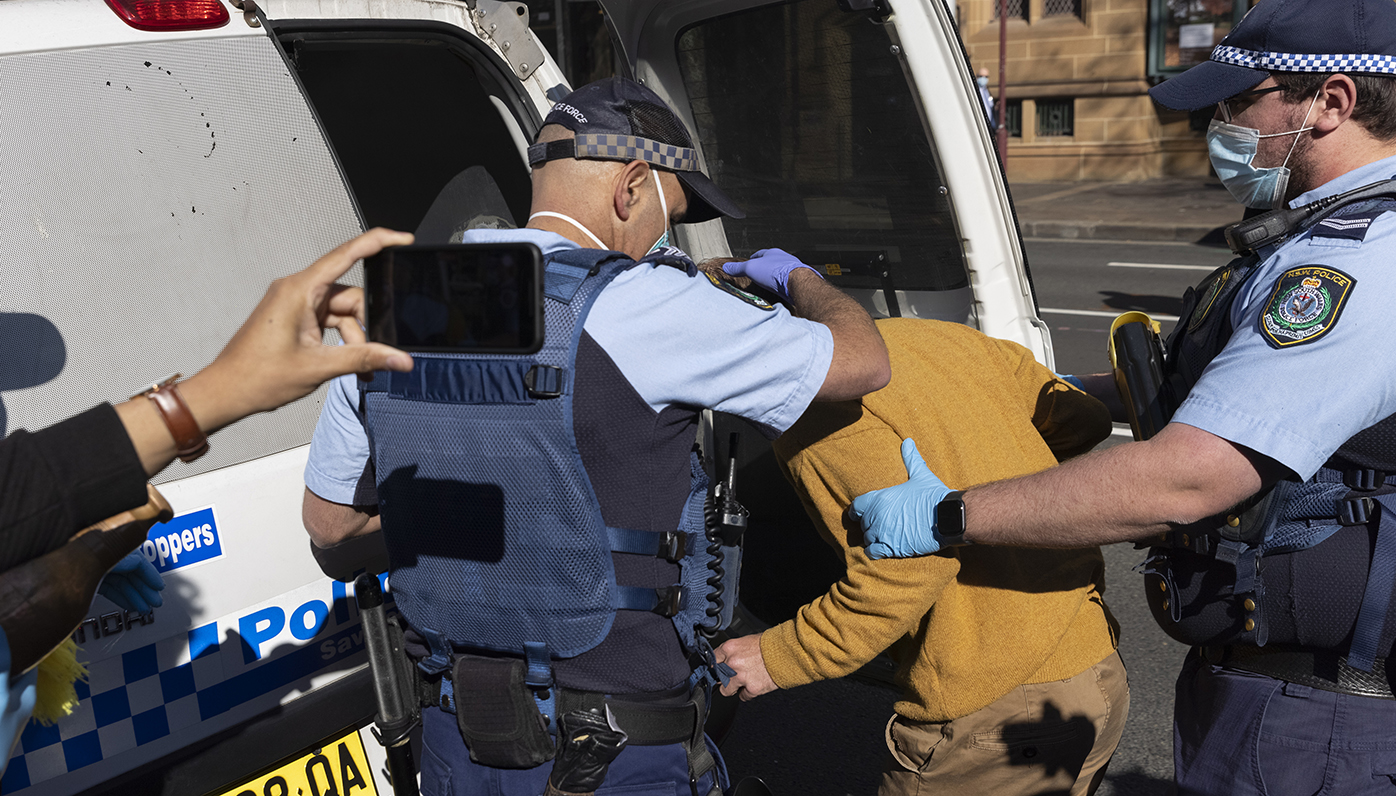
More than 150 people have been arrested and almost 600 fines were issued after the protests at public buildings, NSW Police said.

"It's very disappointing that people would think this was appropriate behaviour in the current circumstances," NSW Police Deputy Commissioner Mal Lanyon said.

LIVE UPDATES: International travel on the cards when NSW hits number

"We are very comfortable with free speech… but when that's with contravention to the public health order, police will not tolerate it.

"The public health order is in place for the safety of all."

Deputy Commissioner Lanyon said the events were organised online.

He said an expected truck blockade in the state, however, didn't happen.

A group of protesters at the NSW Parliament

While there were just a handful of people at some locations, one of the biggest crowds turned up at Fairfield Council, which is one of Sydney's hotspots in the city's west.

More crowds of protesters gathered at Lismore and Ballina Council buildings in northern NSW, as well as at Port Macquarie near Newcastle.

Police responded to 79 unauthorised protests, during which three officers received minor injuries following interactions with protestors at Lismore, Murwillumbah and Raymond Terrace.

In total, 153 people were arrested, many of whom were released after officers were able to establish their identity to issue a PIN.

Police stations and other government buildings were also a target for protesters, who were met by a large police presence.

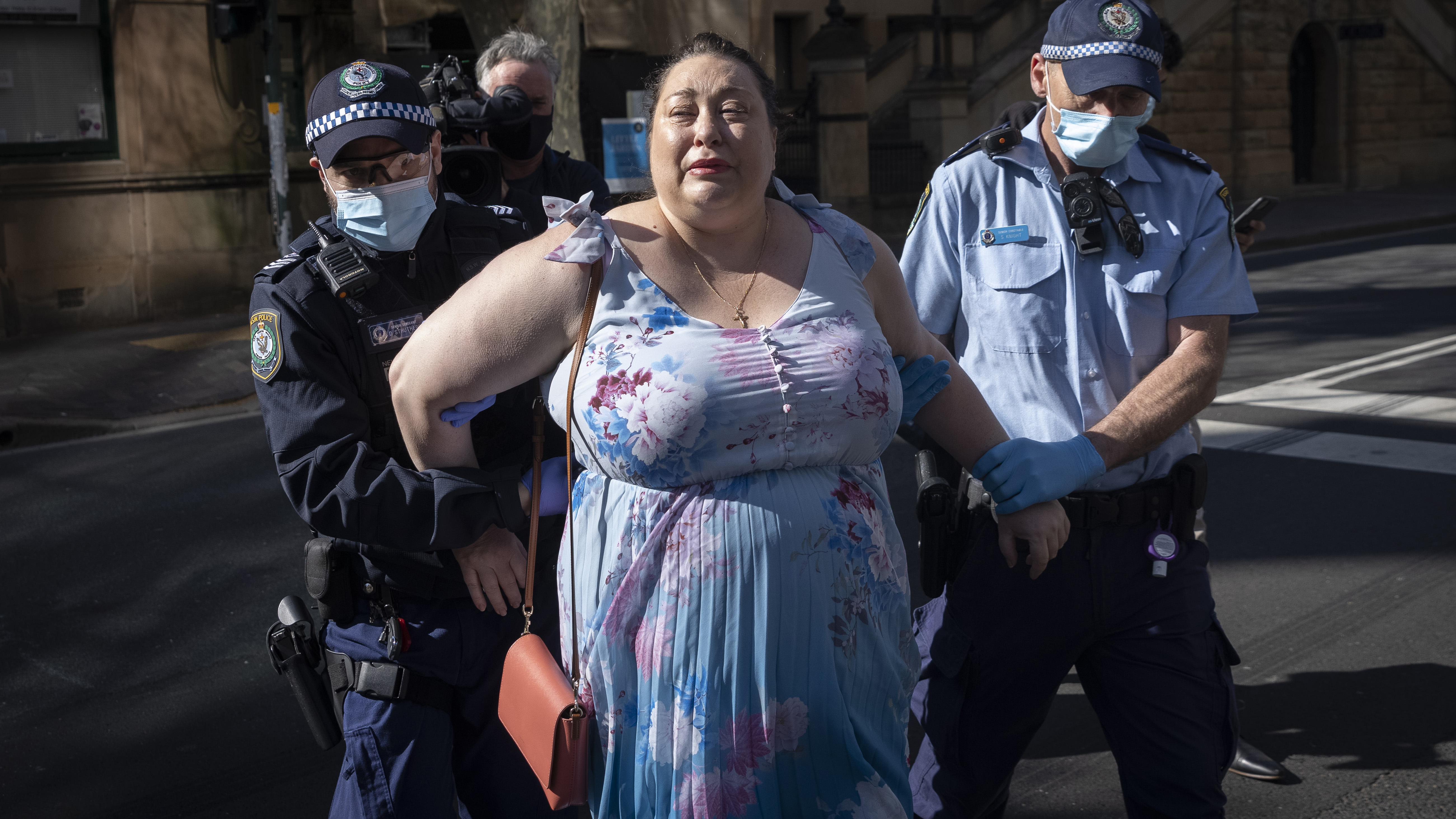
A woman is arrested  outside the Parliament of New South Wales in Sydney.

Meanwhile, Queensland parliament was put into lockdown after protests outside.

Hundreds also gathered at the City of Gold Coast Chambers and stood with their backs to the door.

https://twitter.com/MarkHanrahan9/status/1432500770742489092

In Melbourne, protesters gathered near the Royal Botanic Gardens.

Police swarmed the area, with a number of officers also patrolling the scene on horseback.

It's understood one man was arrested.

Protests at Sydney's Fairfax Council.

The protests come a few weeks after a rally attended by thousands in Melbourne turned violent.

More than 200 people were arrested and numerous police officers were hurt.

Thousands also turned up at a similar event in Sydney, where almost 50 arrests were made despite NSW Police warning against it.

In July, large protests were also held in both cities.