LIMA, Feb 8 (Reuters) – Peruvian President Pedro Castillo swore in his fourth cabinet in just six months in office on Tuesday, picking a loyalist as prime minister, in a bid to end his administration’s recurring crises.
Castillo, a former schoolteacher and member of a Marxist-Leninist party, handed the premiership to Anibal Torres, the justice minister in the previous cabinet.
The previous prime minister resigned last week after just four days in office due to allegations of domestic violence against his daughter and late wife.
The prime minister who came before that had resigned over disagreements with Castillo over appointments of police officials.
Castillo kept on investor-friendly technocrat Oscar Graham as finance minister, the role given to him in last week’s short-lived Cabinet.
An opposition attempt to impeach Castillo in December on grounds that he was morally unfit for office failed to gather enough votes in Congress.
Castillo’s new cabinet still needs to be confirmed by the opposition-controlled Congress, which could reject it and force the president back to the drawing board. Castillo won approval for his first two cabinets, while the third one fell apart before the vote.
During the swearing in ceremony, Castillo appeared without his signature broad-rimmed hat. He has worn the hat, customarily worn in his home province of Chota, for almost all public appearance since taking office.
Neither Torres or Castillo, who both hail from Chota, offered remarks during the swearing in ceremony.
Reporting by Marcelo Rochabrun; Editing by Simon Cameron-Moore
OTTAWA, Feb 9 (Reuters) – Canadians say they are concerned political strife in the United States will undermine security and economic growth at home, according to a new poll, as an anti-vaccine mandate protest praised by former U.S. President Donald Trump gripped the capital and affected the border.
The anxiety captured in the Angus Reid Institute survey provides a backdrop to protests across the country, at the international border, and especially in Ottawa, the capital, where police say Americans have provided a “significant” amount of money and organizational support.
The Ottawa protest, now in its 13th day, has been marred by the appearance of hateful symbols, like the Confederate flag, associated with the aggressive populism embraced by Trump supporters and some protesters say their goal is not only to roll back vaccine mandates, but also to overthrow the government.
“The success or failure of the United States will have a profound impact on Canada,” said Bruce Heyman, former American ambassador to Canada from 2014-2017. “Part of the more extreme nature of our politics over the last few years has now moved to occupy some part of Canada today.”
In the poll, 78% of Canadians said they were worried America’s democratic discord will affect their country’s economy and security. The survey of 1,620 Canadians was conducted between Jan. 27 and Jan. 31, the days in which the Ottawa protest began.
Two-thirds of Canada’s 38 million people live within 100 km (62 miles) of the U.S. border, and the two countries are each other’s top trading partners.
The trade relationship with the United States is of existential importance to Canada, with 75% of all exports going to the southern neighbor. Half of Canada’s imports come from the United States, including 60% of all imported fresh vegetables.
The Jan. 6 anniversary of the storming of Capitol Hill in Washington last year led to a series of articles in Canadian newspapers that sounded an alarm about the resiliency of American democracy in coming years, and in particular after the 2024 election.
Until recently, politics in Canada has been less polarized than in the United States. One example is the adoption of vaccines with nearly 80% of Canadians having had two shots of a COVID-19 vaccine in contrast to 64% in the United States.
However, last week’s ouster of Conservative opposition leader Erin O’Toole in part for failing to embrace the protest suggests the political landscape is shifting.
“Canadians have generally looked to the United States and felt like, ‘Whatever is going on there, it’s not as bad in Canada,’” said Shachi Kurl, Angus Reid president.
“We like to think of ourselves as… a country of circumspection and compromise and friendliness, yet two in five people don’t feel that way anymore,” she said. Some 37% of Canadians say there is no room for political compromise in their country, the poll shows.
Ottawa police said on Tuesday they had worked with Ohio police to track down and arrest a man there for calling in fake threats “designed to deceive and distract our emergency resources,” deputy police chief Steve Bell told reporters.
On Monday, Canada’s federal Public Safety Minister Marco Mendicino said the government would be “very vigilant about external forces, about foreign interference”.
‘A WAKE UP CALL’
Trump last weekend spoke out in support of the truckers and called Liberal Prime Minister Justin Trudeau a “far-left lunatic“.
According to Angus Reid poll, 68% of Canadians believe U.S. democracy cannot survive another Trump presidency, and 47% said the United States is on its way to becoming an authoritarian state.
“The United States used to be a beacon of democracy, and now it’s exporting right-wing sedition to other democratic countries,” said Roland Paris, Trudeau’s former foreign policy adviser and professor of international affairs at University of Ottawa.
“The worse things get in the United States, the more dangerous it will be for Canada,” Paris said, calling the Ottawa protest a “wake-up call”.
Gerry Butts, Vice Chairman of Eurasia Group and formerly Trudeau’s top advisor, says “Canadians are astute observers of what’s happening in the United States, and they’re rightly anxious about it”.
“In the long term, Canada will be like everyone else… badly damaged if the United States becomes a democracy in name only,” he said.
($1 = 1.2661 Canadian dollars)
Reporting by Steve Scherer Editing by Alistair Bell
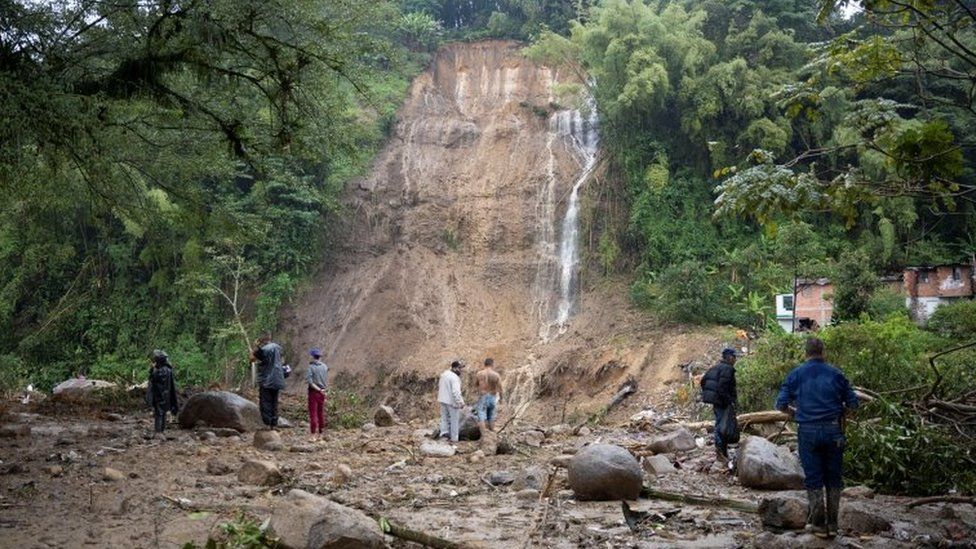
BBC- A landslide triggered by heavy rains has killed at least 14 people in central Colombia, officials say.
Another 35 people were now in hospital after several homes were engulfed in the Dosquebradas municipality, Risaralda province, on Tuesday.
The officials issued a photo showing a gash in the lush foliage covering a mountain overlooking the area.
Other residents living close to a swollen river nearby have been moved to safety.
Rescue teams have been searching in the mud for more survivors, Colombia’s disaster management officials said.
“A very loud noise scared us. We went out and saw a piece of the mountain on top of the houses,” taxi driver Dubernei Hernandez told the AFP news agency.
“I went to that place and it was a disaster, with people trapped.”
Mr Hernandez said he helped dig up two bodies and a survivor. At least five homes were buried by the mud, he added.
There are fears that the death toll will rise further.
We saw a piece of the mountain on top of the houses,” one local resident said
Landslides are common in Colombia and houses built on steep hillsides are at particular risk during the country’s rainy season.
In 2019, at least 28 people were killed after a landslide hit the south-western Cauca province.
Two years earlier, more than 250 people were killed when a landslide hit the town of Mocoa, in the southern Putumayo province.
NIA CHARLESTOWN NEVIS- In its continued pursuit of food sustainability on Nevis, the Ministry of Agriculture through the Department of Agriculture, is recording promising successes in food production.
Mr. Huey Sergeant, Permanent Secretary in the ministry, says the success is based on the demand for crops cultivated on the government-owned farms.
“Peanuts has performed exceptionally well. The demand and quality is phenomenal. We are actually harvesting peanuts again because of the response… Even when the peanuts was still in the ground, we were in a process of accepting huge orders because of that demand. Many persons were happy at the quality that they would have received.
“We are on the road to continue the production of peanuts on the island. We would have produced four acres last year and that still wasn’t enough…We have huge demands for much of the product.
“Sweet potato is something that we are quite proud of. It’s a traditional crop, yes, but the volumes in which it was produced was significantly lower than what is demanded…We are exploring ginger. Ginger is in high demand as well,” he said.
Mr. Sargeant also spoke on the growing demand for sorrel.
“The sorrel that we planted performed well, in that there is a demand for sorrel not just in the festive time but throughout the year. So we’ve embarked in Indian Castle in particular to do sorrel… We have sorrel down to as far as June based on our crop scheduling.
“We have three types of sorrel… We have pink sorrel; we have dark red that is black at the tips; and then we have what we call a white sorrel which is actually green, and all of them they’re doing quite well,” he said.
He noted there is also the demand for soursop and in order to keep up with the demand at the Nevis Agro Processing Centre, the department had to resort to cultivation on a commercial basis.
The department has also ventured into root cop production on the government owned farms and have planted cassava, tannia, ginger, cantaloupe, green banana, onion and sweet potato.
They are also cultivating beets, carrots, and other crops the farmers tend not to want to do and greenhouse sweet pepper.
Mr. Sargeant spoke to the progress at the government-owned farm at Indian Castle Estate where the focus is on tree crop cultivation.
“We would have planted in excess of 7,000 tree crops… We have citrus; we have cassava; we have over 4,000 coconut trees planted; we have mango; we have pomegranates; we have a lot of the crops that we found were not being heavily produced on the island in terms of tree crops.
“We explored sugar cane. We have passion fruit and so on… We have exotic things like the cane fig for example; we have soursop,” he said.
According to Mr. Sargeant, the imported coconut plants are progressing satisfactorily.
“The performance has literally been phenomenal of those coconut trees. I think…it’s 18 months before they start producing,” he said.
The trees, which were imported from Guyana, were brought to Nevis primarily to capture the jelly water market, primarily to reduce cost and provide a fresh product to consumers on Nevis, Mr. Sargeant explained
“We realise people have become a lot more conscious, and they are consuming a lot of jelly water. Sadly, the jelly water that is consumed, all of it is imported… so by the time they get here the shelf life is almost to the end of it.
“If we can get jelly produced on Nevis, that freshness is certainly an advantage. Hopefully, because it’s produced on Nevis and the transportation costs associated with jelly water now is going to be eliminated. We are doing all of this investment so that later on we can actually see a decrease in cost to the consumers,” he said.
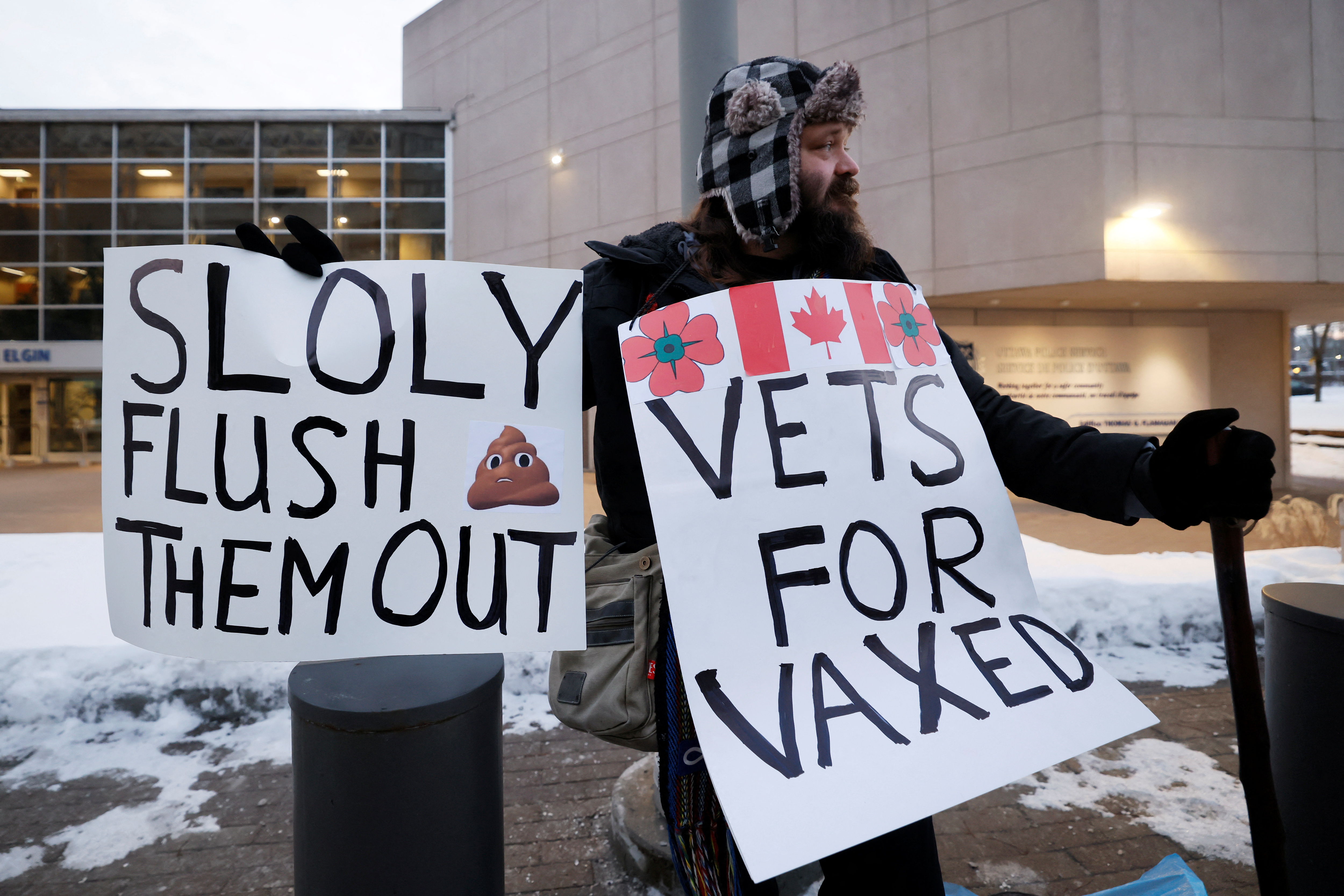
A Canadian protest that began with truck drivers protesting cross-border vaccination mandates has turned into an occupation of the capital city of Ottawa, as demonstrators have blocked traffic, disrupted businesses and threatened local residents for 12 days.
The protests have also mushroomed into broader rallies against most public health measures like masks and vaccinations, as well as against the Canadian government. The demonstrations are attracting members of the far-right movement, along with former President Trump and other GOP politicians, who have warned that the Biden administration may face similar unrest.
But much of the support is coming from our side of the border: polls show most Canadians don’t back the protests, and the country’s largest trucking industry group is distancing itself.
GOP love: “The Canadian truckers are heroes, they are patriots. They are marching for your freedom and for my freedom,” Sen. Ted Cruz (R-Texas) said Sunday on Fox News.
“Those truck drivers are defending Canada, but they’re defending America as well,” he added. “The government doesn’t have the right to force you to comply to their arbitrary mandates.”
On Friday, Trump released a statement slamming Canadian Prime Minister Justin Trudeau as a “far left lunatic” who “destroyed Canada with insane Covid mandates,” and invited American and Canadian truckers to come to Washington “to protest Biden’s ridiculous Covid policies.”
====================================
Pfizer accused of pandemic profiteering as profits double
Drugmaker makes $37bn in vaccine sales and predicts bumper year ahead from Covid jabs and pill
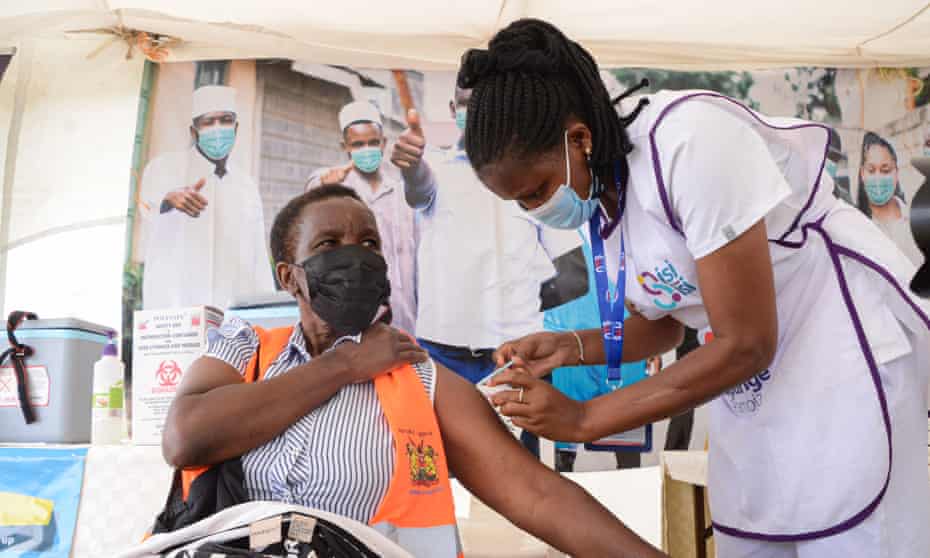
A healthcare worker administers a Pfizer vaccine in Nairobi, Kenya, this month. Photograph: John Ochieng/SOPA Images/Rex
Guardian- Pfizer made nearly $37bn (£27bn) in sales from its Covid-19 vaccine last year – making it one of the most lucrative products in history – and has forecast another bumper year in 2022, with a big boost coming from its Covid-19 pill Paxlovid.
The US drugmaker’s overall revenues in 2021 doubled to $81.3bn, and it expects to make record revenues of $98bn to $102bn this year.
The bumper sales prompted accusations from campaigners of “pandemic profiteering”. The group Global Justice Now said the annual revenue of $81bn was more than the GDP of most countries and accused Pfizer of “ripping off public health systems”.
The Covid jab Company, which the New-York based pharma firm developed with the much smaller German company BioNTech, brought in $12.5bn in revenues in the final quarter of 2021, taking the total for the year to $36.8bn. Pfizer said it had exceeded its target of manufacturing 3bn doses of the vaccine last year.
The drugmaker made a net profit of nearly $22bn last year, up from $9.1bn in 2020. It increased its 2022 estimate for Comirnaty sales to $32bn and expects Paxlovid to contribute $22bn in revenues.
The pill, which boasts nearly 90% success in preventing severe illness among vulnerable adults if taken soon after becoming infected with Covid-19, was approved for emergency use by the US regulator in late December.
Albert Bourla, Pfizer’s chairman and chief executive, said that at the start of the pandemic it had “committed to use all of the resources and expertise we had at our disposal to help protect populations globally against this deadly virus”.
“Now, less than two years since we made that commitment, we are proud to say that we have delivered both the first FDA-authorised vaccine against Covid-19 (with our partner, BioNTech) and the first FDA-authorised oral treatment for Covid-19,” he said.
“These successes have not only made a positive difference in the world, but I believe they have fundamentally changed Pfizer and its culture for ever.”
The Covid vaccine, together with that produced by US rival Moderna and the much cheaper jab made by Britain’s AstraZeneca, has saved millions of lives worldwide.
However, pharmaceutical companies have been accused of not sharing the recipe for their vaccines, which would enable drugmakers in poorer countries to produce cheaper versions of them.
Global Justice Now pointed out that Pfizer’s Covid-19 jab was invented by BioNTech, supported by €100m (£84m) in debt financing from the publicly owned European Investment Bank and a €375m grant from the German government.
Tim Bierley, a pharma campaigner at the group, said: “The development of mRNA vaccines should have revolutionised the global Covid response.
“But we’ve let Pfizer withhold this essential medical innovation from much of the world, all while ripping off public health systems with an eye-watering mark-up.”
Bierley said: “It’s nothing short of pandemic profiteering for Pfizer to make a killing while its vaccines have been withheld from so many. Pfizer is now richer than most countries; it has made more than enough money from this crisis. It’s time to suspend intellectual property and break vaccine monopolies.”
Pfizer has charged the UK’s NHS an estimated £2.8bn above production cost for the 189m doses of Covid-19 vaccines the UK government has bought, Global Justice has calculated.
According to Reuters, Pfizer has sold the vaccine to African countries at $3 to $10 a shot. It has indicated that a non-profit dose costs just $6.75, or £4.98, to produce, but it has reportedly charged the NHS £18 a dose for the first 100m jabs bought and £22 a dose for the next 89m, totalling £3.76bn, Global Justice Now said – amounting to an eye-watering 299% mark-up.
Responding to Global Justice Now’s claims, a Pfizer spokesperson said it was “firmly committed to equitable and affordable access” to the Comirnaty jab.
They said: “High- and middle-income countries pay more than low-income countries, but at a value that is significantly discounted from our normal benchmarks, during the pandemic. Low- and lower-middle-income countries pay a not-for-profit price.
“However, we would highlight that the true costs of bringing this novel mRNA vaccine to patients include ongoing large-scale clinical studies and pharmacovigilance, continued and increased manufacturing efforts including process improvements, and global distribution and supply.
“Covid vaccines are complex biologic products, and their manufacturing requires specialised experience, expertise and equipment.
“It is not as simple as sharing the ‘recipe’. Manufacturing of the Pfizer and BioNTech Covid vaccine involves the use of over 280 materials. There is enormous collaboration already taking place.”
Johnson & Johnson temporarily halted production of its COVID-19 vaccine in the Netherlands, the only manufacturing hub making usable doses for the pharmaceutical company, according to a New York Times report on Tuesday.
The company stopped production of the vaccine at its facility in the Dutch city of Leiden at the end of 2021 and has instead turned its attention to making another vaccine for an unrelated virus, the Times reported. The pause is temporary and is expected to last just a month — but it could reduce Johnson & Johnson’s vaccine supply by a few hundred million doses.
While the Johnson & Johnson vaccine from Janssen Pharmaceuticals has been linked to rare blood clots and is considered less effective than Pfizer’s and Moderna’s shots by the Centers for Disease Control and Prevention, it is extremely important in Africa and low-income countries, which rely on the simpler one-dose shot.
The vaccine also avoids the requirement of storage in ultra-cold temperatures, which makes shipment of Moderna and Pfizer doses more difficult.
In October, Johnson & Johnson said it was committing about 50 million vaccines to 40 countries through COVAX, the vaccine-sharing initiative from the World Health Organization and the United Nations.
But Ayoade Alakija, a co-head of the African Union’s vaccine-delivery program, told the Times that switching up production could endanger the vaccination effort.
“This is not the time to be switching production lines of anything, when the lives of people across the developing world hang in the balance,”she said.
Hong Kong announced stringent new coronavirus restrictions and record new infections, while a shortage of vegetables added to the misery as truck drivers who tested positive for COVID-19 were unable to bring them from mainland China.
The Saudi-led coalition has deployed newly formed units near Yemen’s Marib where battles have abated, according to military and government sources, as the warring sides hold their positions in the fight for energy-rich areas that has led to the war’s biggest escalation in years.
People gather outside the City Hall during an anti-vaccine mandate protest in the Manhattan borough of New York City, February 7, 2022
U.S.
Officials in New Jersey, Connecticut, Delaware, California and Oregon said they will lift indoor mask mandates for schools and other public places in coming weeks, seeking a return to “normalcy” as soaring COVID-19 infections fueled by the Omicron variant abate. The changes signal a growing inclination by political leaders in those states, all led by Democrats, to take pandemic-weary residents off an emergency footing.
Dozens of U.S. Democratic lawmakers with the Congressional Black Caucus have urged the Justice Department to step up legal efforts to protect voting rights across the country, condemning what they say are “anti-democratic” Republican efforts to restrict ballot access for voters of color. The Supreme Court let Alabama use a Republican-backed map of the state’s congressional districts that a lower court found likely discriminates against Black voters.
Right-wing television network Newsmax Media countersued Smartmatic, an election security firm that says it was defamed by Newsmax’s coverage of the 2020 presidential election. Smartmatic sued Newsmax in November for amplifying false claims that Smartmatic voting machines rigged the election against then-President Donald Trump.
The United States faces heightened threats from extremist groups domestic and foreign, underscored by last month’s hostage standoff crisis in a Texas synagogue and bomb threats at many historically Black colleges and universities, a government agency said. The warning comes after some schools across the United States canceled classes and issued shelter-in-place orders last week.
SoftBank has shelved its blockbuster sale of Arm to U.S. chipmaker Nvidia valued at up to $80 billion citing regulatory hurdles and will instead seek to list the company. The Japanese conglomerate acquired Arm, whose technology powers Apple’s iPhone and nearly all other smartphones, in 2016 for $32 billion.
BP’s profits hit their highest in eight years in 2021, lifted by soaring gas and oil prices, as the company boosted share repurchases and accelerated plans to cut emissions with increased spending on low carbon energy.
When Japan handed Tokyo bus driver Keiki Nambu and his wife, Takako, $870 for each of their nine children, they spent it exactly as the government had feared: paying down a mortgage instead of going shopping. That kind of financial prudence represents a headache for policymakers, who are struggling to kick-start consumption and boost a moribund economy.
As bitcoin drifts towards mainstream maturity in 2022, daring crypto investors are eyeing up new sources of explosive action: “altcoins” that power online games and worlds. But, be warned, the foothills of the unformed metaverse are no place for the faint-hearted.
Collection of Black history memorabilia up for auction
The massive personal collection owned by 90-year-old Elizabeth Meaders traces the history of Black Americans and ranges from rare civil rights posters to Muhammad Ali’s shoes.
The revised estimate reduces global sea level rise by 3 inches if all glaciers were to melt. But it raises concern for some communities that rely on seasonal melt from glaciers to feed rivers and irrigate crops.
PORT AU PRINCE, Haiti (CMC) – The abductors of Pastor Lochard Rémy, a popular evangelical singer, are demanding a US$2million ransom for his release, according to his wife, Yolie Rémy.
She told local media that the kidnappers, said to be members of the notorious gang “400 Mawozo”, had made the demand less than 24 hours after abduction of her husband as he made his way to the God Eben Etzer Church for Sunday worship.
The kidnapping is the latest by gangs targeting pastors in this French-speaking Caribbean Community country where kidnappings have become a source of income for criminal gangs.
In recent months, several partos have either been killed or released after they were abducted.
On January 21 Pastor Mathieu Chériné, one of the leaders of the Mahalaleel Church in Delmas, was shot several times and killed while trying to escape his captors.
Gunmen dressed up as members of the National Police of Haiti kidnapped Pastor Jean Mary Ferrer Michel in front of the Jesus Center Church of Delmas 29, as well as two other people who were accompanying him.
Last September, 60-year-old Deacon Sylner Lafaille was shot and killed as gunmen tried to abduct him and his wife, Marie Marthe Laurent Lafaille
A Drug Enforcement Administration chemist checks confiscated powder containing fentanyl at the DEA Northeast Regional Laboratory on October 8, 2019, in New York.
(CNN)A new government report out Tuesday details how opioid trafficking in the United States has changed in recent years, with Mexico now a “dominant source” of the country’s fentanyl supply and synthetic opioids rapidly saturating drug markets.
In its report, the federal Commission on Combating Synthetic Opioid Trafficking — a bipartisan group of US lawmakers, experts and officials from federal departments and agencies — warns that if the US does nothing to change its response to the new challenges, more American lives will be lost.
“This is one of our most-pressing national security, law enforcement, and public health challenges, and we must do more as a nation and a government to protect our most precious resource ― American lives,” said Republican Sen. Tom Cotton of Arkansas and Democratic Rep. David Trone of Maryland, the commission’s co-chairs, in a letter included in the report.
From June 2020 to May 2021, fentanyl and synthetic opioids accounted for roughly two-thirds of the more than 100,000 deaths in the US from drug overdoses, the report found. The fatalities were mostly among Americans ages 18 to 45.
Fentanyl, a type of synthetic opioid, has been the “primary driver” of the US opioid epidemic and is 50 times more potent than heroin, according to the report. It found that while 70% to 80% of fentanyl that federal authorities seized between roughly 2014 to 2019 had come from China, Mexico is now the “dominant source” of fentanyl in the US.
Fentanyl is trafficked principally by land across the US’ southern border with Mexico, though cartels have also increased use of the US Postal Service, the report said.
The commission noted that synthetic opioids are prevalent in illegal, long-standing heroin markets, suggesting that “cheaper” and “more-potent” synthetic opioids are replacing other traditionally misused opioids.
Fentanyl, besides being laced in heroin, is also manufactured into counterfeit tablets, including brand names such as Adderall and Xanax, in “minute” quantities, which the report called “particularly troubling.” “Of deepest concern is that most consumers are not — at least initially — seeking fentanyl specifically,” the report said.
Without intervention, the US “will continue to see the number of overdoses rise as markets for illicit drugs evolve, respond, and produce an even wider variety of synthetic opioids, and transnational criminal organizations (TCOs) diversify the presence of synthetic opioids in nonopioid drugs and into pills to expand the market beyond traditional opioid users,” the report warned.
Call for Cabinet-level role
The commission made several recommendations for the US to stem the flow of synthetic opioids into the country and reduce overdoses, including strengthening policy coordination, disrupting drug supply, increasing international cooperation, improving research and data collection, and establishing strategies to reduce demand, like expanding access to treatments..
As part of recommended policy changes, it called for the White House Office of National Drug Control Policy to be the “central authority for policymaking and interagency coordination on all drug control policy matters” and its director to be returned to a Cabinet-level role.
To disrupt drug supply, the commission recommended improving oversight and enforcement, such as offering federal grants to local law enforcement to swiftly investigate overdose deaths or having federal law enforcement partner with US social media companies to identify vendors of synthetic opioids and chemicals.
To target manufacturers and distributors, the commission recommended the US collaborate with other countries involved in producing and distributing synthetic opioids, and it suggested the US establish a policy framework to engage with China in order to improve oversight of its pharmaceutical industry and push the nation to “adopt clear rules.”
The commission also wants the US to bolster data analysis and surveillance systems to detect changes and trends in the drug market and better respond to the crisis, including developing a national early warning system and a network of wastewater testing.
In 2017, then-President Donald Trump declared the opioid epidemic a national public health emergency and later signed a sweeping annual defense bill that established the commission and charged it with developing strategies to fight the flood of synthetic opioids into the US.
President Joe Biden, at the end of last year, declared a national emergency to deal with international drug trafficking, including the rise in fentanyl and synthetic opioids, along with ordering sanctions against foreign drug traffickers.
The challenge has only grown in the US, with the Covid-19 pandemic having driven increases in substance use. At the height of the pandemic, more than 1 in 10 Americans started or increased their substance use, creating greater demand for fentanyl, the report said.
Nicaraguas President Daniel Ortega attends a two-day meeting with ALBA group representatives at the Revolution Palace in Havana, Cuba, December 14, 2021. Alberto Roque/Pool via REUTERS
MANAGUA, Feb 7 (Reuters) – Nicaraguan lawmakers loyal to President Daniel Ortega on Monday passed legislation allowing the state to take over six universities the government effectively shut down last week, in a move critics say entrench authoritarianism.
The private universities include the Polytechnic University of Nicaragua, the hotbed of student anti-government demonstrations in 2018.
Students and colleges played a key role in the 2018 nationwide protests that at one point threatened to bring down Ortega’s government. More than 300 people were killed during the ensuing crackdown widely condemned by rights groups.
“The National Council of Universities (CNU) will guarantee the continuity of studies for the 14,000 students (of the closed universities),” according to a government document sent by Ortega to Congress.
Maria Asuncion Moreno, a professor of constitutional law, said Ortega was trying to stamp out critical thinking.
The government has also stripped five foreign universities of their operating permits inside Nicaragua, citing violations. For some of the universities, the licenses were linked to programs they run inside Nicaragua.
Ortega and his wife, Vice President Rosario Murillo, have sought to portray their opponents as traitors and have passed laws making it possible to jail critics of their government.
Writing by Drazen Jorgic; Editing by Richard Chang
Feb 7 (Reuters) – Haitian Prime Minister Ariel Henry has called for renewed efforts to organize elections in the Caribbean nation as his adversaries push for the creation of a transition government to tackle escalating gang violence.
Henry’s critics say he no longer has legitimacy as a leader because Monday marks the end of the term of President Jovenel Moise, who designated him prime minister shortly before his July assassination that created a political vacuum.
Henry’s allies say the prime minister can only be removed by parliament, which is not functioning because legislators’ terms have expired. They add that previous prime ministers have stayed on past the terms of the presidents who designated them.
In a speech on Monday, Henry said elections were the only solution to the political impasse and rejected the idea that he hand over power to a two-year interim government – a plan proposed by a group known as the Montana Accord.
“We are organizing good elections so that we can quickly hand over the direction of the country to the people of Haiti who have the right to choose freely,” he said.
“No one has the authority or the right to meet at a hotel or abroad to decide in small committees who to be president or prime minister. All this is a distraction.”
The Montana Accord, which includes economists, journalists, and former politicians, derives its name from a hotel of the same name where the group met to discuss a political platform.
The group has chosen economist Fritz Jean as the leader of a proposed transition government. read more
Jean in an interview on Friday said elections are currently impossible because gangs control vast portions of the country’s territory, making participation so difficult that any vote would lack legitimacy and could even empower delinquent groups.
The streets of Haiti were unusually quiet on Monday, with businesses and schools closed due to concerns of demonstrations against Henry. Protests turned out to be scattered and small.
Henry did not provide a time-frame for holding general elections, which would first require the government naming an elections council.
Reporting by Gessika Thomas in Fort Lauderdale and Brian Ellsworth in Miami, additional reporting by Ralph Tedy Erold in Port-au-Prince; Editing by Lincoln Feast.