Tag Archives: caribbean

Brazil President: A Gun for Anyone Who Wants One

SAO PAULO (AP) — Katia Sastre was walking her 7-year-old to class in Suzano, a violent city near Sao Paulo, when she saw a young man draw a pistol on other parents standing by the school’s front door.

Within seconds, she pulled the .38 special she carried in her purse.

The off-duty police officer’s three shots killed the mugger on that morning in May 2018 and kicked off her transformation into a beacon for champions of looser gun control. Security camera footage produced medals, social media star power and a congressional run in the same conservative wave that lifted pro-gun lawmaker Jair Bolsonaro from the fringes to the presidency.

Now a lawmaker herself, she is backing Bolsonaro’s push to deliver a gun to every Brazilian who wants one, and dismisses public security experts’ concerns about the president’s four recently issued gun decrees. They will take effect next month — unless Congress or courts intervene.

“Brazilians want assurances for self-defense because they feel insecure about criminality,” Sastre told The Associated Press, blaming a 2003 disarmament law for heightened violence and more than 65,000 violent deaths in Brazil in 2017. “The guns used in those killings weren’t in the hands of citizens; they came illegally from traffickers and criminals.”
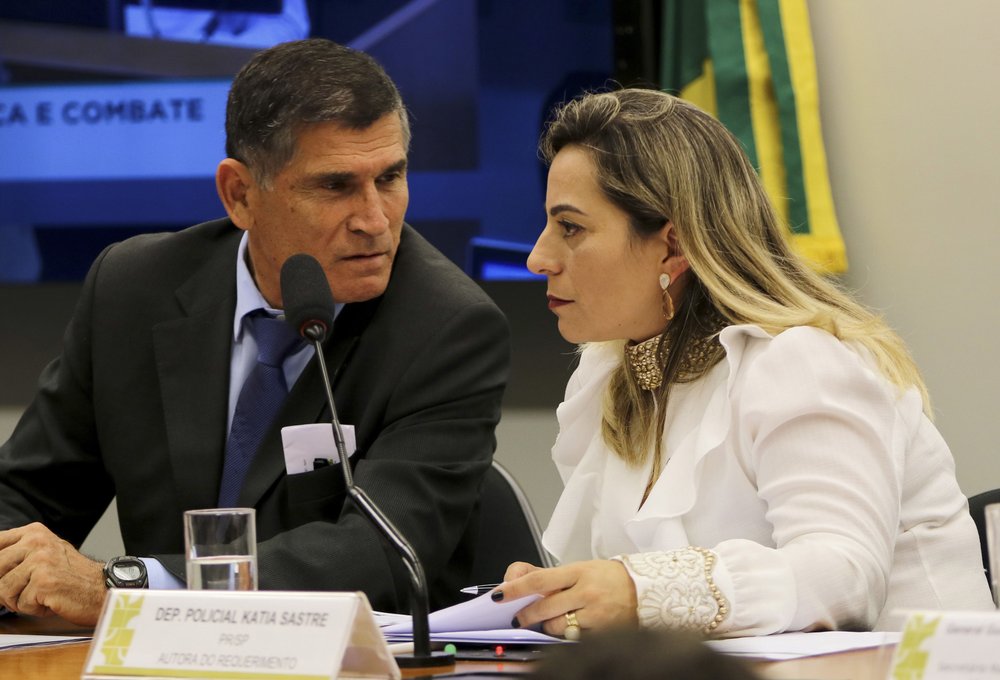

Congresswoman Katia Sastre, an ally of President Jair Bolsonaro, talks with then Secretary of Government Minister Alberto dos Santos Cruz, at Congress in Brasilia. (Wilson Dias/Agencia Brasil via AP File)

A man checks his aim on the makeshift targets — frying pans — at a shooting range in Americana, Sao Paulo state. (AP Photo/Andre Penner)

Sastre is in the minority of Brazilians, almost three-quarters of whom want stricter gun laws, according to the most recent poll. Yet the unpopular proposal is among Bolsonaro’s top priorities for deploying his recently replenished political capital, even in Brazil’s worst throes of the pandemic, with about 1,800 people dying per day.

Anti-gun activists, a former defense minister and high-ranking former police officers, including an ex-national public security secretary, warn the decrees will only add to the body count.

The two decrees causing most controversy would boost the number of guns average Brazilians can own — to six, from four currently — and enable them to carry two simultaneously. Policemen, core supporters of the president, could have eight firearms if the decrees stand.

Ilona Szabó, director at the security-focused Igarape Institute in Rio de Janeiro, has pushed back against Bolsonaro’s attempts to get more guns to Brazilians. Nominated to a national security council, she faced a deluge of threats from Bolsonaro devotees and had to flee the country. From abroad, she’s urging lawmakers and the country’s Supreme Court to strike down the measures.

Court justices are expected to rule within weeks on the first of at least 10 challenges to the decrees.

“There is no technical justification for those decrees; it is evident that they make policing harder and could end up favoring criminal organizations,” Szabó said.

The number of deaths from gunshots rose by 6% a year from 1980 to 2003, when the disarmament law passed. After that, the rate fell to 0.9% through 2018, when it was fully implemented, according to government research institute IPEA’s Violence Atlas. That shows fewer guns translates into fewer deaths, Szabó said.

And although homicides increased in the years leading up to 2017, they plunged in 2018 – before any measures to loosen gun control.

Bolsonaro’s pro-gun position was a trademark of his seven terms as a lawmaker. In July 2018, he shocked adversaries by teaching a toddler how to make the finger-gun sign that came to represent his presidential campaign.
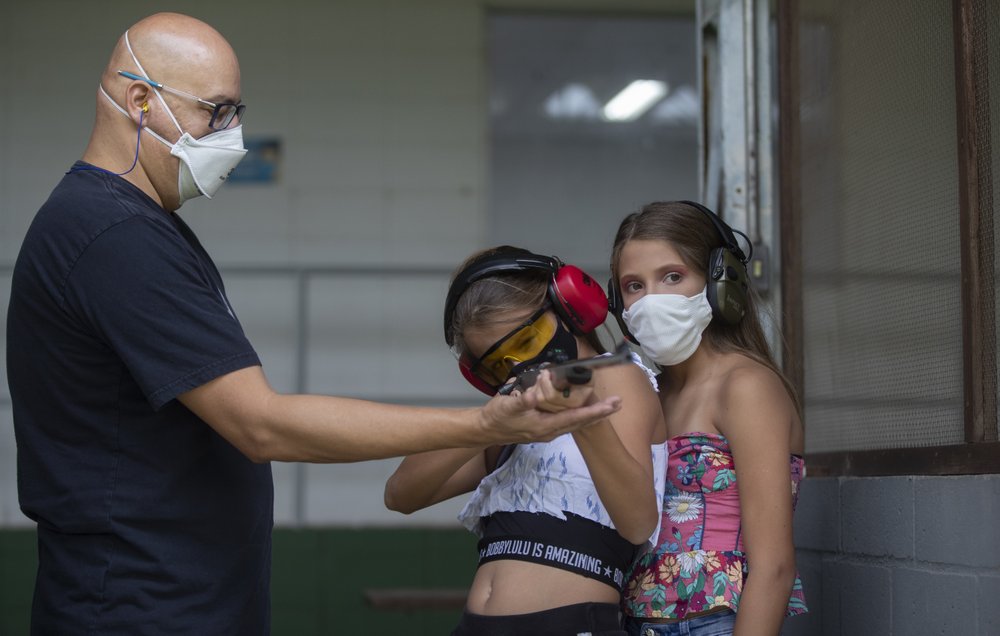

Instructor Robson de Oliveira trains his 10-year-old twin daughters Lorena, center, and Lara, how to properly shoot a firearm at a shooting range in Americana, in Sao Paulo state. (AP Photo/Andre Penner)

In this Jan. 1, 2019 file photo, Brazil’s President Jair Bolsonaro points with his fingers to mimic guns as he rides in an open car with his wife, first lady Michelle Bolsonaro, after his swearing-in ceremony in Brasilia. (AP Photo/Andre Penner)

When he took office in Jan. 2019, a person could own two guns, but had to submit to an onerous process checking criminal record, employment, psychological and physical fitness, and also write a statement explaining one’s need for a weapon.

Decrees from May 2019 allowed rural landowners carry guns across their properties, increased annual ammunition allowances and let registered shooters and hunters transport weapons from their homes to ranges.

Last month, Igarape and the Sou da Paz Institute, which researches violence, said there were almost 1.2 million legal guns in Brazilians’ hands, up 65% from the month before Bolsonaro’s term began.

Bolsonaro, a former Army captain who expresses nostalgia for Brazil’s three decades of military rule, has said he wants to arm citizens to prevent a dictatorship from taking hold. He has suggested armed citizens could counter local government restrictions on activity during the pandemic.

“An armed populace will end this game of everybody needs to stay home,” the president said on Christmas Eve.

Advertisments promote the sales of armed weapons with one banner reading in Portuguese: “Get your weapon,” in Luziania, Brazil. (AP Photo/Eraldo Peres)

The decrees also empower local councils of psychologists to grant shooting range members permission to own guns, rather than experts chosen by Brazil’s Federal Police. And they wrest from the Army control over sales of several caliber bullets, which makes them harder to track, and boost annual ammunition allowances by as much as fivefold.

These are welcome prospects to people like Eduardo Barzana, president of a shooting club in Americana, a city in Sao Paulo state’s countryside. Before a practice session, while uncasing semi-automatic assault rifles and preparing his protective glasses, he explained why he cheers Bolsonaro’s moves to loosen controls.

“Guns are like cellphones; it’s the person behind them who matters,” said Barzana. “What the government is doing is benefiting our sport and giving average citizens the right to defend themselves.”

Eduardo Barzana practices at a shooting range in Americana, Brazil. (AP Photo/Andre Penner)

Former public security secretary José Vicente da Silva acknowledges the decrees would help responsible owners, but says they also will facilitate guns falling into the wrong hands. One month after Sastre was sworn in as a lawmaker, students at the school she once attended were targeted in a shooting; the assailants used guns purchased online.

“No one needs six or eight guns for protection, and there’s no evident reason to give so many guns to shooters and hunters,” said da Silva, who retired from Sao Paulo state police after three decades of service. “The decrees make it almost impossible for police to track bullets or weapons. If this goes ahead, we will have weapon stockpiles, many of which bought by organized crime.”

Gisely Nunes learns to handle a submachine gun from an instructor at the Valparaiso Shooting Club on the outskirts of capital Brasilia. (AP Photo/Eraldo Peres)

Some analysts have expressed fear that the riot at the U.S. Capitol in January may inspire an armed uprising of Bolsonaro supporters should he fail to win a second term in next year’s election.

Bolsonaro’s lawmaker son, Eduardo, a fellow die-hard gun rights supporter and former federal police officer, visited the White House on the eve of the riot. He later denied any tie to the invasion.

On March 8, Eduardo Bolsonaro told newspaper O Estado de S.Paulo during a visit to Jerusalem that if rioters in the U.S. had been organized, they would have been able to take the Capitol and make their demands heard, and had “a minimum of bellicose power” to avoid casualties on their side. In 2018, he said it would take just two soldiers to shut down the Supreme Court.

Statements like those prompt Igarape’s Szabó and other analysts warn risks for Brazil’s democracy are higher than in the U.S..

“This rhetoric of politicization of the issue, with the president saying he will arm citizens against lockdowns or electoral fraud is the Trump model,” Szabo said. “We saw what happened at the Capitol invasion, with deaths. It could have been worse.”

In the U.S, gun sales hit a historic high in January after the riot, and continued the record-setting surge that began as the pandemic took hold. Gun sales often spike during election years amid worries a new administration could change gun laws. U.S President Joe Biden has supported gun control measures like a ban on “assault weapons.”

In Brazil, both the speaker of the house and the Senate’s president won their positions last month with Bolsonaro’s backing. Congressional analysts say it is unlikely either will cross the president on an issue his base holds so dear. The opposition isn’t strong enough to whip the votes needed to strike down the decrees.
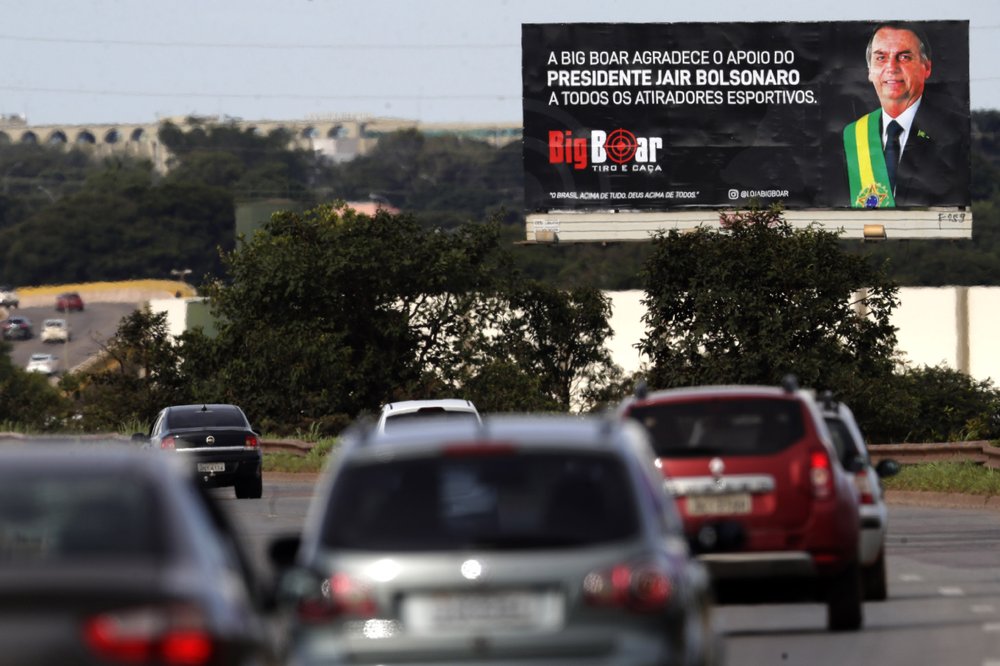
A billboard towering over traffic promotes the Big Boar gun shop, with a message that reads in Portuguese: “Big Boar thanks President Jair Bolsonaro for his support of all shooters,” in capital Brasilia. (AP Photo/Eraldo Peres)

Caravans of Bolsonaro supporters drove the streets of major cities on Sunday. Pictures that went viral on social media showed some holding guns near their car windows.

“We are operating beyond public security here; this is the terrain of politics, which is really serious,” said Raul Jungmann, a former minister of defense and public security. “Arming populations is always done at the service of coups, massacres, genocides and dictatorships.”

The post Brazil President: A Gun for Anyone Who Wants One appeared first on The St Kitts Nevis Observer.

New Variant Sweeping US, Public Warned of Letting Up Too Soon, Astra Zenica Shot, More

Travelers are shown in Salt Lake City International Airport Tuesday, March 9, 2021, in Salt Lake City. U.S. airlines are adding jobs as industry employment extends a rebound from a low in October, when tens of thousands of airline workers were briefly laid off after federal payroll aid expired. (AP Photo/Rick Bowmer)

(CNN) Experts are worried some Americans are letting up too early — at a critical time when looming dangers are threatening to wipe out the progress the US has made in its battle against Covid-19.

At least a dozen state leaders have eased Covid-19 restrictions this month, often citing improving Covid-19 trends and growing vaccination numbers. At the same time, air travel is hitting pandemic-era records and the first spring break crowds have begun descending on Florida and other sunny regions while cases of a dangerous variant are on the rise.

The Transportation Security Administration said it screened more than 1.3 million people at airports Sunday — meaning about 5.2 million travelers flew since Thursday. That’s the highest number of people that have traveled by air during any other four-day period of the pandemic.

White House races to blunt potential Covid-19 surge

In Florida, spring breakers have begun packing shores with some Miami Beach officials reporting swelling crowds and precautions going out the window.

It’s a combination of all those factors, officials fear, that could lay the groundwork for another spike.

“We have seen footage of people enjoying spring break festivities, maskless,” Centers for Disease Control and Prevention Director Dr. Rochelle Walensky said Monday. “This is all in the context of still 50,000 cases per day.”

So is another surge inevitable?

“We could go in either direction,” emergency physician Dr. Leana Wen told CNN on Monday. “What happens now is really up to us and whether we keep up masking and avoiding indoor gatherings as we should be until the point that we’re vaccinated.”

You asked, we answered: Your top questions about Covid-19 and vaccines

In this March 9, 2021 file photo, travelers walk through the Salt Lake City International Airport

A dangerous variant will be dominant soon

The safety measures will be especially crucial now that multiple variants of the virus are circulating — including the highly contagious B.1.1.7 variant that was first identified in the UK. 

It’s projected to become the dominant variant in the US by the end of this month or early April, Walensky said Monday.

Cases of the B.1.1.7 variant have so far been found in 48 states, Puerto Rico and Washington, DC, according to CDC data.

“The way the variants spread is by letting our guard down,” Dr. Richard Besser, the former acting CDC Director told CNN on Monday. “By not wearing masks, by not social distancing. If we can hang in there for a few more months, there will be enough vaccine for every adult in America to be vaccinated.”

“Then we can truly let go of some of the restrictions that are in place. But if we do this too quickly, we could see an increase in cases, we could see a backslide that is occurring in many European countries and that does not have to be the outcome here in America,” he added.”

Research published last week suggested that the variant was associated with an estimated 64% higher risk of dying from Covid-19.

This was Texas’ first weekend without Covid-19 limits. Here’s how it went for business owners

And another peer-reviewed study has linked the variant to a higher risk of death, according to a paper accepted by the journal Nature. This time, the risk of death from the variant was estimated around 55% higher than earlier strains after adjusting for a number of factors like age, sex, and where and when tests were conducted.

A subsequent analysis in the study that accounted for missing and potentially miscategorized test results found the overall increased risk of death may be somewhat higher — around 61% more than earlier strains.

The study was not able to factor in vaccination nor could it show why the variant might be more deadly than earlier strains.

Daily vaccination numbers hit record levels

But there is good news: Vaccinations are ramping up and experts are hopeful Americans will be able to see a semblance of normality by the summertime.

Data updated by the CDC on Monday shows the country hit a seven-day average of about 2.4 million Covid-19 vaccine doses administered per day, a new record.

That comes as more states expanded their eligibility requirements for vaccinations.

A high BMI may qualify you for a vaccine, but may not mean you’re unhealthy. Here’s how to check

In Mississippi, Gov. Tate Reeves announced Monday the state would be opening up appointments to all residents who are 16 and older starting Tuesday.

Pfizer’s Covid-19 vaccine is the only one available for use by people who are 16 or older, while the Moderna and Johnson & Johnson vaccines are restricted to people 18 or older.

“Starting tomorrow, ALL new appointments will be open to ALL Mississippians. Get your shot friends – and let’s get back to normal!” he wrote on Twitter.

In West Virginia, Gov. Jim Justice expanded the list of pre-existing medical conditions that make residents eligible to receive a vaccine.

“We’re on a glide slope to being able to get our lives back to normal, and that’s what we want more than anything,” Justice said.

So far, more than 71 million Americans have received at least one dose of a Covid-19 vaccine, according to CDC data. More than 38 million have been fully vaccinated — roughly 11.5% of the US population.

Most Americans are getting their second dose on time

Also, most people who have received a first dose of a Covid-19 vaccine are getting their second dose on time, according to early data from the CDC.

But the CDC researchers warned that the initial groups prioritized to receive the vaccine — healthcare workers and long-term care facility residents — have had easy access to a second dose through their workplace or residence.

Millions more Americans can now get Covid-19 vaccines, including teachers in all 50 states

“As priority groups broaden, adherence to the recommended dosing interval might decrease,” they wrote in the report that published Monday.

For the Pfizer and Moderna vaccines, it is recommended second doses be administered 21 and 28 days later, respectively, but the researchers noted in their report that up to 42 days between doses is permissible, if needed.

The report includes data on more than 37 million people who received at least their first shot between December 14 and February 14.

Among those who had received both doses, the researchers found that 95.6% received their second dose within the recommended time interval.

They noted that severe weather events led to distribution challenges and canceled appointments during the time of the study and more research will be needed to examine the completion of second doses over a longer period of time.

“Continued monitoring of series completion status across jurisdictions and by demographic characteristics is important to ensure equity in vaccine administration and vaccination coverage, especially as vaccination efforts expand to additional population groups,” they wrote.

CNN’s Michael Nedelman, LaCrisha McAllister, Gregory Lemos, Deidre McPhillips, Pete Muntean and Jacqueline Howard contributed to this report.

=================================================

AstraZeneca vaccine: Safety experts to review

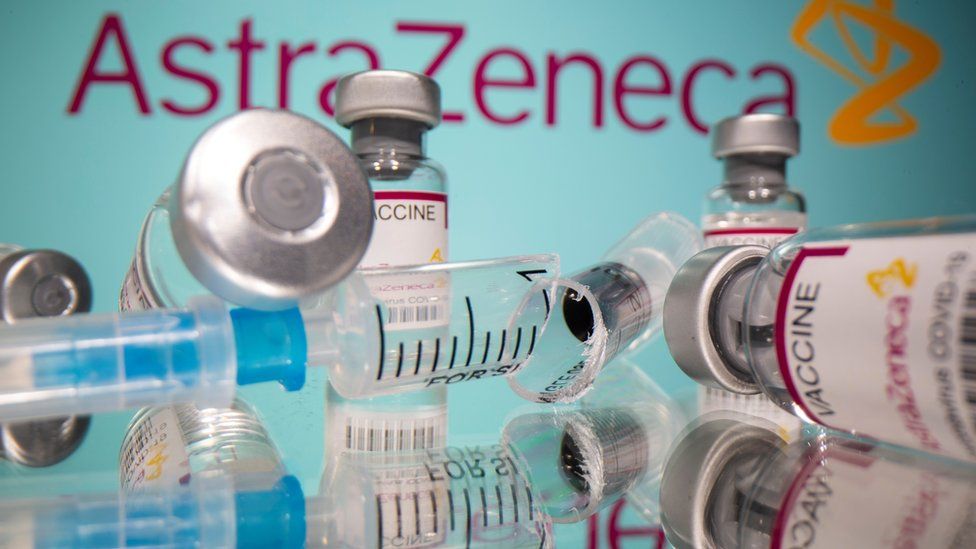
AstraZeneca vaccines (file pic)image copyrightReuters
image captionSeveral European countries have paused their roll-out of the jab

Vaccine safety experts from the World Health Organization (WHO) are meeting on Tuesday to review the Oxford-AstraZeneca jab, after several European countries halted their rollouts.

A number of cases of blood clots were reported in Europe after the vaccine was administered.

But the numbers are below the level you would expect in the general population.

The UK medicines regulator and the WHO say there is no evidence of a link between the vaccine and clots.

The European Medicines Agency (EMA) – the European Union’s medicines regulator – is also meeting on Tuesday.

It is expected to issue its decision on the continued use of the Oxford-AstraZeneca vaccination on Thursday.

About 17 million people in the EU and the UK have received a dose of the vaccine, with fewer than 40 cases of blood clots reported as of last week, AstraZeneca said.

Concerns that there could be a link prompted leading EU states to suspend use of the vaccine, including Germany, France, Italy and Spain.

Other countries, including Austria, have halted the use of certain batches of the drug as a precautionary measure.

However, Belgium, Poland, the Czech Republic and Ukraine said they would continue to administer the AstraZeneca vaccine.

And in Thailand, Prime Minister Prayuth Chan-ocha became the first person in the country to receive the AstraZeneca inoculation.

The post New Variant Sweeping US, Public Warned of Letting Up Too Soon, Astra Zenica Shot, More appeared first on The St Kitts Nevis Observer.
Mexico: Former Island Prison’s Transformation to Tourist Attraction

MEXICO CITY (AP) — Mexican officials said ferries and cruise ships may soon be visiting the former Isla Marias prison, after the last island penal colony in the Americas was closed and turned into an environmental education center in 2019.

The education camp hasn’t gone very well — only 40 youths have been trained on the island — and the administration of President Andrés Manuel López Obrador is now trying a different tack, because the island hasn’t been offsetting the costs associated with keeping it open.

Officials said Saturday they are planning to build a dock for larger ships on the Isla Madre main island, the only one of the four Marias islands that is inhabited. Visitors will be able to tour the remote island jail, but not stay overnight. Tourism Secretary Miguel Torruco described future tours.

“The experience begins with the cruise ship or ferry arriving from Mazatalán or San Blas, to Isla Madre, and on the voyage the passengers can admire the beauty of the ocean,” Torruco said. It would be quite a long ride; the four islands are located 70 miles (110 kilometers) off the Pacific coast of Nayarit state.

“Visitors will have their first contact with the former island prison which for 100 years sheltered numerous criminals,” Torruco said. Officials compared it to the now-closed U.S. prison at Alcatraz, and said tourist visits could start within three months.

The penal colony, founded in 1905, passed through some periods of infamous brutality, and as recently as 2013, the Islas Marias held 8,000 inmates.

The hemisphere was once dotted with remote island jails like the one depicted in the movie “Papillon,” but they all gradually closed. When Panama closed its Isla Coiba penal colony in 2004, Isla Marias became the last one remaining in the Americas.

But far from the bloody reputation of places like Devil’s Island — the French Guiana penal colony shuttered in 1946 — toward the end, the Islas Marias harbored many lower-risk or well-behaved inmates and the colony was viewed as a step toward release or rehabilitation.

While the prison kept mass tourism at bay, the islands suffered severe environmental degradation from over a century of use as a penal colony.

Island penal colonies were used around the world starting in the 1700s as remote, escape-proof places to “rehabilitate” inmates through hard labor. Often known as “prisons without bars,” with the ocean serving as the most effective barrier to escape, the penal colonies were also known for being at least in part self-supporting and a way to settle remote islands.

But in the end, the Islas Marias wound up costing Mexico far more per prisoner than did mainland jails.

Chile closed its Santa Maria prison island in the late 1980s, Costa Rica’s Isla San Lucas penal colony closed in 1991 and Brazil’s Isla Grande in 1994. Peru dramatically ended its El Fronton island prison in 1986: Gunboats blew up most of the buildings to put down a riot, killing more than 100 inmates.

The post Mexico: Former Island Prison’s Transformation to Tourist Attraction appeared first on The St Kitts Nevis Observer.

Brazil: As Pandemic Rages, Country Gets 4th Health Minister

SAO PAULO (AP) — Brazilian President Jair Bolsonaro on Monday picked his fourth health minister since the COVID-19 pandemic hit, amid the worst throes of the disease in the country yet and after a series of errors decried by public health experts.

Marcelo Queiroga, the president of the Brazilian Society of Cardiology, will replace Eduardo Pazuello, an active-duty army general with expertise in logistics, who landed the position last May despite having no prior health experience.

Earlier Monday, Pazuello acknowledged in a press conference that Bolsonaro aimed to replace him. The first candidate for the job, cardiologist Ludhmila Hajjar, rejected it.

Pazuello’s departure means ushering in Brazil’s fourth health minister during the pandemic, although he has presided over the ministry for the longest period of the three to date. The revolving door signals the challenges for the government of Latin America’s largest nation to implement effective measures to control the virus’ spread — or even agreeing which measures are necessary.

Pazuello’s two predecessors left the position amid disagreements with Bolsonaro, who criticized broad social distancing and supported the use of an unproven anti-malarial drug to treat the disease. He continues to hold those positions, despite health experts’ admonishments and studies showing the drug has no effect on COVID-19.

Pazuello proved more compliant. Immediately after taking the job his ministry backed use and distribution of the malaria pill. On several occasions, he said that his boss tells him what to do, and he obeys.

“The conversation (with Queiroga) was excellent. I already knew him from a few years back. He has everything it takes to do nice work, continuing what Pazuello has done up until today,” Bolsonaro told supporters at the entrance of the presidential residence in Brasilia, adding there will be a transition period of up to two weeks with the outgoing and the incoming minister.

“Pazuello’s work was well done in the management part. Now we are in a phase that is more aggressive in the fight against the virus,” Brazil’s president said.

Brazil has recorded almost 280,000 deaths from the virus, almost all of which were on his watch. The toll has been worsening lately, with the nation currently averaging more than 1,800 deaths each day. Health care systems of major cities are at the brink of collapse, and lawmakers allied with Bolsonaro have proposed suitable replacements for Pazuello, while threatening to step up pressure for an investigation into his handling of the crisis.

The country’s top court is also investigating Pazuello for alleged neglect that contributed to the collapse of the health care system in Amazonas state earlier this year. That probe will now be sent to a low court judge.

Weeks later, in a particularly embarrassing episode, his ministry accidentally dispatched a shipment of vaccines intended for Amazonas state to neighboring Amapa state, and vice versa, after confusing the abbreviations for each state.

Finally, Pazuello has faced intense criticism for Brazil’s slow vaccine rollout. According to Our World in Data, an online research site that compares official government statistics, only 5.4% of Brazilians have been vaccinated. Almost all were shots from Chinese biopharmaceutical firm Sinovac, which Bolsonaro repeatedly cast doubt upon.

Pazuello’s health ministry also delayed its decision to purchase the vaccine from Sao Paulo state’s government until it was left with no other option to start immunization in January.

The only vaccine deal Pazuello had signed at the time, for 100 million doses of the AstraZeneca jab, has brought few shots to the arms of Brazilians so far. His ministry has since scrambled to cobble together agreements with other suppliers, recently concluding deals to acquire the Pfizer and Sputnik V shots.

Pazuello said in the press conference that he would not resign, and insisted there will be continuity with whomever assumes his position.

Cardiologist Hajjar had already revealed that Bolsonaro interviewed her to replace Pazuello. She told television channel Globo News that science has already ruled against treatments Bolsonaro and his legions of supporters continue to champion, like drugs to fight malaria and parasites, and that the country needs to adopt more restrictive measures on activity. She said she declined the position.

“He needs to choose someone he trusts, who is aligned with him, his ideas, his vision, and with the government’s desire. And I’m certainly not that person,” she said.

Hajjar forecast between 500,000 and 600,000 total deaths, not to mention long-term consequences, unless Brazil changes course.

Queiroga has already called Bolsonaro “a great Brazilian.” His social media channels have not made any criticism of the president’s handling of the pandemic and pushed for a quick vaccine rollout

AP journalist David Biller contributed to this report from Rio de Janeiro.

The post Brazil: As Pandemic Rages, Country Gets 4th Health Minister appeared first on The St Kitts Nevis Observer.

East Bus Drivers plead for fairness

Bus drivers of the East Bus Terminal on Monday were out protesting unfair chances to make a decent living while others are allowed to break the law.

A little under two dozen drivers parked their busses outside the East Bus Terminal on Wellington Road and marched towards Government Headquarters and performed a peaceful protest outside the main government building.

The drivers claimed while they are following the rules and using the terminal the way it was meant to be used others are allowed to break the law and take advantage and pick up passengers outside the terminal and make returns significantly greater than what they are making.

The Observer spoke with the secretary of the East Bus Association Vinshaw Mangra who said some bus drivers have fallen on hard times as a result of the unfairness

Mangra said the protest was necessary to put pressure on the authorities to enforce change.

He said they do not feel the negotiations and complaints with the government officials have not been working and a protest was the resulting action.

More on this will be published in this weekend’s Observer.

The post East Bus Drivers plead for fairness appeared first on The St Kitts Nevis Observer.

US Under Pressure to Share Vaccines with World

President Biden is under increasing pressure to share the U.S. vaccine stockpile with the rest of the world.

The federal government has been amassing doses, growing its supply into what will likely become a surplus, as the rest of the world struggles with shortages. The U.S. has purchased enough vaccines to immunize every adult in the country three times over.

The supply is likely to grow.This week, Biden announced he had directed the administration to purchase an additional 100 million doses from Johnson & Johnson.

The White House said the extra doses could be a backstop for possible manufacturing issues, help vaccinate children, or serve as booster doses if they become necessary to fight against variants of the virus.

If finalized, the deal would not be fulfilled until the second half of the year, but would give the U.S. a total of 200 million shots from Johnson & Johnson, enough for 200 million people.

When asked at the White House event about the widening gap between the U.S. and the rest of the world, Biden acknowledged the global nature of the pandemic but said his goal is to bring COVID-19 under control in America first.

“This is not something that can be stopped by a fence, no matter how high you build a fence or a wall,” Biden said. “So we’re not going to be ultimately safe until the world is safe. We’re going to start off making sure Americans are taken care of first, but we’re then going to try to help the rest of the world.”

“If we have a surplus, we’re going to share it with the rest of the world,” Biden added, noting that the U.S. has already committed $4 billion to COVAX, the World Health Organization-led program for distributing the vaccine across the world.

On Friday, Biden committed to working with the leaders of Australia, India and Japan to expand vaccine manufacturing and delivery in Asia. The new commitment is aimed at addressing shortages in vaccines in Southeast Asia.

Yet administration officials reiterated that the United States will not donate any vaccines until the full American population is inoculated, and did not say what threshold the country would set before considering exporting vaccines.

Experts and global health advocates think the U.S. has the ability to donate vaccines to other countries without significantly impacting their availability to Americans, but has been unwilling to make such a plan.

“The world is currently facing a vaccine access crisis and the Biden administration has not yet established a clear framework or timeline for distributing excess vaccine doses while simultaneously vaccinating the U.S.’ domestic population,” said Sarah Swinehart, a spokeswoman for The ONE Campaign.

The global aid organization UNICEF, which is working with COVAX to deliver vaccines, has said countries that have vaccinated their own health workers and highest risk populations should share vaccine doses with other countries.

In the U.S., demand still outpaces supply, but that is beginning to change. States are opening up eligibility, and President Biden said he expects there will be enough supply for every American who wants a vaccine by the end of May.

During a speech Thursday evening, Biden said every adult will be able to sign up for a vaccine no later than May 1.

But pressure and frustration among allied countries is only growing after the administration said it has been keeping tens of millions of doses of a vaccine made by AstraZeneca in storage.

The Trump administration ordered 300 million doses of the vaccine, but issues with clinical trials have held up its authorization and the Food and Drug Administration (FDA) is still waiting on additional data.

The vaccine has been authorized for emergency approval in the European Union, and is the primary vaccine being used by COVAX in poor countries. But even though it has not been authorized in the U.S., Biden administration officials said they are holding on to the supply.

White House coronavirus coordinator Jeff Zients told reporters the U.S. has a “small inventory” of the AstraZeneca vaccine on hand so it can be ready to distribute quickly if the company receives FDA clearance in the coming weeks.

“We’re following the exact same process that we did with the other three now-approved vaccines; Moderna, Pfizer and J&J,” Zients said

White House press secretary Jen Psaki said the U.S. has rejected all requests from other countries to share doses of its vaccines.

“There have been requests around the world from a number of countries who have requested doses from the United States, but we have not provided doses from the U.S. government to anyone,” Psaki said.

Psaki said the administration is trying to cover all contingencies and ensure Americans are getting put first.

“We want to make sure we have maximal flexibility, that we are oversupplied and over prepared and that we have the ability to provide vaccines — whatever the most effective ones are — to the American public,” Psaki said. “There are still 1,400 people who are dying in our country every single day and we need to focus on addressing that.”


The post US Under Pressure to Share Vaccines with World appeared first on The St Kitts Nevis Observer.

Beyonce, Taylor Swift Win Big at Grammys

Beyoncé has set a new record at the Grammy Awards with her 28th win. The star is now the most-awarded woman in Grammys history, overtaking bluegrass singer Alison Krauss.

“I am so honored, I’m so excited,” she said while accepting her record-breaking trophy, for best R&B performance.

Taylor Swift also made history at Sunday’s ceremony, by becoming the first female artist ever to win album of the year three times.

The star was rewarded for her lockdown album Folklore – after previously winning with Fearless in 2010 and the pop opus 1989 in 2016.

Only three other artists have ever won the album of the year prize three times: Frank Sinatra, Paul Simon and Stevie Wonder.

The post Beyonce, Taylor Swift Win Big at Grammys appeared first on The St Kitts Nevis Observer.

US Disaster Agency to Assist with Child Migrant Surge

A US agency that normally deals with major emergencies and natural disasters has been brought in to help care for the rising numbers of migrant children arriving at the US southern border.

The Federal Emergency Management Agency (Fema) would “help receive, shelter and transport the children” for the next 90 days, it was announced.

President Joe Biden has been reversing some of his predecessor’s policies.

But the recent surge of arrivals is putting pressure on processing systems.

There were a record number of children – 3,200 – being held in US immigration facilities on the US-Mexican border as of 8 March.

Hundreds continue to arrive each day, and many are being held beyond the legal three-day limit for being processed and transferred.

Secretary of Homeland Security Alejandro Mayorkas said last week that the situation on the border was “overwhelming” but not yet a crisis.

Announcing Fema’s involvement, Mr Mayorkas said the agency would work with the Health and Human Services Department (HHS) to “look at every available option to quickly expand physical capacity for appropriate lodging”.

“Our goal is to ensure that unaccompanied children are transferred to HHS as quickly as possible, consistent with legal requirements and in the best interest of the children,” he added.

On the campaign trail, Joe Biden promised to reverse many of Donald Trump’s restrictive migrant policies.

Since taking office in January, he has ordered the reunification of migrant children with their families, ended construction of the border wall and called for reviews of legal immigration programmes terminated by his predecessor.

But in the same month Mr Biden became president, 5,871 unaccompanied children crossed the border – up from 4,995 in December – according to data from the US Customs and Border Protection (CPB).

As of 8 March, the number of children held in US immigration facilities had tripled in just two weeks – to 3,250. Of that number, nearly half had been in detention longer than the three-day limit and were in CBP-managed facilities that were designed for adults

The HHS is required to link children up with their parents, guardians, US relatives or find a sponsor to take them in while their immigration case is being considered.

Although Covid-19 restrictions have been lifted on HHS-managed shelters to expand capacity for unaccompanied children, the New York Times reports that they are just days away from reaching maximum capacity.

Most of the unaccompanied children detained are boys between the ages of 15-17.

Some reports suggest desperate families, who have been turned away at the US border, have been sending their children on alone to improve their chances of entering the US

The post US Disaster Agency to Assist with Child Migrant Surge appeared first on The St Kitts Nevis Observer.

Toots and the Maytals Win 2021 Grammy Award

Legendary Reggae band Toots and the Maytals won Best Reggae Album at the 2021 Grammy Awards, a tribute to the late Toots Hibbert.

The 63rd Grammy Awards show took place on Sunday, March 14 in a hybrid fashion.

The Got to Be Tough album was released just days before the death of Toots Hibbert, the band’s frontman, who passed away on September 11, 2020.

This marks the second Grammy win for the band after they won Best Reggae Album in 2005. The group has been nominated for a reggae Grammy five times.

The other nominees this year were  ‘Higher Place’ by Skip Marley, ‘One World’ by The Wailers, ‘Upside Down 2020’ by Buju Banton, and ‘It All Comes Back to Love’ by Maxi Priest.

Toots & the Maytals played a pioneering role in the birth of reggae in the 1960s. Toot’s 1968 song, ‘Do The Reggay’, is said to have given the genre its name.

Toots Hibbert was laid to rest at the National Heroes Park in Kingston, Jamaica on November 15, 2020. Among the other cultural icons interred at the National Heroes’ Park are reggae singer Dennis Brown, Olympian Herb McKinley, artist Edna Manley, folklorist Louise Bennett Coverley (Miss Lou) and actor Ranny Williams.

Earlier this year, it was announced that the reggae icon would posthumously receive the Keys to the City of Kingston. 

The post Toots and the Maytals Win 2021 Grammy Award appeared first on The St Kitts Nevis Observer.

Barbados Planning to Ditch Queen as Head of State

Barbados is planning to remove Queen Elizabeth II as its head of state, according to BBC.

“The time has come to fully leave our colonial past behind,” said Barbados government in a statement.

According to the report, the process of Queen Elizabeth’s removal would be complete in November 21 when the nation marks the 55th anniversary of independence from Britain.

Prime Minister Mia Mottley said Barbadians wanted a Barbadian head of state.

“This is the ultimate statement of confidence in who we are and what we are capable of achieving,” he said in a speech.

Reacting to the announcement, Buckingham Palace said that it was a matter for the government and people of Barbados.

Quoting a palace source BBC reported that the idea “was not out of the blue” and “has been mooted and publicly talked about many times.”

The post Barbados Planning to Ditch Queen as Head of State appeared first on The St Kitts Nevis Observer.