In one area of Auckland, fewer than 20 per cent of eligible people voted in the local elections, a result described by a councillor as “very sad” and warranting systemic change.Overall just 31 per cent of Auckland’s nearly 1.2 million…
Tag Archives: oceania
A decade has passed since Julia Gillard's misogyny speech
Today marks a decade since Julia Gillard rose to her feet in parliament and delivered a blistering takedown – not only of her opponent Tony Abbott, but of the gender discrimination in Australian politics.
On October 9, 2012, Gillard, Australia's first and only female prime minister, had had enough.
She unleashed 15 minutes of pointed and eloquent fury in what became known as her "misogyny speech".
READ MORE: Julia Gillard reveals regrets over sexist language
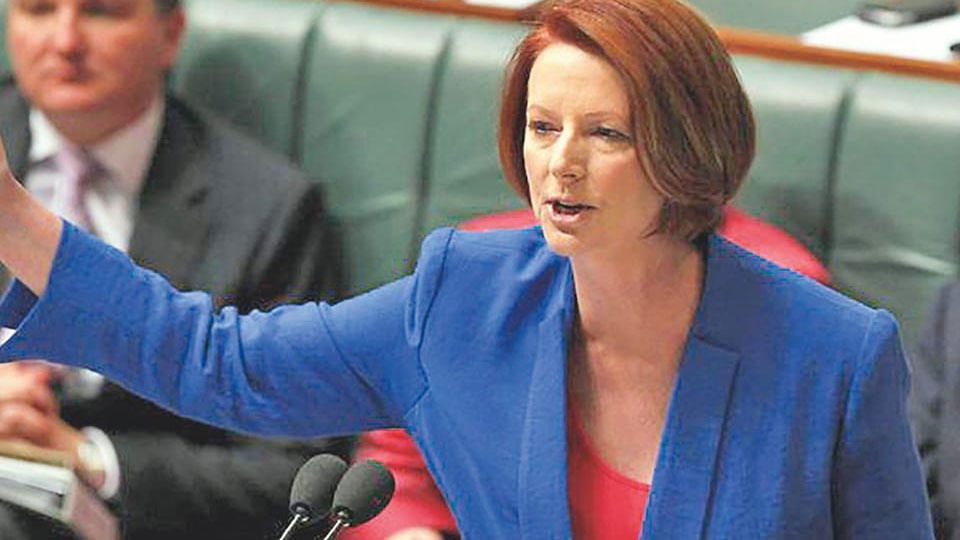
The debate in parliament that afternoon was centred around speaker Peter Slipper, who had been accused of sexually harassing his former staffer James Ashby.
Highly offensive and sexist text messages Slipper sent to Ashby were revealed, however Labor decided not to remove Slipper from his position as speaker.
Opposition leader Tony Abbott used the controversy to accuse the government of sexism and misogyny.
For years, Gillard had endured sexist attacks.
There were endless comments on her appearance and her fashion choices. Her partner's sexuality was also questioned, as was her decision not to have children.
Gillard could not let the hypocrisy stand. She stood up and delivered the words that would go on to become a seminal moment in Australian political history.
"I will not be lectured about sexism and misogyny by this man, I will not," Gillard said. And the government will not be lectured about sexism and misogyny by this man. Not now, not ever. The leader of the opposition says that people who hold sexist views and who are misogynists are not appropriate for high office. Well, I hope the leader of the opposition has got a piece of paper and he is writing out his resignation."
Watch Gillard's full speech in the video player above.
Gillard's speech went viral online and was picked up across the world.
That night, 'Gillard' was trending on Twitter, and she made headlines in the US, Britain, India, South Africa and Canada.
The UK's Spectator magazine said there was "much to admire" in Gillard's address.
The Daily Beast noted that Ms Gillard's speech would bring a smile to the face of former British leader Margaret Thatcher, while US feminist blog Jezebel called the prime minister "badass".
Gillard has since said she initially resisted the attention her speech brought, fearing it would overshadow the political legacy of her and her government.
But the former Labor leader appears to have come to terms with it, releasing a book titled 'Not now, Not Ever' to coincide with the 10-year anniversary of her speech.
READ MORE: Australia Post suspends sea mail amid rise in prohibited items
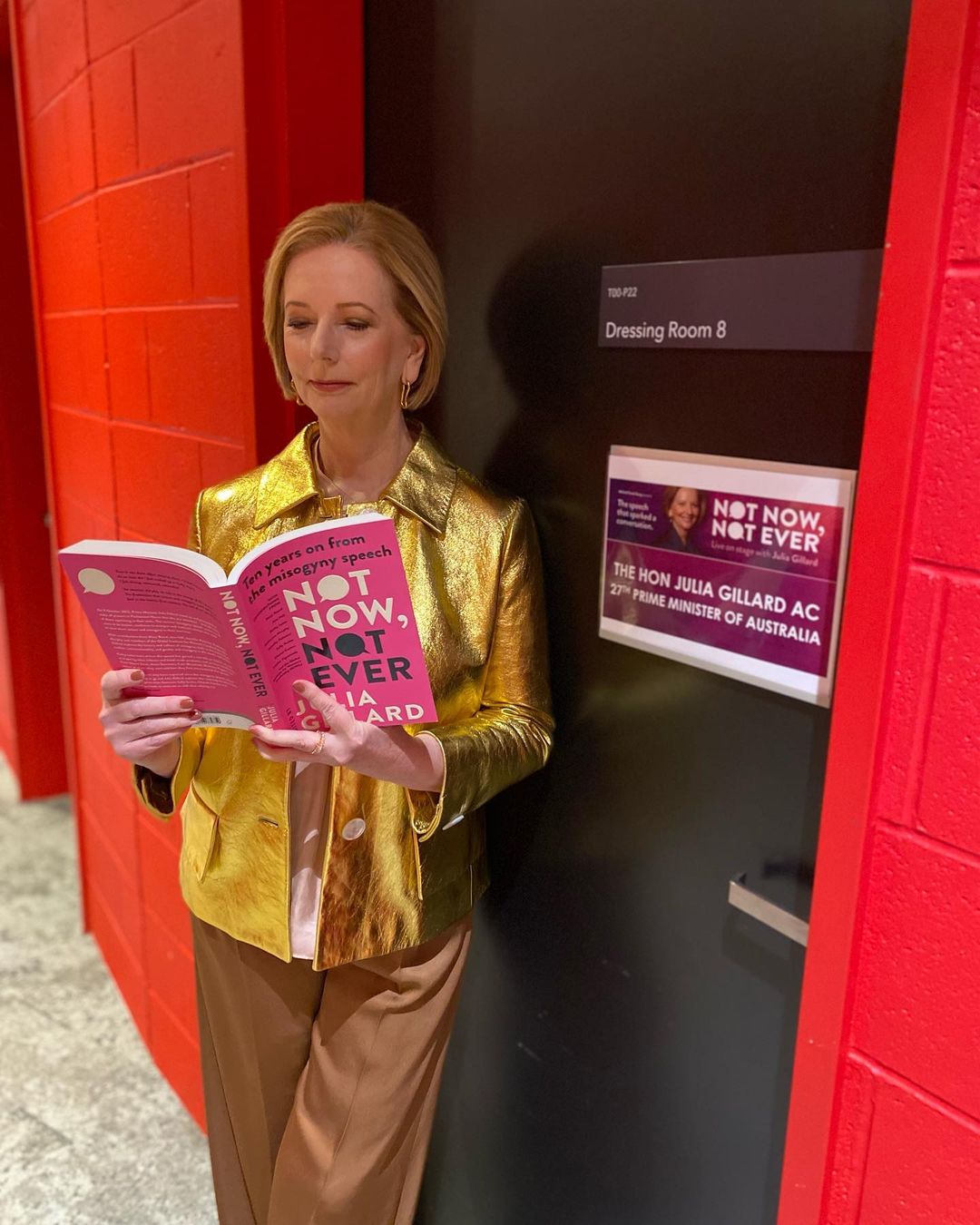
"After staying silent, I'd had my say," Gillard writes in her book.
"At no time did I feel worked up or hotly angry. I felt strong, measured, controlled.
"Yet emotion did play its role in the energy of the speech. The frustration that sexism and misogyny could still be so bad in the twenty-first century. The toll of not pointing it out."
Putin faces more grim choices after blast hits his prized Crimea bridge
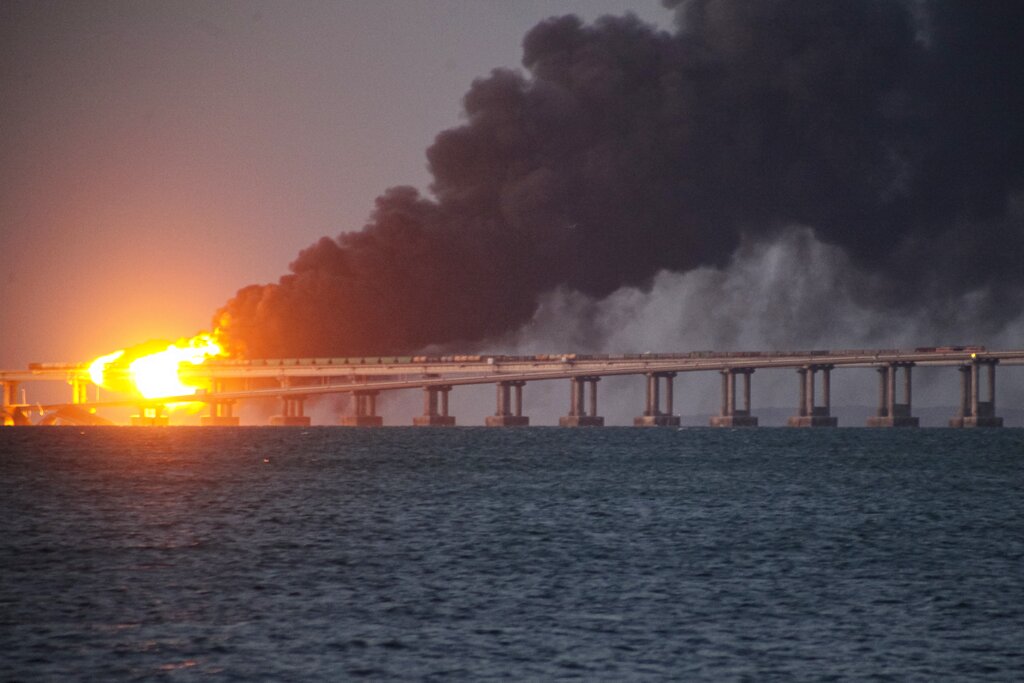
Analysis: An explosion that severely damaged parts of the road and rail bridge between annexed Crimea and the Russian mainland seems designed to play into President Vladimir Putin's current talent for making bad decisions.
It brings forward by a number of weeks the strategic choices he must make about Russia's occupation of southern Ukraine. This entire presence was already poorly supplied, managed and in retreat. And it shows that the key railway route into Crimea and onwards to the frontlines in Kherson is highly vulnerable to future attacks.
While Kyiv has not claimed responsibility for the Kerch Strait bridge blast, it has previously taken credit for a series of strikes on targets in Russian-occupied Crimea over the summer.
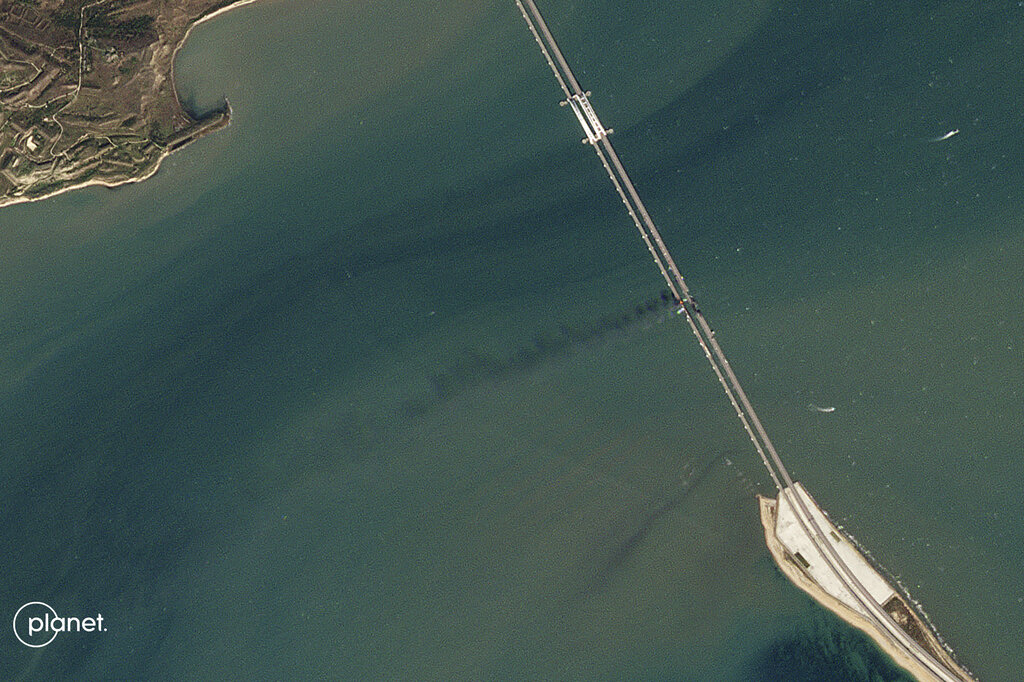
Russian officials said a limited amount of car traffic had resumed on undamaged sections of the bridge's roadways by Saturday evening and that train services were resuming on the bridge's railways. But trucks were being asked to take ferries across the strait, state media reported.
Rickety ferry crossings in bad weather or highly dangerous air cargo flights may now be needed to bolster military shipments into Crimea and towards the frontlines, which will place more pressure on a single railway track further east coming through Melitopol along the Azov Sea coast.
It exposes the staggering 20th century weakness of Russia's armed forces and occupation: They need railways to get around.
Ukraine has been targeting this system with slow, patient accuracy. First Izium, which led to the collapse around Kharkiv. Then Lyman, which is leading to the erosion of Russia's control of Donetsk and Luhansk. And now the Kerch Bridge, which had become so vital to everything that Russia is trying to hold on to in the south.
Compounding the problem for Putin is the fact that Russia's rail hub further inside Donetsk was also hit on Saturday; a look at Ilovaisk on a map shows the railway arteries running through it. A cargo train detonated there this morning, likely having some impact on Russia's ability to feed the railway lines inside Donetsk and Luhansk that Ukraine has already put under great pressure.
Ukraine has had patient timing on hitting these pressure points. They have not struck until they have seen a moment of weakness – until the Russians are experiencing serious issues already – ensuring that the damage inflicted lasts while time-consuming repairs are underway. (While Russia claims that railway traffic was restored by Saturday night, the bridge's vulnerability to attack at the least will lessen traffic).
A challenge to Putin's poker face
Putin now faces a series of expedited and painful decisions, all of which will severely belie his continued poker-face of pride and bombast towards the gathering signs of slow defeat. To the west of the Dnipro river, his army in Kherson is besieged by fast-moving Ukrainian forces. They are already in retreat, partially owing to the same poor resupply that will be accentuated by the Kerch blast.
They are again cut off from this faltering supply line by another series of damaged or targeted bridges across the Dnipro. Over the past week, they have already fallen back over 500 square kilometres. Can Moscow sustain this force over two damaged supply routes? A precarious presence has perhaps overnight become near-impossible. Does enough truth filter through to the Kremlin head to lead him to pull back? Or does he take the higher stakes gamble of spreading his isolated forces thinly across a wide expanse?
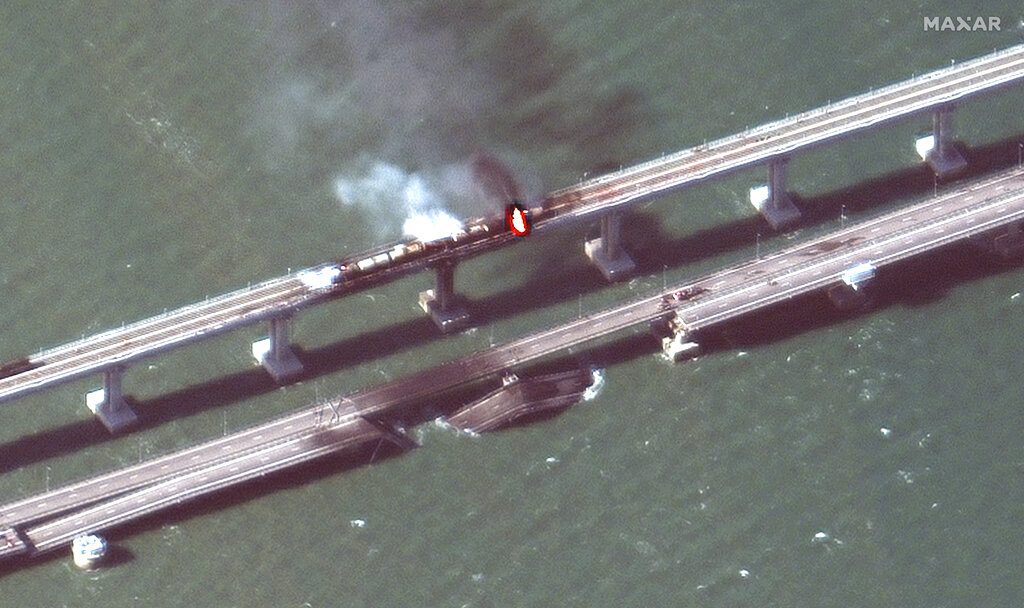
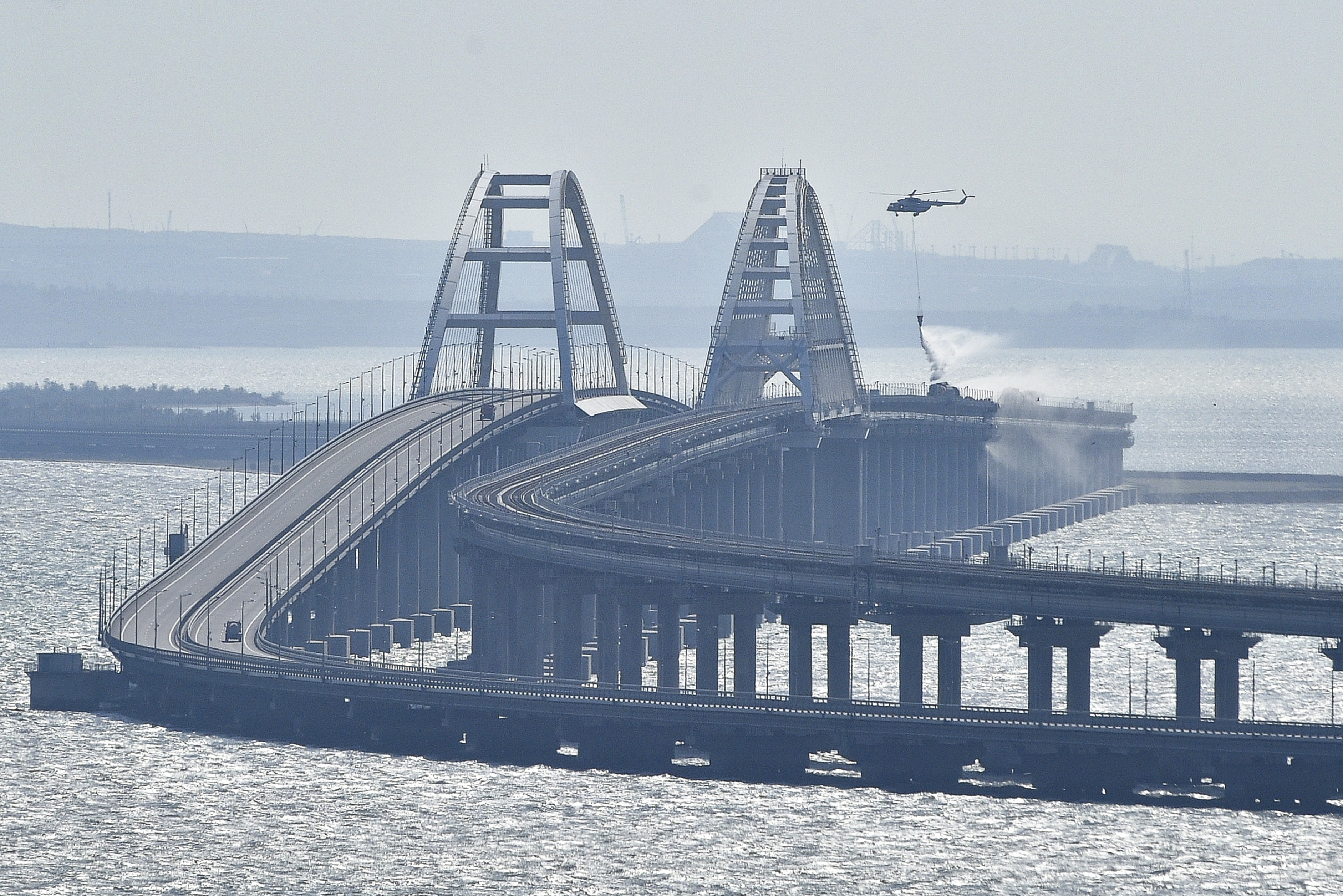
The second point of decision relates to Crimea. Putin personally opened the bridge across the Kerch Strait by driving a truck across it in 2018. The illegal annexation of the Ukrainian territory has been the source of misplaced pride and imperial pomp for the Kremlin. But Putin now faces the difficult choice of fortifying it further with depleted forces who face resupply issues, or partially withdrawing his military to ensure their significant resources on the peninsula do not get cut off.
There is a sizeable risk of this. The Kerch bridge can be hit again. The railway link across Melitopol is now a target of outsized value. Ukrainian President Volodymyr Zelensky said just last week that an offensive from Zaporizhzhia towards Melitopol was a possibility. The mere possibility that Russia's last untouched railway path into the south could be disrupted raises existential issues for its occupation.
Putin must choose between feeding his larger ambitions with a dwindling chance of success, or consolidating forces around an objective he has a greater chance of achieving. One carries the risk of catastrophic collapse, for his entire brutal adventure into Ukraine, and quite possibly his rule. The second leaves him with an immediate loss of face, but a stronger chance of sustaining the occupation of smaller parts of Ukraine.
His internal position has not looked weaker since he came to power in 2000. An admission of failure may be unpalatable at this stage, and a greater gamble the easier move. Yet he again tips the war towards a binary moment where his occupation – and even regime – faces a complete collapse or a tiny, madcap prospect of victory. Nuclear threats and rhetoric have been the horrifying backdrop of this war. Yet still Moscow has not resorted to any doomsday moves while NATO armed Ukraine to an extent that was unthinkable before the war.
Kyiv's smart and patient strikes on Russia's ageing transport dependencies has left Putin with a series of existential decisions to make in the hours ahead. He's made a lot of bad ones in the past seven months. Does the Kerch explosion add to that list, or provide a cold bath of reality, and a readjustment of the Kremlin's view of the possible.
One person dead and another seriously injuried after crash in Whakatāne
One person has died following a single-vehicle crash in Whakatāne.Police were called to the incident on Mottram Rd in Nukuhou North at about 2.30 this afternoon, a spokeswoman said. DO YOU KNOW MORE? EMAIL US One person…
Election, what election? Auckland councillor kicks up her heels on turning 50
For one Auckland councillor, yesterday’s re-election played second fiddle to turning 50 and kicking up her heels with family and friends.In a video posted online, Labour councillor Josephine Bartley can be seen screaming and clapping…
Species thought extinct since the '30s was just rediscovered
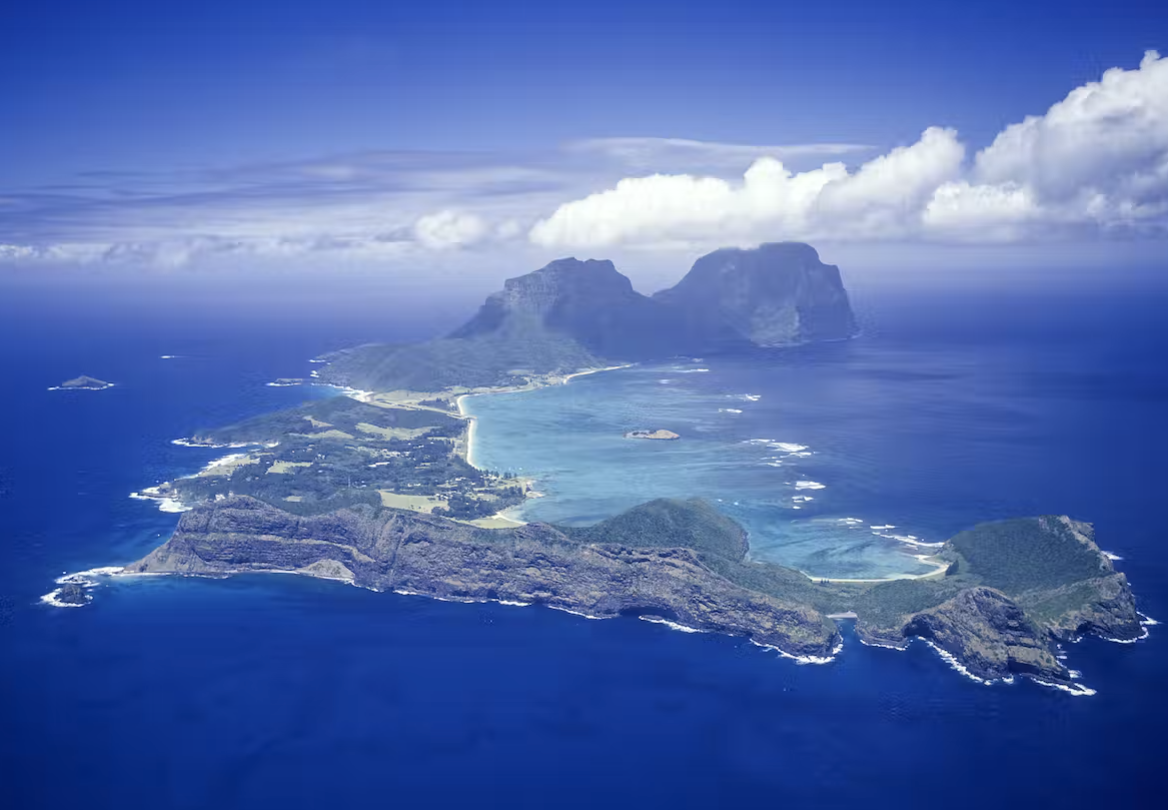
In 1887, Australian Museum scientists undertook a pioneering expedition to Lord Howe Island, a tiny patch of land off the east coast of Australia. Among their many discoveries, they recorded "a large Blatta" – a type of cockroach – under a decaying log.
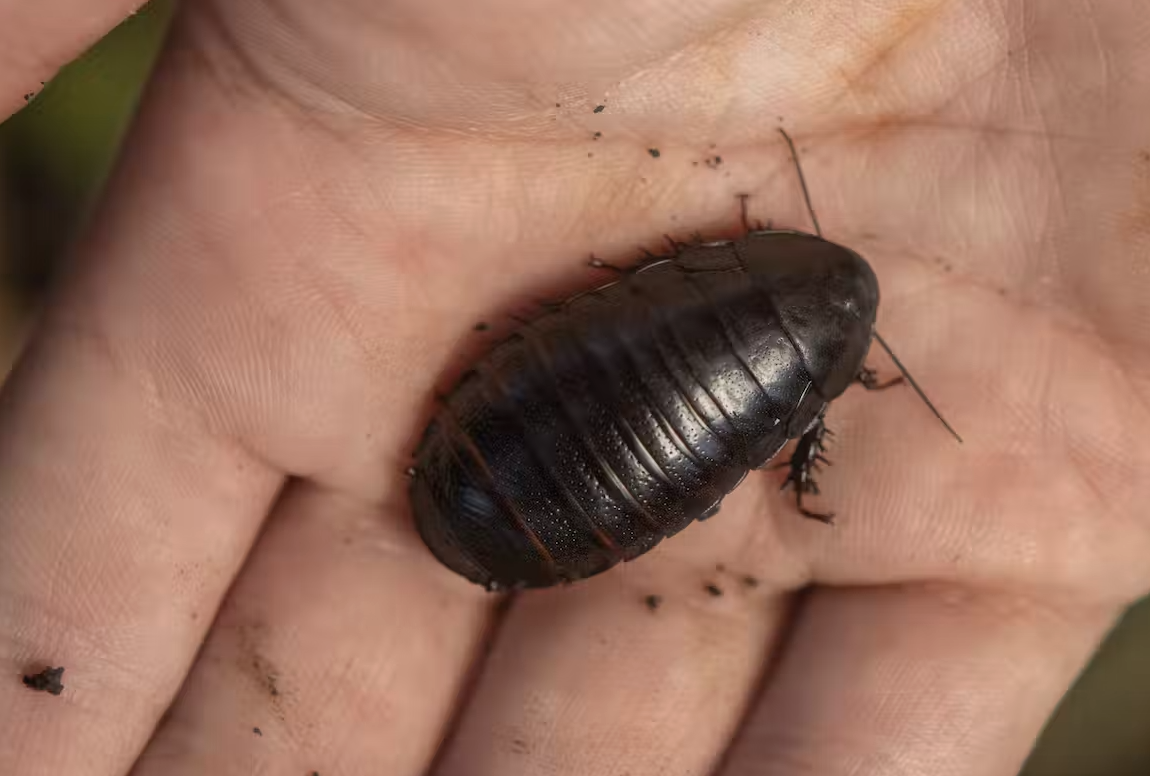
This was later described as Panesthia lata, the Lord Howe Island wood-feeding cockroach. P. lata was noted as being highly abundant, playing a key role in nutrient recycling, and presumably a food source for the many birds on the island.
Alas, in 1918 rats arrived on the island from a shipwreck. By the late 20th century, P. lata could not be found despite extensive searches over multiple decades, and was assumed to have gone extinct due to rat predation.
But could it have survived in some unexplored pocket of the island?
Putting the cockroach back where it belongs
In 2019, the New South Wales Department of Planning and Environment (NSW DPE) implemented the final stage of its highly successful (although at times controversial) rat eradication program on the island.
Following this, I and my colleagues from NSW DPE, Lord Howe Island Museum, Chau Chak Wing Museum, CSIRO's Australian National Insect Collection and the University of Melbourne became interested in the biology of P. lata and the potential to repopulate the island with this insect.
This was on the cards because in 2001, P. lata had been discovered on Blackburn and Roach islands, two small islands near Lord Howe Island.
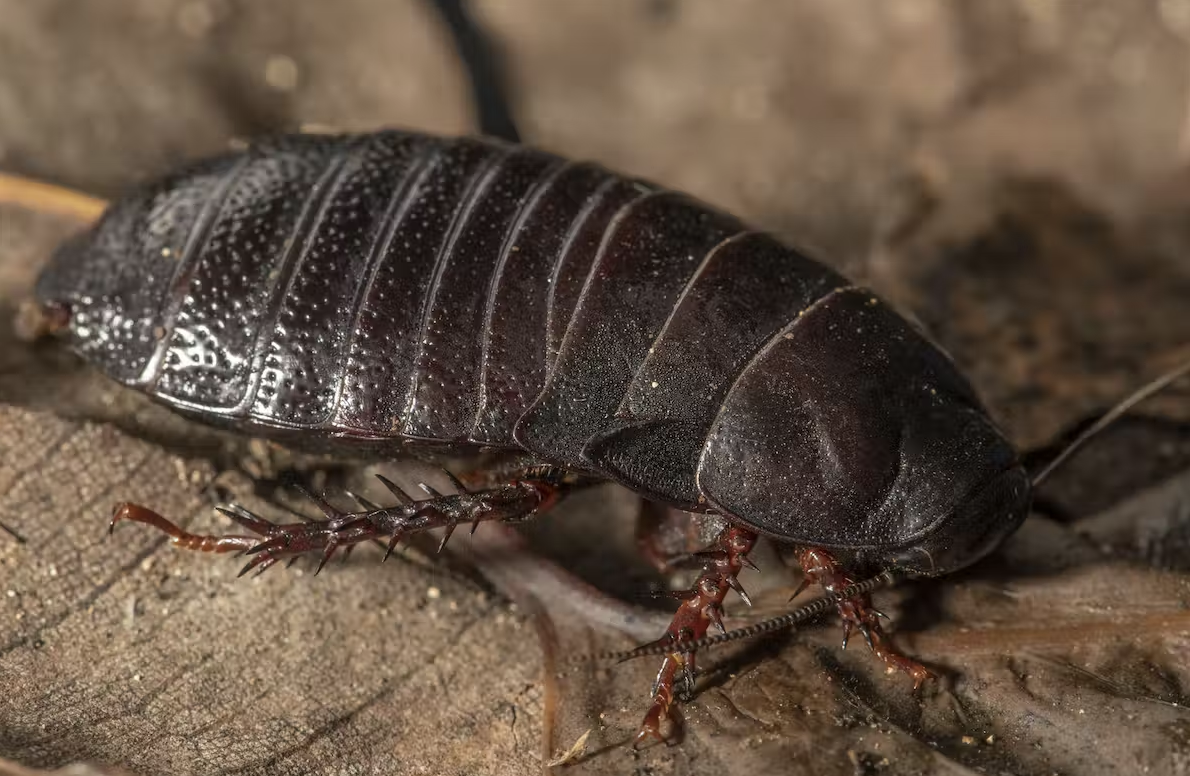
But hang on a minute: why would we want to put cockroaches, one of the most reviled creatures on Earth, back on a beautiful island after their seemingly fortuitous extermination?
Well, P. lata is, believe it or not, quite cute and charismatic, and has no interest in going into people's houses. It is wingless, about 4cm long, and stays hidden in the forest, where it burrows into the soil and feeds on leaf litter and rotting wood by night.
Fortuitous rocks
In July we received funding from the Australia Pacific Science Foundation to investigate the genetics and ecology of P. lata from Blackburn and Roach Islands. So Maxim Adams, an honours student in our lab at the University of Sydney, and Nicholas Carlile from NSW DPE headed off to Lord Howe Island to begin the study.
Bad weather prevented them from going out to Blackburn Island, so they decided to examine potential sites on Lord Howe Island that might have once been teeming with P. lata before the rats arrived.
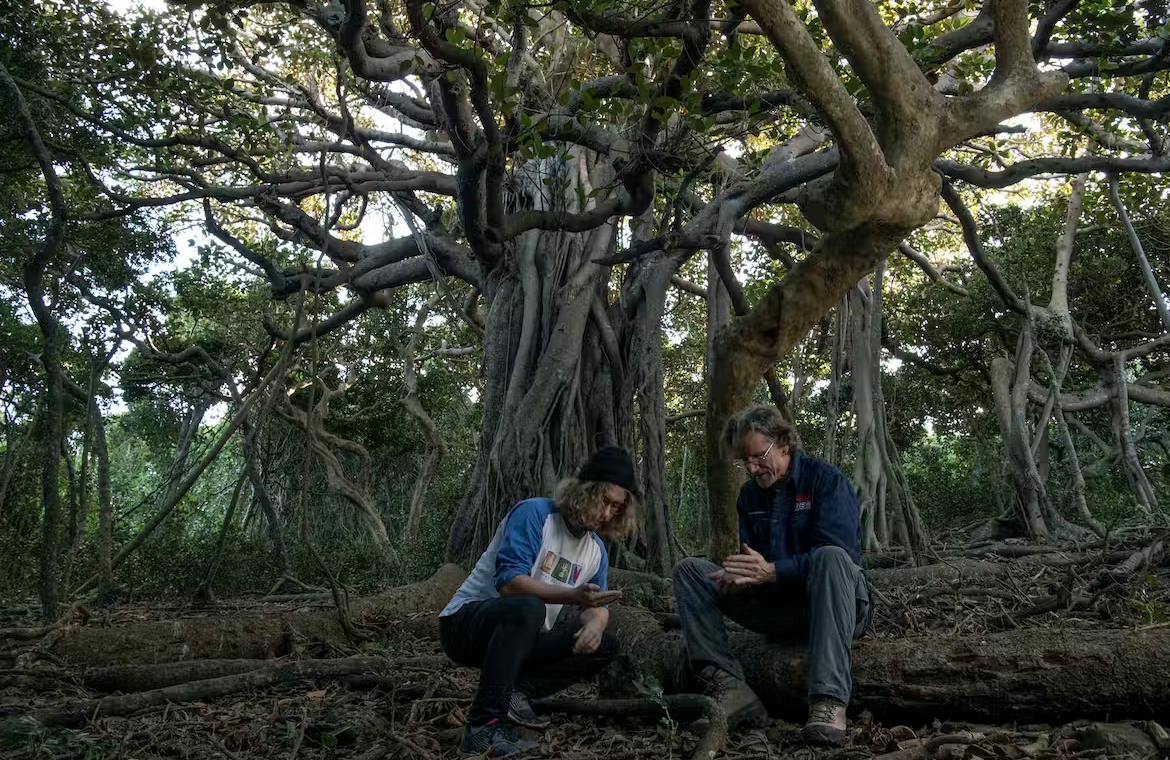
They walked to a secluded area in the north of the island, and decided to turn over a few rocks. Literally the first rock they checked revealed a small congregation of the cockroaches.
I was due to join them three days later, but they called me that afternoon with great excitement to relay the news.
They found a few others within a few metres under the same fig tree, but extensive searching over the next few days revealed none in other nearby areas or other parts of the island.
Not the same as their neighbours
We carried out some preliminary DNA tests upon our return to Sydney, finding the rediscovered Lord Howe Island population of cockroaches was distinct from the ones found on Blackburn and Roach islands.
It is possible the population hung on as a result of rodent baiting in the area. The baiting was done in recent decades to assist the survival of various other threatened species.
We are now carrying out more extensive DNA studies, including historical museum samples collected from the late 19th and early 20th centuries, and samples from Ball's Pyramid, roughly 20km southeast of Lord Howe Island, collected by Dick Smith in the 1960s.
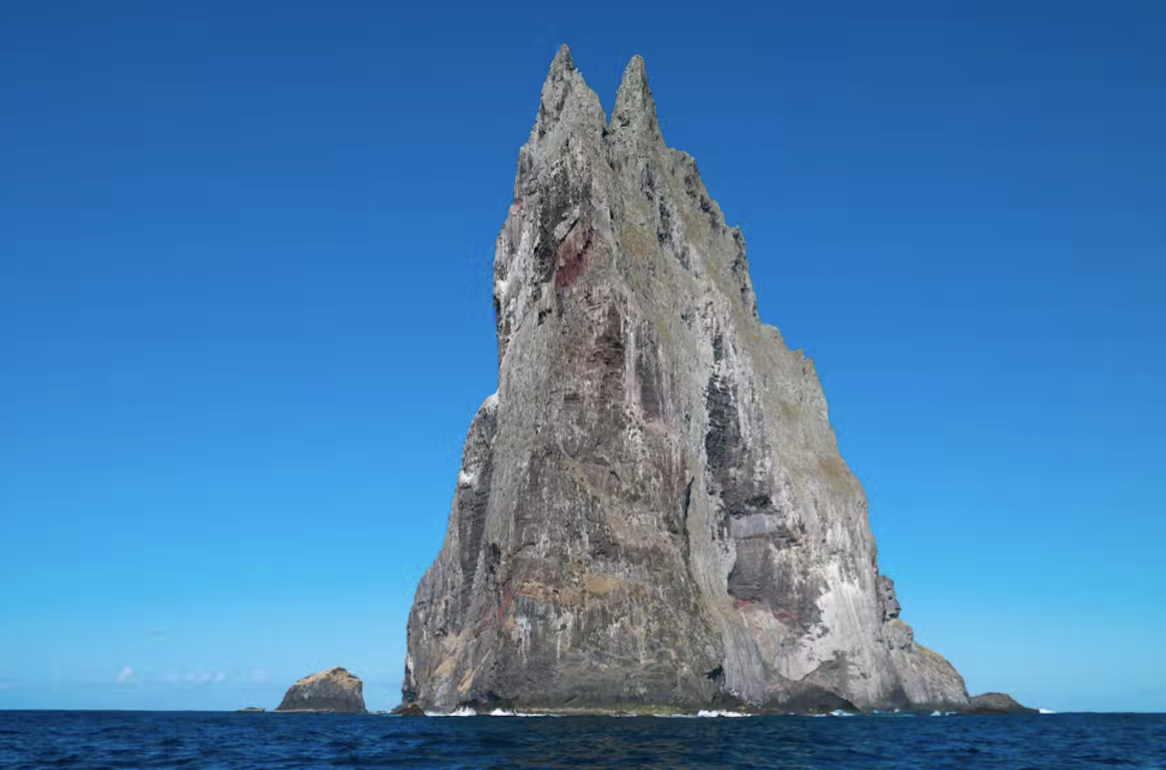
Through these studies, we hope to determine the relationship of the rediscovered population with those originally collected on the island a century or more ago and those on the outer islands. We also hope to uncover the origins and evolutionary history of P. lata.
The Lord Howe Island Group is a UNESCO world heritage site of global natural significance, and is home to more than 100 plant species found nowhere else on Earth, and many more endemic animal species. The biology of many of these species, particularly the island's invertebrates, remains mysterious.
We hope our use of DNA techniques will help us to establish P. lata as a model for understanding several million years of evolution on the Lord Howe Island archipelago, and aid the re-establishment of this shy yet charismatic creature on its homeland.
This article is republished from The Conversation under a Creative Commons license. Read the original article.
Fire in abandoned Papatoetoe building 'suspicious'
A small fire alight inside a Papatoetoe building this afternoon is being treated as suspicious.Fire and Emergency New Zealand (FENZ) was alerted to the blaze inside an abandoned building on Kingswood Rd, Papatoetoe at 12.10pm today.Two…
Editorial: Hawke's Bay chooses the status quo, but can they fix its problems?
EDITORIAL: A resounding vote it wasn’t, but Hawke’s Bay has decided that the status quo is just fine.Napier mayor Kirsten Wise, Wairoa mayor Craig Little and Tararua mayor Tracey Collis won each of their bids for another three years…
Police cordons stood down around Somme Pde, Whanganui
A man is in custody and a person was taken to hospital after police, including the armed offenders squad, were called to a property in Somme Pde in central Whanganui.A police spokeswoman said an incident was reported around 12.25pm…
Immigration Minister Michael Wood: Qualification requirement to hire migrant chefs dropped
The qualification requirement needed by migrant chefs to be hired by employers under an immigration accreditation scheme has been removed as a way to support hospitality, Immigration Minister Michael Wood has announced.Wood also…